Hi, what do you want to do?






Consortium for Ocean Science Exploration and Engagement (COSEE)
Fish Morphology
Life comes in all different shapes and sizes, and fish are no exception. Here, young scientists create fish prints as they learn how specific characteristics allow different species to survive in their particular habitats.

New York State Department of Environmental Conservation
Adaptations – Designs for Survival
What's the difference between behavioral adaptations and physical adaptations? Learn about the various ways that organisms adapt to their environment with a worksheet about the creatures of the Hudson River.

Royal Canadian Geographical Society
Canadian Geographic: Animal Facts: Rainbow Trout
explore fast facts, physiology, habitats, behaviors, and range of the rainbow trout.
A-Z Animals
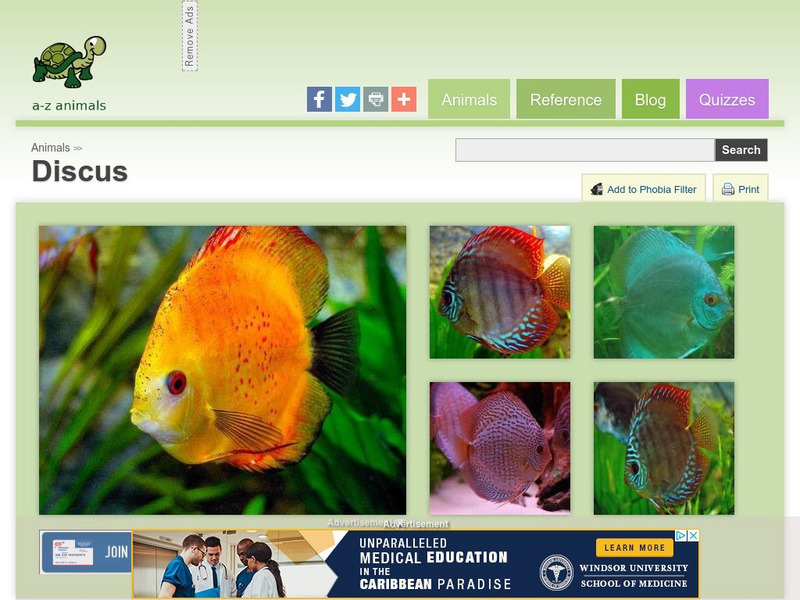
A Z Animals: Animal Facts: Discus (Symphysodon)
Presents an overview of the Discus, including its habitat, appearance, behavior, breeding, diet, conservation status, and much more. Images of this species and statistics can also be found here.
Royal Canadian Geographical Society
Canadian Geographic: Animal Facts: Atlantic or Pacific Salmon
Learn fast facts, the physiology, habitats, behaviors and range of the Atlantic or Pacific salmon.
Royal Canadian Geographical Society
Canadian Geographic: Animal Facts: Tundra Swan
Learn fast facts, the physiology, habitats, behaviors and range of the tundra swan.
Regents of the University of Michigan
Animal Diversity Web: Ray Finned Fish
Comprehensive reference material on ray-finned fishes, with information on their habitat, evolution, physical features, eating habits, reproduction, behavior, how they communicate, role in the ecosystem, and threats to their continuing...