Hi, what do you want to do?






Classroom Law Project
What does the Constitution say about voting? Constitutional Amendments and the Electoral College
As part of a study of voting rights in the US, class members examine Constitutional amendments connected with voting and the role of the Electoral College in the election process.

Street Law
The Challenge of Selecting an Ideal Supreme Court Nominee
Nearly every president has had the opportunity to name a nominee to the United States Supreme Court. But what makes someone an ideal candidate to become a Supreme Court justice? High schoolers test their prior knowledge about the...

Federal Reserve Bank
Constitutionality of a Central Bank
Considering the expressed and implied powers of Congress, was it constitutional for the United States to establish the Second National Bank in the early nineteenth century? What is the constitutionality of the Federal Reserve...

Center for Civic Education
Ronald Reagan and Executive Power
Article II of the United States Constitution grants Presidents executive powers in areas of international conflict, domestic and foreign policy. Using examples drawn from Ronald Reagan's presidency, class members are asked to consider...

Middle Tennessee State University
Fights, Freedom, and Fraud: Voting Rights in the Reconstruction Era
As part of a study of post Civil War era, young historians investigate the changes in voting rights during the Reconstruction Era (1863-1876), the fraud involved in the Hayes-Tilden presidential election of 1876, and efforts by Pap...

Center for Civic Education
The Power of Nonviolence: Change Through Strategic Nonviolent Action
How did major historical figures, such as Henry David Thoreau, Susan B. Anthony, and Mohandas K. Gandhi, explain and defend their beliefs in nonviolence? Your learners will begin by studying the backgrounds of these individuals, and then...

Deliberating in a Democracy
Free and Independent Press
Students determine how free press principles can be compromised. For this global studies lesson, students read an article titled "Free and Independent Press." Students respond to discussion questions regarding the article.

Deliberating in a Democracy
Freedom of Movement
Class members examine human migration. For this population lesson, they read an article entitled, "Freedom of Movement" and respond to discussion questions about the article related to guest worker programs.

Music Publishers Association of the United States
I Made It. I Own It. Please Don't Steal It.
Explore the world of copyright law with a variety of activities to instill the importance of respecting creative property. Scholars watch an animated tale then take part in a grand conversation detailing the video's main idea, details,...

Deliberating in a Democracy
Global Climate Change
Students examine an environmental issue. In this global studies lesson plan, students read an article entitled, "Global Climate Change," and respond to the discussion questions that accompany it.

Deliberating in a Democracy
Violent Video Games
High schoolers examine violence in video games. In this American history instructional activity, high schoolers read an article on the link between video games and violence. High schoolers respond to discussion questions and debate the...

Deliberating in a Democracy
Minorities in a Democracy
Students consider diversity in democracies. In this democratic values lesson, students read an article titled, "Minorities in a Democracy." Students respond to discussion questions about the article.
Thomson Reuters
Find Law: Article Iv: Development of the Modern Rule
This resource provides information about Article IV of the United States Constitution.
Thomson Reuters
Find Law: Article Iv: National Supremacy
This resource provides a review of Clause 2, Article VI, "Supremacy of the Constitution, Laws and Treaties."

The History Cat
The History Cat: The Constitutional Convention: Creating the Constitution
Explains why the Articles of Confederation were not strong enough to hold the country together. One result was a farmers' rebellion in Massachusetts led by Daniel Shays, which was precipitated by a debt crisis that caused many farmers to...

Annenberg Foundation
Annenberg Classroom: The Annenberg Guide to the United States Constitution
The Annenberg guide to the United States Constitution: what It says, what It means. RI.11-12.8 seminal U.S. texts
Thomson Reuters
Find Law: Article Iii: Organizations of Court, Tenure, & Compensation
This resource covers Article III, Section 1, which focuses on the judicial branch of the United States government.

Georgia Humanities Council and the University of Georgia Press.
New Georgia Encyclopedia: The Butler Family
An entry on the Butler family who owned large plantations on the Sea Islands. The "patriarch" was Pierce Butler who also served as a delegate to the Constitutional Convention.
University of Pennsylvania
University of Pennsylvania Archives & Records: Jared Ingersoll (1749 1822)
This article gives highlights on the career of this delegate from Pennsylvania to the Constitutional Convention. Ingersoll was considered one of the best lawyers in Philadelphia at that time.
Bill of Rights Institute
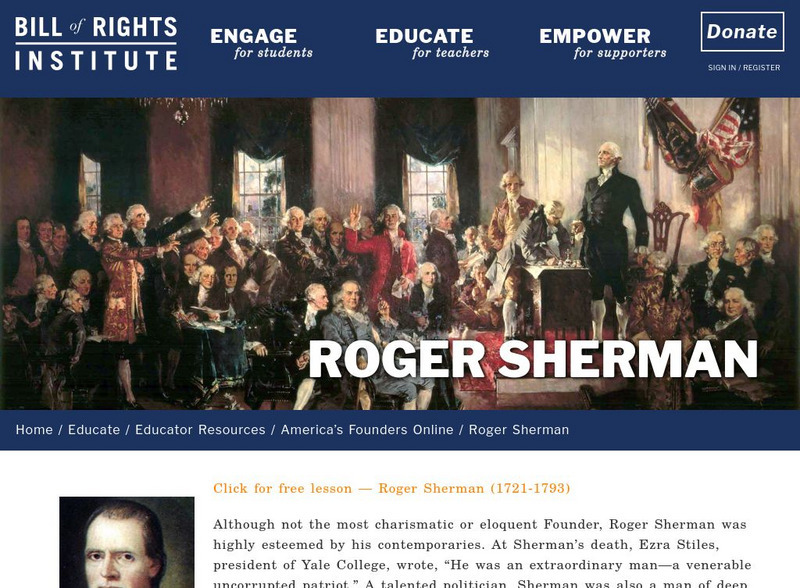
Bill of Rights Institute: Roger Sherman
Although not the most charismatic or eloquent Founder, Roger Sherman was highly esteemed by his contemporaries. At Sherman's death, Ezra Stiles, president of Yale College, wrote, "He was an extraordinary man-a venerable uncorrupted...
Bill of Rights Institute
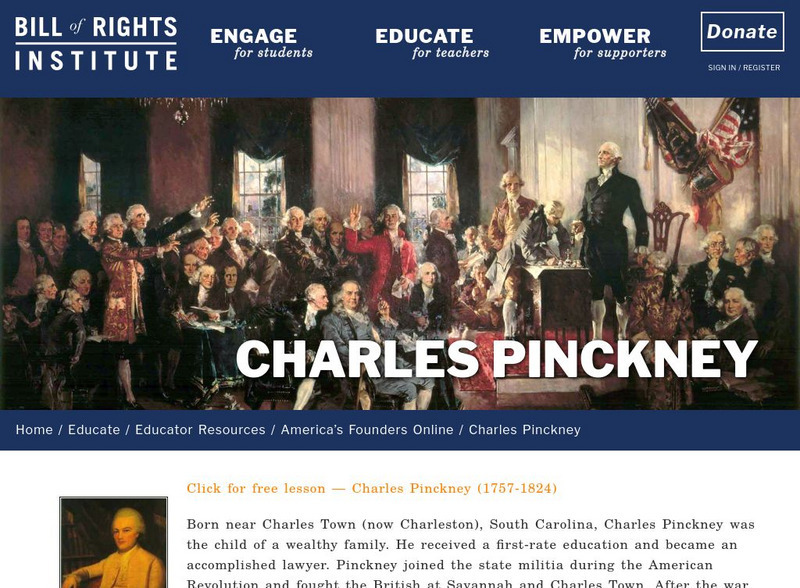
Bill of Rights Institute: Charles Pinckney
Born near Charles Town (now Charleston), South Carolina, Charles Pinckney was the child of a wealthy family. He received a first-rate education and became an accomplished lawyer. Pinckney joined the state militia during the American...

Bill of Rights Institute
Bill of Rights Institute: John Dickinson
John Dickinson was called "The Penman of the American Revolution." During the 1760s and 1770s, he authored numerous important essays in defense of American rights, including The Late Regulations Respecting the British Colonies, the...
Thomson Reuters
Find Law: Article I: Duties on Exports From States
This resource explains Clause 5 of Article I of the U.S. Constitution by defining specific words and phrases contained within the clause. Also gives historical background to explain the purpose of the Clause.

The White House
The White House: The Judicial Branch
Learn about the judicial branch of the federal government, how the organization of the federal judiciary is determined, the functions and responsibilities of the Supreme Court, and features of the judicial process.