Hi, what do you want to do?






Crash Course
When Predictions Succeed - Crash Course Statistics
In our series finale, we're going to take a look at some of the times we've used statistics to gaze into our crystal ball, and actually got it right! We'll talk about how stores know what we want to buy (which can sometimes be a good...
Crash Course
Mean, Median, and Mode Measures of Central Tendency - Crash Course Statistics
Today we’re going to talk about measures of central tendency - those are the numbers that tend to hang out in the middle of our data: the mean, the median, and mode. All of these numbers can be called “averages” and they’re the numbers...
Curated Video
Solving Problems Using Linear Regression
In this lesson, students will learn how to use statistics to understand relationships between variables and solve problems using linear regression. They will explore real-world examples, such as the correlation between team batting...
Crash Course
Measures of Spread - Crash Course Statistics
Today, we're looking at measures of spread, or dispersion, which we use to understand how well medians and means represent the data, and how reliable our conclusions are. They can help understand test scores, income inequality, spot...
Curated Video
The Fascinating World of Left-Handedness: Exploring the Advantages and Statistics
In this video, the presenter explores the topic of left-handedness and its prevalence in the world. They discuss the factors that influence handedness, such as genetics and external forces. Additionally, they highlight the advantage that...
Curated Video
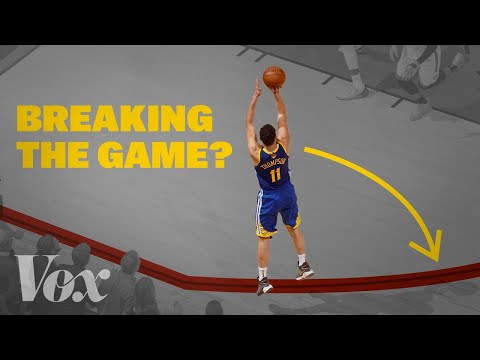
How the 3-point line is breaking basketball
The game is at a turning point. Should the rules be changed? Subscribe and turn on notifications 🔔 so you don't miss any videosf='http://goo.gl/0bsAjO' target='_blank' rel='nofollow'>videos The NBA introduced the 3-point line in...
TED Talks
Brian Goldman: Doctors make mistakes. Can we talk about that?
Every doctor makes mistakes. But, says physician Brian Goldman, medicine's culture of denial (and shame) keeps doctors from ever talking about those mistakes, or using them to learn and improve. Telling stories from his own long...

PBS
Real-Life Math | Baseball
The math in baseball is more than just batting averages. The Assistant General Manager of the Diamondbacks shows the numerous ways the management uses baseball math. The class participates in an activity to simulate batting averages and...

Curated OER
Math in Sports
What does math have to do with sports? This math report explains how math is used in sports. In boxing, area is needed to determine the size of the ring, statistics are compared and sorted, and points are counted. In baseball, math and...

PBS
Pbs Learning Media: Real Life Math: Baseball
Watch and listen as the assistant general manager of a major league baseball team explains how he uses math in this video from KAET, Arizona PBS. A lesson plan and handouts are included. [7:43]
Crash Course
Crash Course Statistics #3: Measures of Central Tendency
This episode talks about measures of central tendency - those are the numbers that tend to hang out in the middle of our data: the mean, the median, and mode. All of these numbers can be called "averages" and they're the numbers we tend...
PBS
Pbs Learning Media: Fantasy Baseball
Explore the game of baseball, then use what you've learned to use decimals and ratios to analyze key statistical data, draft players and make trades, based on an analysis of the data.
Annenberg Foundation
Annenberg Learner: Against All Odds: Normal Distributions
A look at how histograms, and the curves that are drawn based on histogram data, can help one analyze data. Video program offers real-life examples to illustrate this: population age and baseball statistics. [28:40]
Virtual Nerd
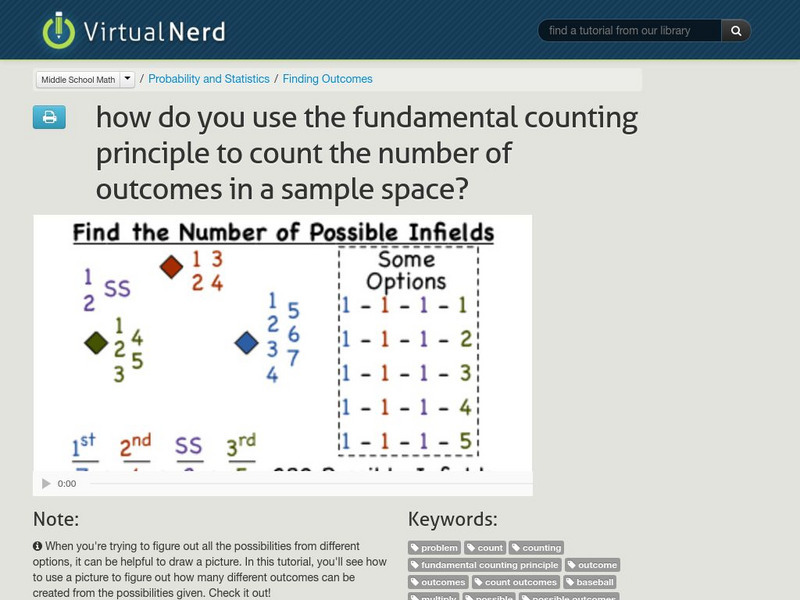
Virtual Nerd: How Do You Use the Fcp to Count the Number of Outcomes in a Sample
Using baseball as an example, watch how you can apply the Fundamental Counting Principle to count the number of different ways a coach can fill his infield. This video will show you how to make a drawing to better understand the problem....