Hi, what do you want to do?






Curated OER
Penny Science
A penny can be a much more valuable teaching tool that you might think. Whether you are teaching about chemical reactions, surface tension, the behavior of gases, or are just looking for engaging activities for early finishers,...

Curated OER
Nuts About Squirrels
Early childhood students will develop listening skills as they read "Nuts To You" by Lois Ehlert. In this lesson students will learn about Students will learn facts about different types of squirrels and their behaviors. There will be a...

Teach Engineering
Measuring Viscosity
Groups use a marble to determine the viscosity of household fluids. The procedure calls for pupils to measure the amount of time it takes a marble to fall a specified distance in the fluids. Using unit conversions and algebra, the teams...

Teach Engineering
Red Cabbage Chemistry
Using the natural pH indicator of red cabbage juice, groups determine the pH of different everyday liquids. As they work, pupils gain an understanding of pH that may help deal with contaminants in the water supply.

Teach Engineering
Using Hooke's Law to Understand Materials
Provide a Hooke for a lesson on elasticity with an activity that has groups investigate a set of springs. They use a set procedure to collect data to calculate the spring constant for each spring using Hooke's Law. The groups...
Science Buddies
Science Buddies: Applying Hooke's Law: Make Your Own Spring Scale
Hooke's law says that the opposing force of a spring is directly proportional to the amount by which the spring is stretched. How accurately Hooke's law describe the behavior of real springs? Can springs be used to make accurate scales...

Dartmouth College
Dartmouth College: Acids, Bases, and Buffers 1: Monoprotic and Polyprotic Acids
In this experiment, you will explore the behavior of the monoprotic acid (acetic acid) and the polyprotic acid (phosphoric acid). By titrating, you will examine the acid and conjugate base species present across the pH scale and the...
TeachEngineering
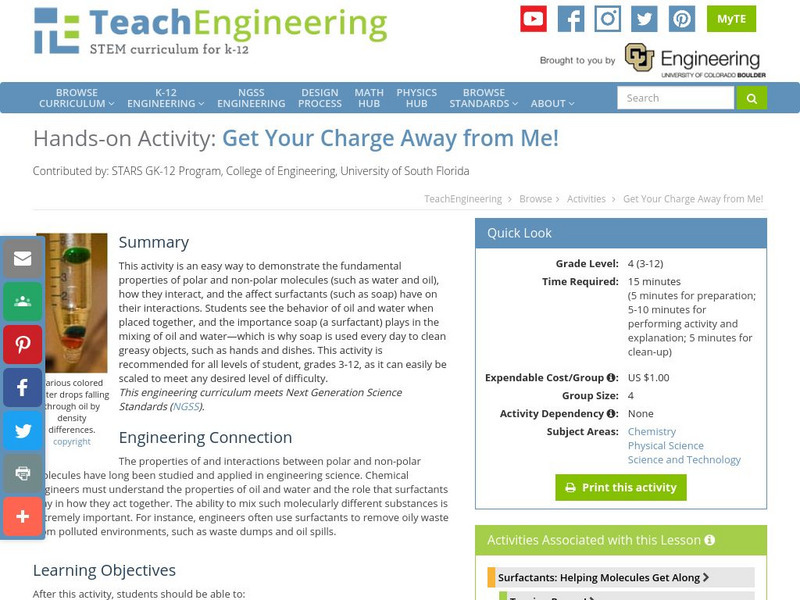
Teach Engineering: Get Your Charge Away From Me!
This activity is an easy way to demonstrate the fundamental properties of polar and non-polar molecules (such as water and oil), how they interact, and the affect surfactants (such as soap) have on their interactions. Students see the...