Hi, what do you want to do?






Curated OER
Human Body Series - Cardiovascular System
Pump up your class while studying the cardiovascular system with this pair of activities. In one, learners record heart rates during different actions. In the second, they read kid-friendly heart health articles online and then write a...

Baylor College
Examining the Heart
Break hearts with this lesson plan: chicken or sheep hearts, that is! Your class examines the external and internal structure of the heart with a dissection activity. A handy anatomy resource provides the necessary materials for...

Baylor College
Heart Rate and Exercise
Teach your exercise enthusiasts to read their pulse rate at the radial artery and multiply by four to calculate beats per minute. Learners perform a variety of activities, recording their heart rates after one minute of each. Though...

Baylor College
Heart and Lungs
With a partner, youngsters measure their pulse and breathing rates, both at rest and after running in place for a minute. While this activity is not novel, the lesson plan includes a large-scale classroom graphing activity and other...

Baylor College
Why Circulate?
Lub-dub, lub-dub. Why does the heart beat? Why does blood circulate throughout the body? Life scientists find out how important circulation is for dissolving and dispersing materials by timing how long it takes for food coloring spread...

Tracy Pendry
Cardiovascular/Circulatory System
Explore the circulatory system with a cardiovascular pump activity that promotes discovery and discussion as class members create a functioning model of the heart. Continue the learning process through a web quest showcasing the...

Baylor College
What is Blood Pressure?
Find out how we describe the force created by the blood against the walls of the vessels in a heart-pumping lesson! As part of a unit on the heart and circulatory system, cardiology kids use a blood pressure monitor to find their...

Baylor College
Challenge: Microgravity
What a festive way to examine what happens to the heart in different gravitational situations! Small groups place a water-filled balloon in different locations (on a table top, in a tub of water, and held in a vertical position), drawing...
![Read Works: The Human Body: The Human Heart [Pdf] Activity](https://statictemp.lp.lexp.cloud/images/attachment_defaults/resource/large/FPO-knovation.png "Read Works: The Human Body: The Human Heart [Pdf] Activity")
Other
Read Works: The Human Body: The Human Heart [Pdf]
An informational text about the human heart, its parts, and it functions. A question sheet is available to help students build skills in reading comprehension.
Science Buddies
Science Buddies: Can Your Body Temperature Tell the Time of Day?
If you have ever had to adjust to a new time zone, you have noticed that it takes a while before you start to feel normal again. By shifting your sleep and activity schedule, you have altered the pattern of your body's circadian rhythms....
Science Buddies
Science Buddies: Heart Rate Recovery Times
After exercise, your heart rate increases, this is normal for everyone. However this experiment asks whether the recovery time for a heart's beating rate is faster for people who get regular exercise versus those that do not.
Science Buddies
Science Buddies: A Day in the Life of Your Heart
Heart rates can be determined by the amount of physical activity your body is engaging in. The more physically active you are, the faster your heart beats. You can measure the rate your heart is beating by taking your pulse. This science...
National Cancer Institute at the National Institutes of Health
Seer Training Modules: Introduction to the Cardiovascular System
Self-guided learning activity where students learn about the structure and function of the human cardiovascular system. There is a short quiz at the end of the lesson to check for understanding.
Science Buddies
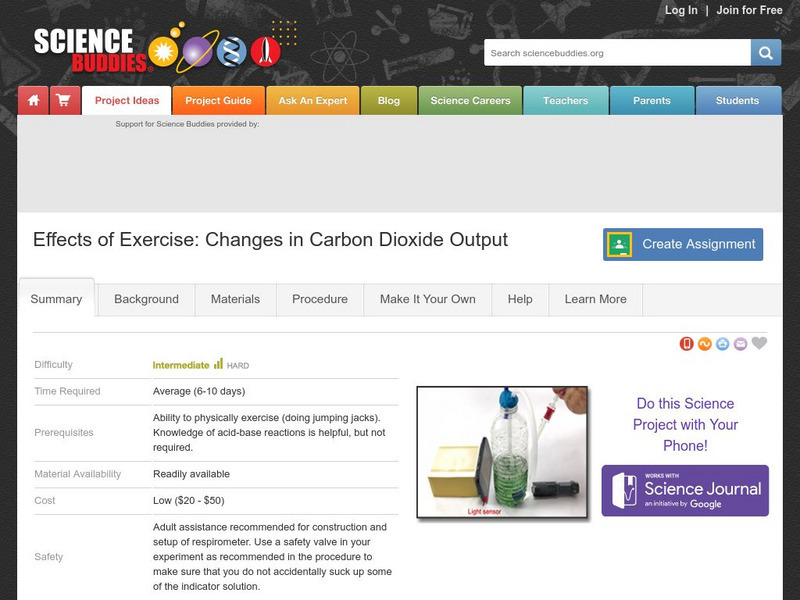
Science Buddies: Effects of Exercise: Changes in Carbon Dioxide Output
Everybody knows that your body needs oxygen to keep going, and that you breathe out carbon dioxide as waste. What happens when you exercise? You've probably noticed that you breathe faster, and your heart beats faster. What triggers your...
Other
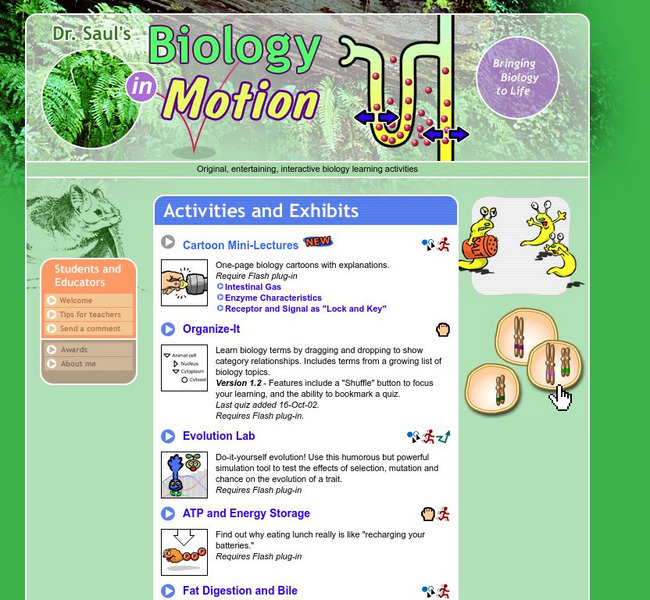
Dr. Saul: Biology in Motion
This interactive site provides animations and activities in several areas of physiology. The images are simple, but clear. The accompanying text provides a good description of the process being shown.