Hi, what do you want to do?






Spark Notes
Review of Chemical Bonding: Review Test
This is an online exercise in which chemistry learners answer a series of multiple choice questions about bonding. Topics addressed include ionic and covalent bonds, electronegativity, ions, valence electrons, resonance structure, and...

Concord Consortium
Forming a Molecular Bond
They say two's company, but three's a crowd... unless you're talking about molecular bonding! Chemistry scholars experiment with two- versus three-atom bonding in an engaging simulation. Learners must place the third atom in a location...

Concord Consortium
Energy of Bond Formation
Show your chemistry class that there's much more to covalent bonding than sharing electrons! Pupils manipulate atoms of hydrogen, oxygen, and carbon to observe the energy of bond formation using a well-rounded interactive. The resource...

Royal Society of Chemistry
Everyday Chemicals (14-16)
Two men want drinks and the first orders H2O. The second man orders H2O too, but he dies. Scholars apply their knowledge of H2O2 and other everyday chemicals during the activity. They match chemical formulas to common chemical names in a...

CK-12 Foundation
Battery
Don't take for granted the technology behind power packs. Build an understanding of the chemical mechanics of a battery pack that charges your phone. The simulation allows young scientists to manipulate the type of elements in a pack and...

Concord Consortium
Stoichiometry and Balancing Equations
Is your stoichiometry lesson plan just not adding up? Incorporate an exciting interactive to balance things out! Chemistry scholars manipulate the number of molecules added to the reaction vessel, then observe as bonds form and break as...

Royal Society of Chemistry
Electronegativity Values
Finally, an electronegativity resource your class will be strangely drawn to! Skilled scientists manipulate interactive puzzles to gain an understanding of common electronegativity values. The great thing? You can conduct the lesson...

Royal Society of Chemistry
Alkanes
Alkanes contain only single bonds and have no functional groups. Scholars match the properties of six alkanes in a series of four puzzles. Problem solving and logic help cement the concepts with repetition.

Royal Society of Chemistry
The Blast Furnace
The largest chemical reactors are blast furnaces, used to make iron from ore. Scholars explore reactants by first matching each one to its purpose and formula. Then, a series of three gridlock puzzles reinforce the content while...

Royal Society of Chemistry
State Symbols
When water is a solvent in a chemical equation, we consider it an aqueous solution. Scholars match the name of four states of matter to their proper symbol in a chemical equation. Four puzzles provide repetition to help pupils remember...

Royal Society of Chemistry
Forensic Tests
Flame tests determine if there is a specific metal in a chemical compound. Young forensic scientists review their understanding of flame tests and hydroxide precipitates by solving puzzles. The timed review encourages mastery.

Royal Society of Chemistry
Tests for Anions
The anode, the positive electrode, attracts negative charges, which is why we call negatively charged atoms anions. The interactive allows pupils to match six different anions to the associated properties when testing. Offering four...

Royal Society of Chemistry
Some A-level Reagents
Learning names and formulas can be a daunting task for young chemists, so support their study with interactive puzzles! First, users match each formula with its correct name. Then, individuals use them to complete three logic games.

Curated OER
Water, Water Everywhere
In this water worksheet, students complete a five question multiple choice online interactive quiz about water. This is a more advanced quiz that includes chemistry questions.

Curated OER
Comparing Covalent and Ionic Substances
In this covalent and ionic substances worksheet, students use the internet to find information about the characteristics of covalent and ionic substance and explain what causes the differences in these types of substances.

Concord Consortium
Concord Consortium: Molecular Workbench Showcase: Chemistry, Chemical Bonds
Simulations to show students the nature of chemical bonds. Simulations include an explanation of stereochemistry, atomic orbitals, chemical polarity, formation of an atom, and a summary quiz.
Chemistry Collective
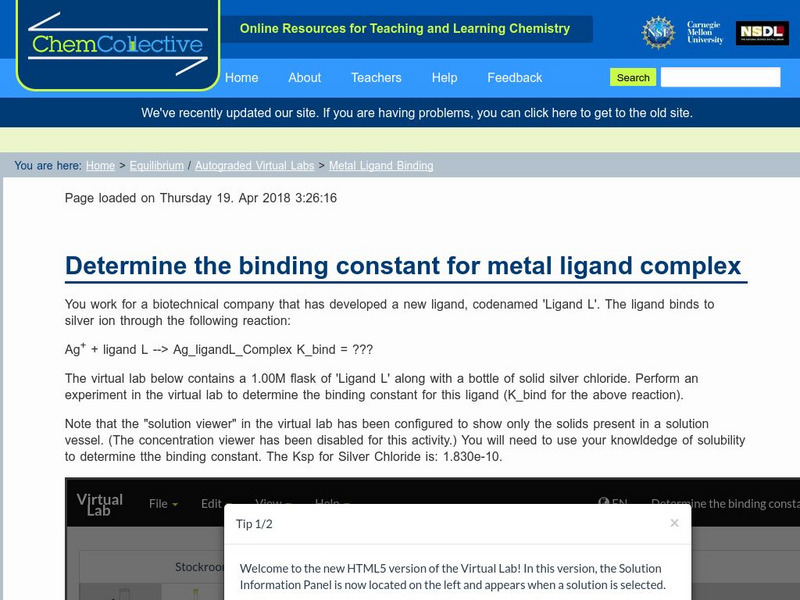
Chem Collective: Metal Ligand Binding
Use silver chloride to determine the binding constant for a metal ligand complex.