Hi, what do you want to do?






Illustrative Mathematics
Shape Sequence Search
Learning that size and orientation don't affect the classification of shapes is a big step for young mathematicians. Support children with developing this key understanding by looking at the array of shapes included in this resource. For...

Illustrative Mathematics
What Shape Am I?
Sharpen your pencil and grab a ruler, it's time to draw some quadrilaterals! Given the definition of a parallelogram, rectangle, and rhombus, learners draw examples and nonexamples of each figure. The three definitions are...

Illustrative Mathematics
3-D Shape Sort
From the apple on your desk and the coffee cup in your hand, to the cabinets along the classroom wall, basic three-dimensional shapes are found everywhere in the world around us. Introduce young mathematicians to the these common figures...

Illustrative Mathematics
All vs. Only Some
All shapes have certain defining attributes that set them apart from others. In order to understand this, young mathematicians look at examples and non-examples of triangles, rectangles, and squares, working as a whole class to create...

Illustrative Mathematics
What is a Trapezoid? (Part 1)
Challenge your class to construct a definition for trapezoids. Looking at four examples and four non-examples, learners individually create definitions and use them to classify an unknown shape. Allow for small group and whole-class...

Illustrative Mathematics
Are These Right?
Is that a right triangle or a wrong triangle? Young mathematicians look at eleven different shapes and use a measuring tool of their choice to determine which triangles have right angles. Consider cutting out sets of the shapes to...

Illustrative Mathematics
The Geometry of Letters
Use the alphabet as a tool for teaching your class about geometric figures. Break apart capital letters into line segments and arcs. Classify angles as right, acute, or obtuse. Identify parallel and perpendicular lines. An excellent...

Illustrative Mathematics
Lines of Symmetry for Triangles
What can symmetry tell us about triangles? After looking at four examples, learners will come to realize that lines of symmetry are different for equilateral, isosceles, and scalene triangles. Use this guided practice activity as an...

Illustrative Mathematics
Lines of Symmetry for Quadrilaterals
Explore how lines of symmetry help define different categories of quadrilaterals. Looking at a square, rectangle, trapezoid, and parallelogram, young mathematicians discover that each shape has its own, unique symmetry. Encourage your...

NumberNut
Number Nut: Shapes, Symbols, and Colors: 2 D Shapes
Did you know that two-dimensional shapes are also called polygons? This lesson describes the various 2-D shapes and includes two interactive games to reinforce skills.
Annenberg Foundation
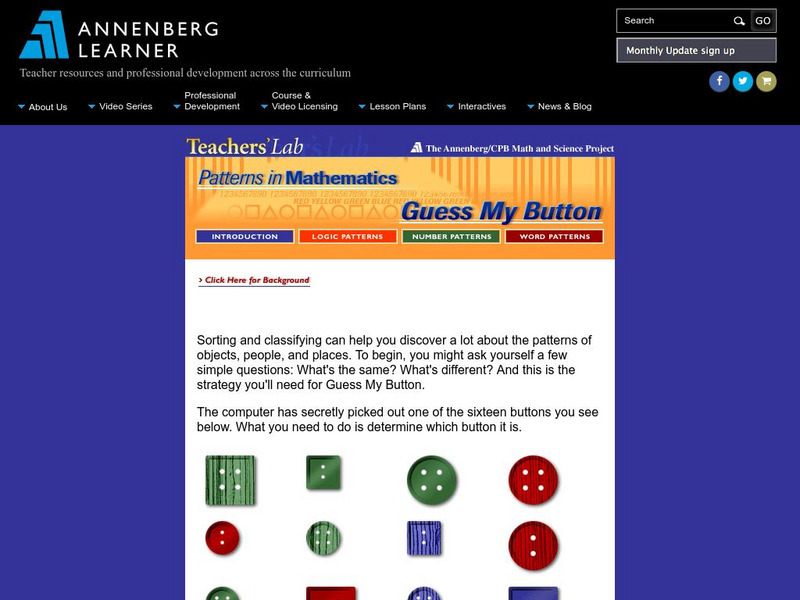
Annenberg Learner: Patterns in Mathematics: Guess My Button
This website gives students an opportunity to sort and classify attributes of a group. The applet responds to each selection made and guides student to the next step.
NumberNut
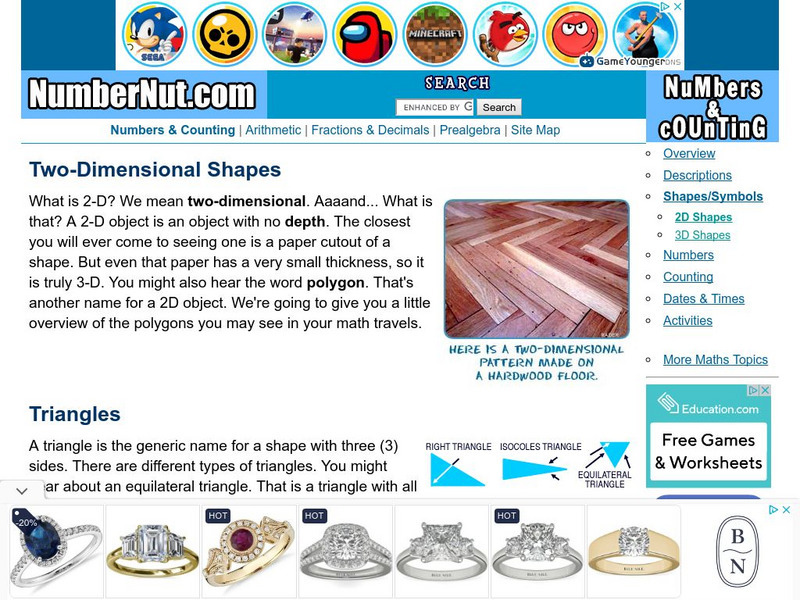
Number Nut: Shapes, Symbols and Colors: Two Dimensional Shapes
Describes, with illustrations, the basic two-dimensional shapes students will encounter in elementary Math.