Hi, what do you want to do?






PBL Pathways
Arsenic and Selenium Removal From Drinking Water at a Minimal Cost
Decide on the most efficient plan to supply drinking water. The second project-based learning task in a two-part series builds upon the first project. Pupils revisit the wells to supply drinking water, but they must make sure the...

US Environmental Protection Agency
Protecting Your Drinking Water
Having a clean, reliable source of drinking water is essential for any community, but in many cases this is easier said than done. Engage young environmentalists in exploring the five factors affecting vulnerability of a groundwater...

US Environmental Protection Agency
Water Purification by Evaporation and Condensation
This easy-to-perform demonstration shows students how the water cycle, specifically the processes of condensation and evaporation, purifies Earth's water supply. Just mix up some water, dirt, and gravel in a glass bowl, place a cup in...

Teach Engineering
Water Remediation Lab
Water filtration — that's pure genius! Groups test the ability of a water filter to purify water by running chlorine contaminated water through a filter and measuring the chlorine concentrations as they filter the water. They then graph...

US Environmental Protection Agency
Aquifer in a Cup
Young scientists create their very own aquifers in this science lesson on ground water. After learning about how some people get their drinking water from underground wells, young learners use sand, modeling clay, and aquarium rocks to...

DiscoverE
Water Pollution Cleanup
How do scientists determine the best method for removing pollutants from our water sources? Environmental scholars experiment with pollution clean-up options to discover which are the most cost-effective, fastest, and most thorough....

US Environmental Protection Agency
A Mock Town Meeting on a Proposed Tank Farm
Intended as a follow up to the Protecting Your Drinking Water activity, young environmentalists use their assessment of the a hypothetical town's water supply to debate the installation of underground chemical storage tanks. With...

US Environmental Protection Agency
Building an Model Aquifer
With almost half of Americans relying on groundwater supplies, it is more important than ever to protect aquifers from possible contaminants. Working in small groups, young environmentalists explore this problem as they create an aquifer...

DiscoverE
Clean It Up
Water, water, everywhere, but not a drop to drink—until we clean it, of course! Scholars design a filtration device that removes pollutants from water. The goal is to have the water come out as clean as possible from the device. How...

Street Law
Mock Trial - Ricki Jones v. Metro City
Was Metro City negligent? The parents of a young AIDS patient sue the city when their son dies after drinking water from contaminated pipes.

Teach Engineering
Chromatography Lab
Groups use alcohol and chromatography paper to separate the color components of black ink. The purpose of the activity is to allow the class to become aware that mixtures exist in hidden places.
Michigan Reach Out
Reach Out Michigan!: Contaminated Drinking Water
This site is provided for by Reach Out Michigan! Use the site to learn if our eyes and taste buds can detect contaminated drinking water by doing a simple experiment.
TeachEngineering
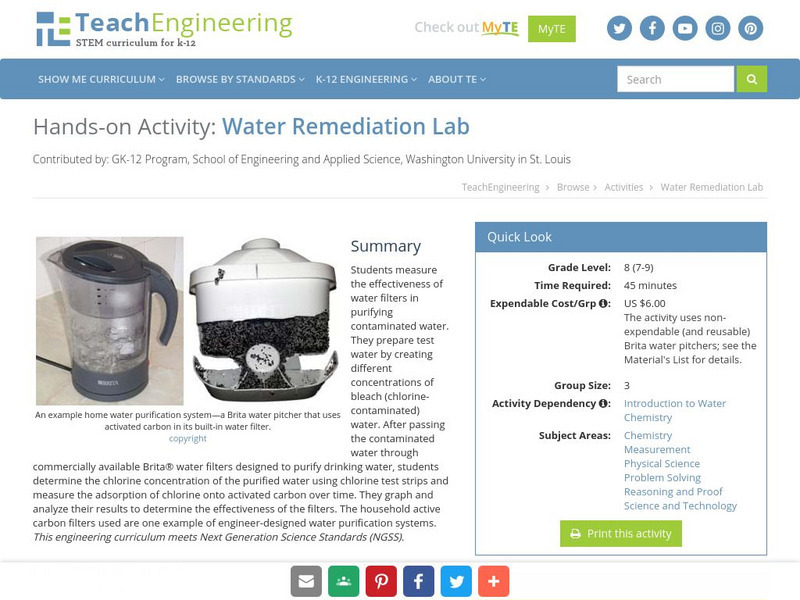
Teach Engineering: Water Remediation Lab
Students measure the effectiveness of water filters in purifying contaminated water. They prepare test water by creating different concentrations of bleach (chlorine-contaminated) water. After passing the contaminated water through...
TeachEngineering
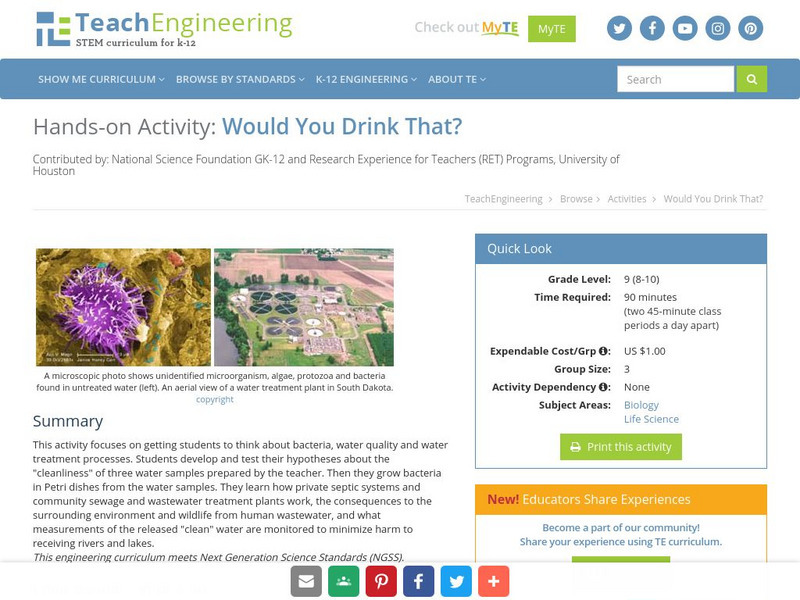
Teach Engineering: Would You Drink That?
This activity focuses on getting students to think about bacteria, water quality and water treatment processes. Students develop and test their hypotheses about the "cleanliness" of three water samples prepared by the teacher. Then they...
TeachEngineering
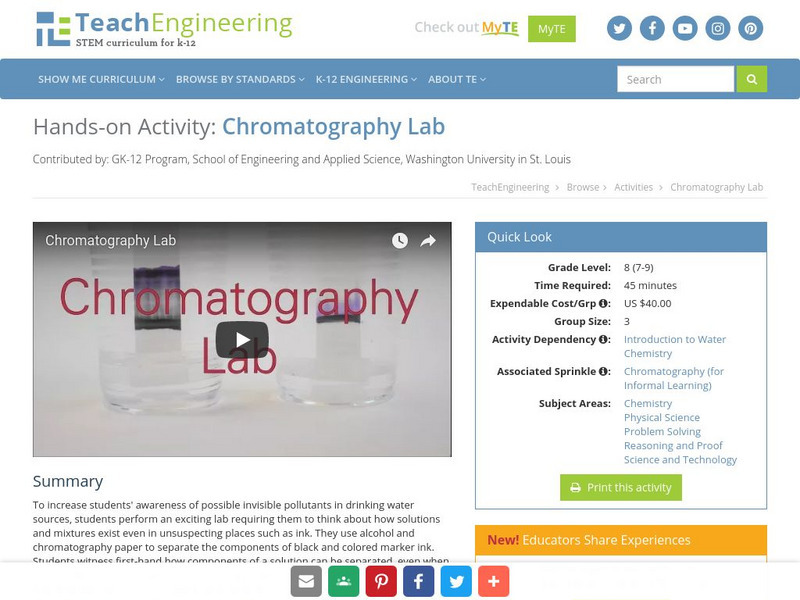
Teach Engineering: Chromatography Lab
To increase students' awareness of possible invisible pollutants in drinking water sources, students perform an exciting lab requiring them to think about how solutions and mixtures exist even in unsuspecting places such as ink. They use...
TeachEngineering
Teach Engineering: From Lake to Tap
In this activity, students will use a tutorial on the U.S. Environmental Protection Agency's website to learn about how surface water is treated to make it safe to drink.