Hi, what do you want to do?






Curated OER
Geo Jammin' By DeSign - Day 7, Lesson 37: Summarizing for the Summative
Pupils listen for specific information during summary presentations. They practice giving feedback on given topic according to a set of standards. The speaker reports to the rest of class from a report and listeners determine if criteria...

Curated OER
The Matrix
Second graders compare and contrast groups of Native Americans and culture groups from different regions and times.

Curated OER
Aunt Chip And the Great Triple Creek Dam Affair
Students examine Patricia Polacco's web site as an introduction to her life and literature. They listen to "Aunt Chip and the Great Triple Creek Dam Affair" before discussing how the main character believe in the power of books. They...

Curated OER
Passport to the Eastern Hemisphere
Seventh graders create a time line of significant dates in the history of their nation. This requires students to examine the entire history of a country and make informed judgments based on their historical knowledge.

Curated OER
Urban Renewal
Eleventh graders write down their best guess at the meaning of "urban renewal." students stage a Mayor's press conference announcing a new urban development plan for the Fillmore.

Curated OER
Body Building
Learners determine whether ancient Egyptian drawing was proportional and in perspective by comparing ancient Egyptian drawings, a mummy's x-ray, and contemporary photographs of people.

Curated OER
My Heritage Country Report
Young scholars list five food dishes that are part of their family's heritage. Each student then does research of a country and a recipe (possibly a family recipe). With the help of members of his/her kitchen group, the student prepares...

Curated OER
Female Fur Traders: Breaking Arbitrary Barriers
Eighth graders read a variety of articles and watch a video about the history of female Canadian fur traders. They contribute to a website on the subject and develop a presentation with their research for the class.

Curated OER
The Kanaka Village at Fort Vancouver: Crossroads of the Columbia River
Pupils study the interaction between Native American and European cultures in the Pacific Northwest in the 1800s. They focus their study on the Hudson's Bay Company and Fort Vancouver.

Curated OER
Simple Machines
Sixth graders explore simple machines. They identify tools and machines that are used in everyday life. Students examine the purpose and uses of everyday tools. They create a tool or machine that can be used to solve a problem.

Arizona State University
Arts Work: Visual Arts Criticism
If you're looking for a complete list of art critique questions, this is the site for you! You'll find ideas for description, analysis, elements, technique, judgement, and audience.

John F. Kennedy Center
The Kennedy Center: Art Critiques Made Easy
A tipsheet giving ideas on how to encourage students to think and speak critically about visual arts, music, dance, and even literature.

Khan Academy
Khan Academy: What Separates Science From Art?
Practice critical analysis and reasoning skills with this reading excerpt from the MCAT.
Department of Defense
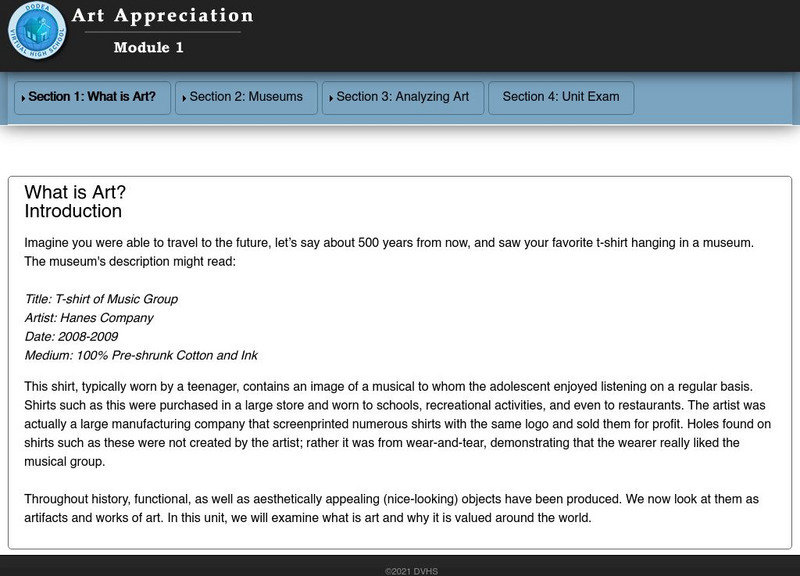
Do Dea: Art Appreciation: Unit 2: Introduction
In this second unit of a course on Art Appreciation, students are shown how to explain what the meaning of art is, they learn about the function of art in different cultures, why so much value is placed on art and cultural items, and...
Arizona State University
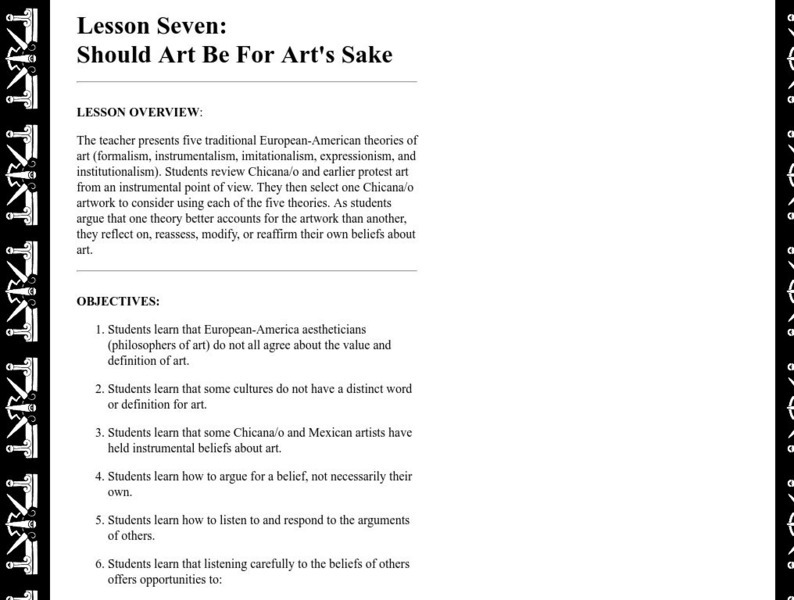
Art Lesson: Should Art Be for Art's Sake?
A lesson plan where the teacher presents the five traditional theories of art (formalism, instrumentalism, imitationalism expressionism and institutionalism.) Students review Chicana/o and earlier protest art from an instrumental point...
ArtsNow
Arts Now Learning: Mona Mesa: What Is Your Opinion? [Pdf]
In this lesson, 1st graders look at a print of "Mona Lisa" by Leonardo DaVinci and talk about what they see, searching for visual clues to help them form an opinion. They discuss the importance of portrait paintings during the...
South Carolina Educational Television
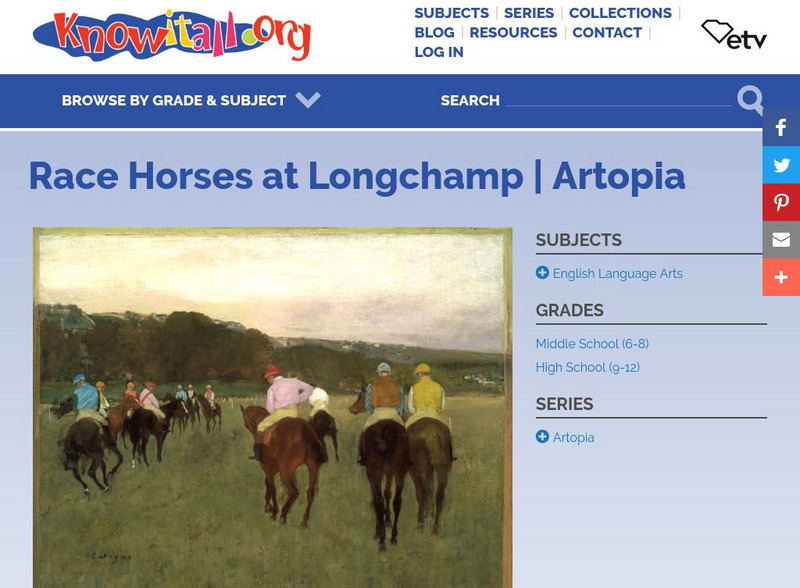
Etv: Artopia: Painting Critic: Race Horses at Longchamp by Edgar Degas
Explains how Edgar Degas painted impressions of things he saw in his painting, Race Horses at Longchamp. Also describes the content of the painting and gives a short biography of the artist. Students can answer questions about the...
Boston University
Boston University: Putting Value Into Art
Andrew Ward decides to get into the middle of an argument between David Hume and Hume's critic Malcolm Budd about the standard for assessing the value of works of art upon the feeling of pleasure or displeasure. This topic will be a...
National Endowment for the Humanities
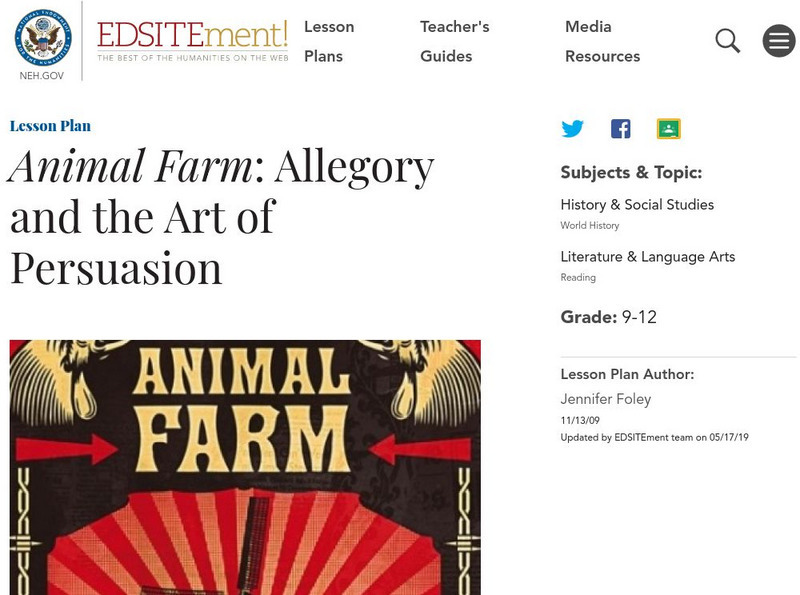
Neh: Edsit Ement: Animal Farm: Allegory and the Art of Persuasion
This lesson plan will introduce learners to the concept of allegory by using George Orwell's widely read novella, Animal Farm. Through this novel, students will learn what an allegory is, the rhetorical components of an allegory, and...
Yale University
Yale New Haven Teachers Institute: How to Appreciate a Painting
Christine A. Elmore's curriculum unit designed "to facilitate her third-graders' enjoyment of and response to fine art." This unit can be applied to all age groups and provides an extensive background on art in general.
Other
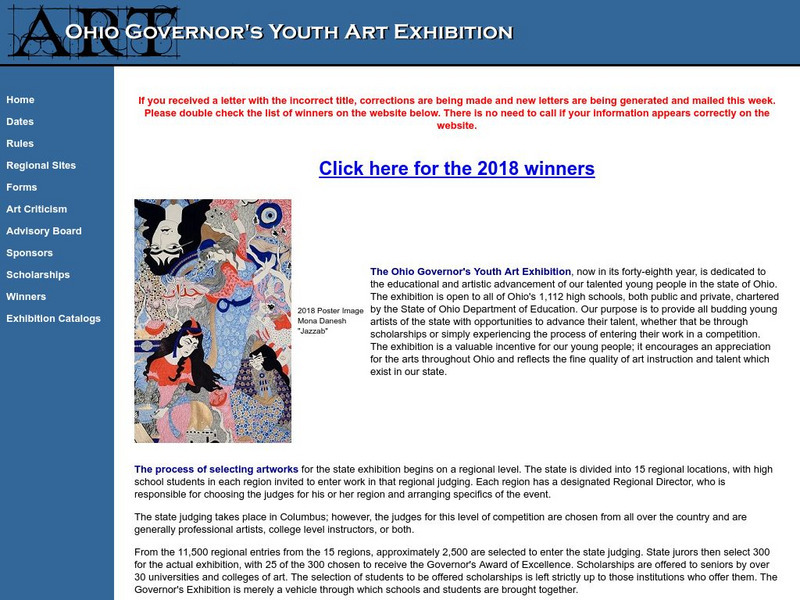
Ohio Governor's Youth Art Exhibition
The home page for the Ohio Governor's Youth Art Exhibition. There are pages to see what scholarships are available, to see who has won in the past and pages to view the winning artwork, writings, and criticism. Get informed for making a...
Other
Art Criticism: Four Stages of the Critical Process
Provides a brief description of each stage of art criticism using music as an example: description, analysis, interpretation, and judgement.
ArtsNow
Arts Now Learning: Self Portraits With the Touch of a Finger [Pdf]
For this lesson, students will explore self-portraiture by looking at classical portrait paintings, such as Diego Velazquez's La Infanta Margarita or Raphael's Portrait of Baldassare Castiglione. A close look at these works reveals...
ArtsNow
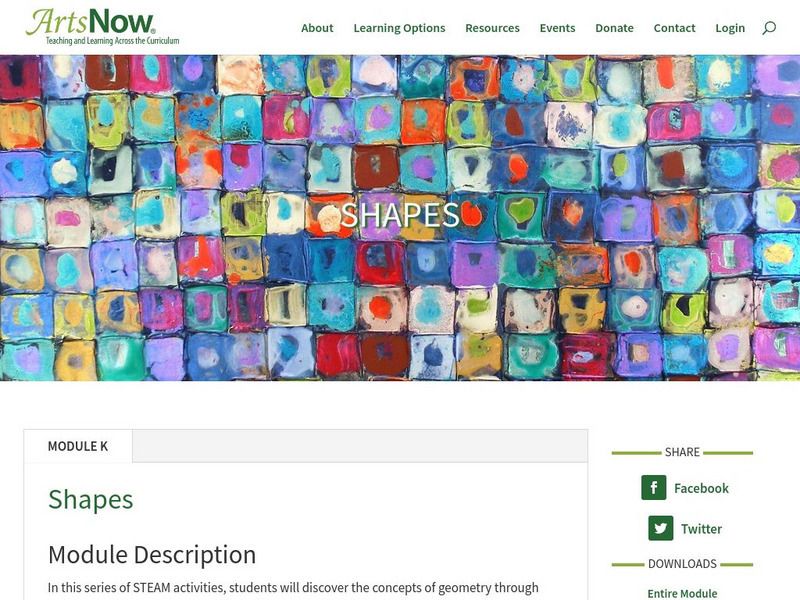
Arts Now Learning: Module K: Shapes
In this series of STEAM activities, students will discover the concepts of geometry through shape exploration and the creation of choreographic sequences. Another activity in this module will allow students to identify shapes by applying...