Hi, what do you want to do?






McGraw Hill
Orbital Velocity Interactive
Why does it take Pluto 90,000 days to orbit the sun, but it only takes Mercury 88 days? An interactive lesson helps pupils find a connection between the speed of orbit and distance a planet is from the sun. The simulation allows for...

PBS
Map a Model Solar System
Creating a solar system map is a snap thanks to a hands-on activity! Science scholars explore the solar system by building it wherever they choose during an interactive from PBS's Space series. Users pick both the location and scale for...

Laboratory for Atmospheric and Space Physics
Orbit Simulator
Researchers think they have evidence of a new planet deep in our solar system that is the size of Neptune and orbits the sun far beyond Pluto. The orbit simulator shows the orbits of our well-known planets, as well as Pluto and the comet...

American Museum of Natural History
Planetary Mysteries
A website all about planetary mysteries—it's a one-stop-shop for all things, stars, planets, and space travel. Scholars read an astronomy overview to discover the page's big ideas, then choose from the plethora of resources, including...

PHET
Gravity And Orbits
Have you ever wanted to turn off gravity? This simulation allows learners to do just that in addition to altering other variables. Scholars can move the sun, Earth, moon, and space station to see how distance affects gravitational pull....

Physics Classroom
Gravitational Field Strength
Budding scientists fall hard for a gravitational field strength activity! Physics pupils compare the masses and distances relative to the center of planets using an interactive from a Circular and Satellite Motion series. Individuals...

American Museum of Natural History
What is Astronomy?
Go study the universe. Pupils learn seven aspects about astronomy and astronomers. They begin to learn about constellations; distance and motion between objects; gravity; the electromagnetic spectrum; dark matter and energy; and teams of...

Physics Classroom
Kelper's Three Laws
A flipped classroom lesson introduces astrophysics fanatics to Kepler's three laws of planetary motion. After reading about the laws of ellipses, equal areas, and harmonies, and also learning how Newton's gravitation concepts come into...

Curated OER
Johannes Kepler
In this online interactive history worksheet, students respond to 10 short answer and essay questions about the achievements of Johannes Kepler. Students may check some of their answers on the interactive worksheet.

Curated OER
Using Proper Tools to Solve Problems-Pre Test
In this using proper tools worksheet, students answer a set of 10 multiple choice questions. Students may click on a link to see answers and may print worksheet out.

Curated OER
Astronomy: Prepositions Quiz- ESL
In this preposition quiz activity, students select the preposition that correctly completes a sentence. Students may click on an "answer" button for immediate feedback. A reference web site is given for additional activities.

CK-12 Foundation
Ck 12: Plix: Orbital Motion: Distance
[Free Registration/Login Required] The meteor is orbiting one of the 3 planets in a circular orbit. Drag the point associated with each planet to the meteor to see its orbit around that planet.

Physics Classroom
The Physics Classroom: Circular and Satellite Motion: Gravitational Fields
Students discover the Law of Universal Gravitation by changing the masses of planets and moons and the distance that separates them.
Exploratorium
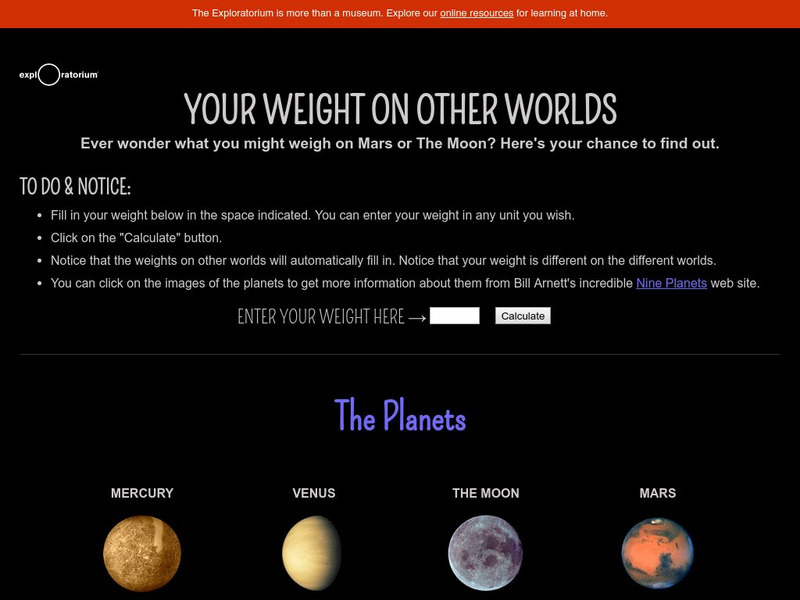
Exploratorium: Your Weight on Other Worlds
From the Exploratorium Museum. Includes an interactive feature in which a visitor enters their weight on earth and has their weight on other planets computed and displayed. Discusses the distinction between mass and weight and describes...
PBS
Pbs Learning Media: Your Weight on Other Worlds
This interactive resource from the Exploratorium calculates your weight on other bodies in our solar system and offers an explanation of mass and weight and the relationship between gravity, mass, and distance.