Hi, what do you want to do?






DocsTeach
How Have Americans Responded to Immigration?
While America says it welcomes from other countries the tired and poor yearning to be free, the record is mixed on whether there has been a warm reception for immigrants. Class members use an interactive graphic scale and primary source...

DocsTeach
Two Moments in the Life of Rick Rescorla: Vietnam and 9/11
He saved a group of men under fire from the Viet Cong, and he urged those fleeing the burning Trade Center Towers on 9/11 to "be calm, be strong." Rick Rescorla was last seen going back into the twin towers to bring others to safety....

DocsTeach
Women of Color and the Fight for Women's Suffrage
Introduce young historians to primary source analysis with a lesson that teaches them how to use a four-step process to analyze a photograph of a 1913 Suffrage Parade. Groups practice the process and share their observations with the...

DocsTeach
Fannie Lou Hamer and Voting Rights
To understand the challenges Black voters faced in Mississippi, middle schoolers first gather background information about Fannie Lou Hamer and then read her testimony given during the 1964 Democratic Nation Convention. After a...

DocsTeach
The Amendment Process: Ratifying the 19th Amendment
The process for adding an amendment to the U.S. Constitution is long and arduous, by design. High School historians study a series of documents about the Nineteenth Amendment and, using an interactive program, drag the documents onto a...

DocsTeach
School Desegregation Court Cases: Mendez v. Westminster and Brown v. Board
Separate is not equal! Young historians analyze the petition from the U.S. Supreme Court case Mendez v. Westminster filed in 1945 and examine background material about the case. They then compare it to the more famous Brown v. Board of...

DocsTeach
African American Soldiers and Civil Rights During WWI
Young scholars analyze primary source documents and images to determine how African American soldiers were denied their civil rights during World War I.

DocsTeach
What is Patent Number 1,693,515?
Scholars examine a document from 1928 featuring a mystery invention. Following their observations and discussion, the document reveals the invention of the permanent wave machine by Marjorie S. Joyner. Class members read about Joyner,...

DocsTeach
Who Were Some of the People Who Worked to End Slavery?
As pupils match information to photographs, a document is revealed—the Joint Resolution Proposing the Thirteenth Amendment. Scholars read about some of the people who worked to end slavery, then list each person and at least one way that...

DocsTeach
Compare and Contrast: School Photographs
Separate and very unequal! An interactive presents learners with two images: a photograph of a boys' bathroom at a school in Gloucester County, Virginia, and a second of a girls' bathroom at a different school in the same county. The...

DocsTeach
The 19th Amendment and the Road to Universal Suffrage
Your vote matters! An informative activity focuses on the Nineteenth Amendment and explains how it paved the way for universal voting rights. Young historians analyze several documents and a complete a worksheet, describing the impact of...
US National Archives
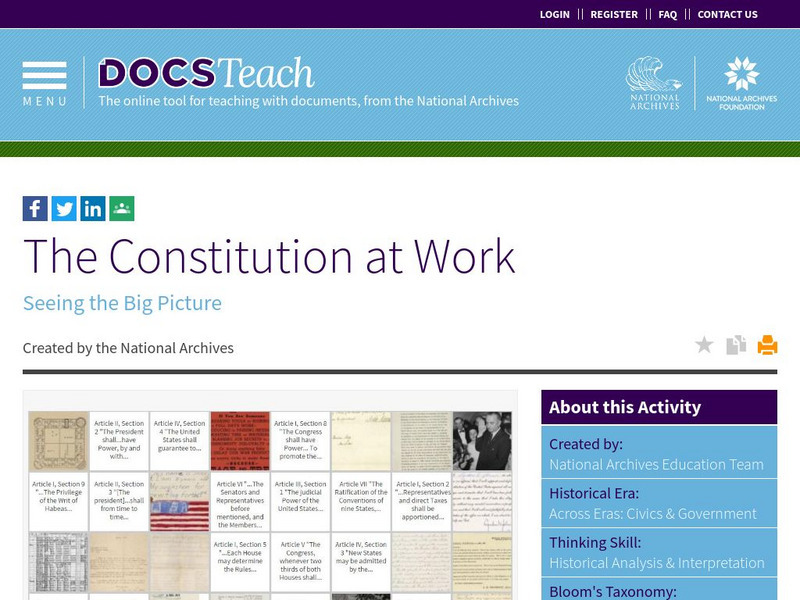
Docsteach: The Constitution at Work
In this activity young scholars will analyze documents that span the course of American history to determine their connection to the U.S. Constitution. Students will then make connections between the documents they have examined and the...
US National Archives
Docsteach: The Civil War as Photographed by Mathew Brady
Students will analyze a series of photographs taken by renowned photographer Mathew Brady to reflect on the lives of soldiers during the Civil War. The holdings of the National Archives include over 6,000 photographs taken by Brady and...
US National Archives
Docsteach: Integration of the u.s. Armed Forces
Students will draw upon the visual and textual data presented in photographs and documents to gain an understanding of the participation of African Americans in the U.S. Armed Forces and of changes in American military policy regarding...

US National Archives
Docsteach: A Revolution, a Reaction and a Reform: National History Day
Students will analyze primary source documents related to the National History Day (NHD) theme for 2011-12: Revolution, Reaction, Reform in History, determine how the documents are connected to the theme, and evaluate the effectiveness...
US National Archives
Docsteach: Extending Suffrage to Women
In this activity, students will analyze documents pertaining to the women's suffrage movement as it intensified following passage of the 15th Amendment that guaranteed the right to vote for African American males. Documents were chosen...
US National Archives
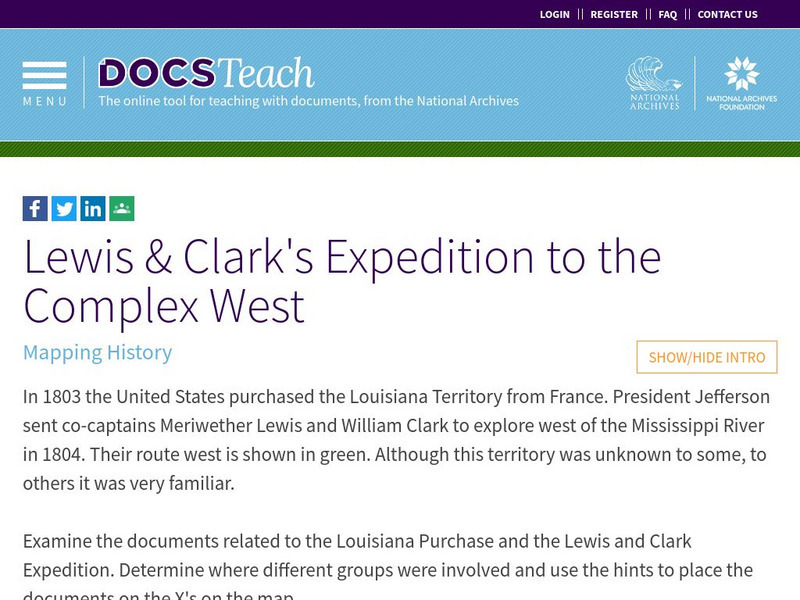
Docsteach: Lewis & Clark's Expedition to the Complex West
This activity can be used as an introduction or for a closer study of the Lewis & Clark Expedition. Students will learn that the United States purchased the Louisiana Territory in 1803 and President Thomas Jefferson sent Lewis and...

US National Archives
Docsteach: From Dred Scott to Civil Rights Act of 1875: Eighteen Years of Change
In 1857, the U.S. Supreme Court ruled in the Dred Scott decision that African-Americans were not citizens of the United States. Yet within 18 years, Black Americans would not only have citizenship, but would be guaranteed the right to...
US National Archives
Docsteach: The Voting Record of the Constitution
In this activity, students will analyze a primary source document to find relevant historical data and measure the degree of agreement and disagreement during the Constitutional Convention.
US National Archives
Docsteach: Watching What?
Students will hypothesize what the president and cabinet members were watching on television by analyzing facial expressions, and body language, and the physical environment. Students will learn that President Ronald Reagan and his staff...
US National Archives
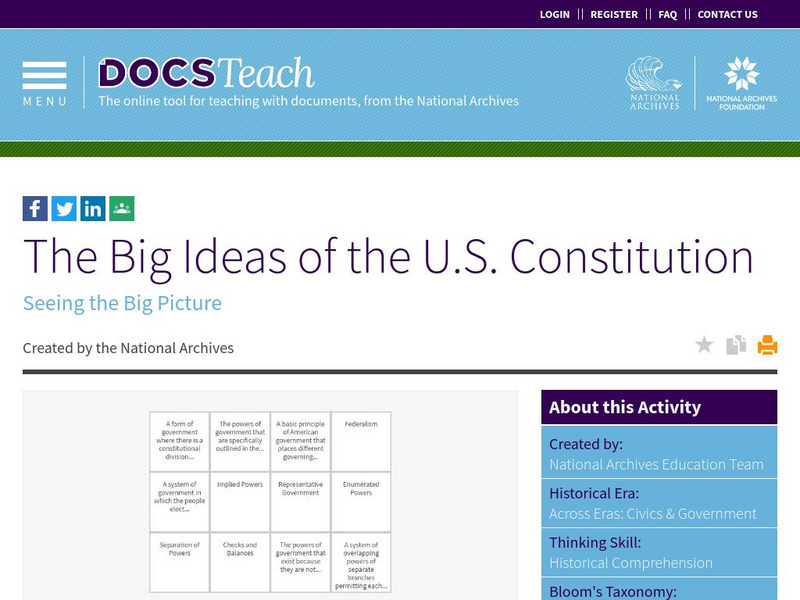
Docsteach: The Big Ideas of the u.s. Constitution
In this activity young scholars will identify and define seven key ideas contained in the U.S. Constitution by making matches from the grid. They will then analyze documents that demonstrate each big idea in action.
US National Archives
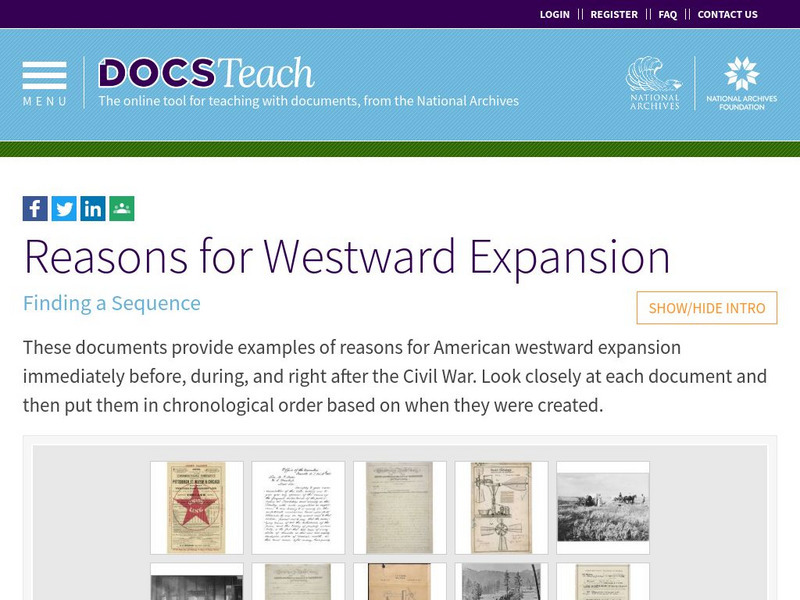
Docsteach: Reasons for Westward Expansion
Students will examine a variety of documents that reference reasons why Americans living in the East migrated west of the Mississippi immediately before, during, and right after the Civil War. Documents cover the mining industry, new...
US National Archives
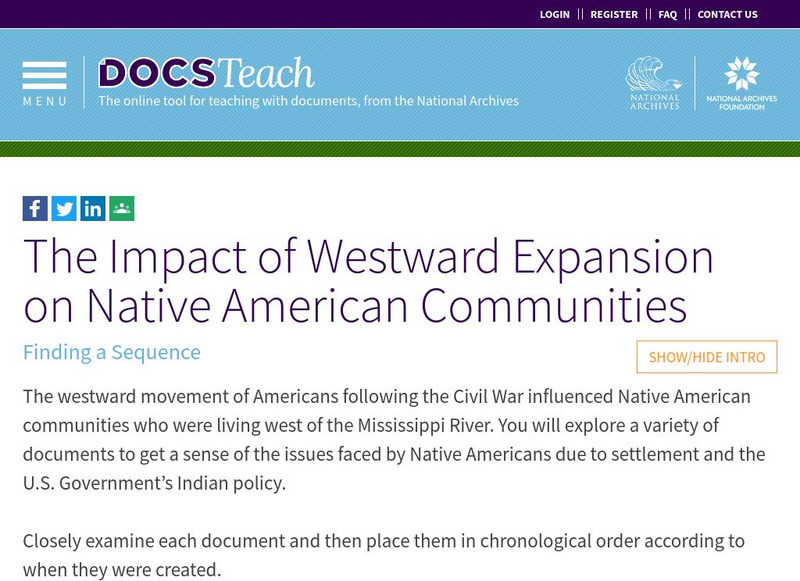
Docsteach: The Impact of Westward Expansion on Native American Groups
In this activity, students will examine the impact of westward expansion and settlement on Native American groups following the Civil War. Students will explore a variety of documents to get a sense of the issues faced by Native...
US National Archives
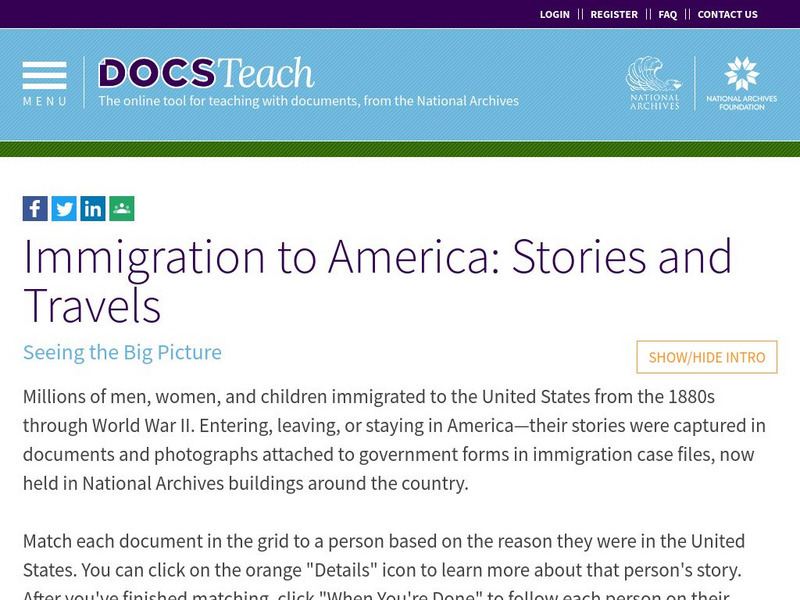
Docsteach: Immigration to America: Stories and Travels
This activity asks learners to match documents to individuals based on the reasons these people came to and were living in the United States. The photographs and documents are attached to government forms in some of the millions of...