
Curated OER
Weaving Project
Students practice artistic weaving. In this Colonial arts lesson, students weave pieces using lint from their home dryers. Students replicate the weaving process early Americans used. Students are also challenged to weave using the extra...

Curated OER
Wheat: Ancient and Ageless
Students label the parts of a wheat plant on a worksheet. In this Egyptian farming lesson, students thresh a wheat stem and estimate the amount harvested. Students research Ancient Egypt online.

Curated OER
Haiku and Beyond: Exploring Genres of Japanese Literature
Fourth graders compare and contrast the literature of Japan as they study the culture, history and geography of the island nation. They read various genres of literature, describe geographic and landform features of Japan, and find...

Curated OER
Origami Paper Fun
Learners explore the art of Origami. They listen to various stories about Japan, create Origami shapes by following step-by-step directions, sing Japanese songs, locate Japan on a map, and take a quiz.

Curated OER
What the Empire Lost: The Ottoman Empire
For this Ottoman Empire worksheet, students read a 1-page selection about the decline of the empire, examine the provided map on the topic, and then respond to 5 short answer questions about the information presented.

Curated OER
Smithsonian Asian Pacific American Lesson: Immigration
Many of your class members will have heard of Executive Order 9066 and the Japanese internment camps of World War II. Some may even recognize the terms “Issei” and “Nisei,” but few will have heard of Enemy Alien Hearing Boards, of the...

John F. Kennedy Presidential Library & Museum
Military Advisers in Vietnam: 1963
How did the beginning of the Vietnam War factor into the Cold War with the Soviet Union? As part of a study of American involvement in Vietnam, class members read a letter address to President Kennedy and his response in which...

Curated OER
Conflict Resolution in the World Today: Introduction to Current World conflicts, their Antecendents, the Progression, and their Potential Conclusions
Students write a paragraph describing a conflict they had with a friend or a family member and a paragraph explaining how it was resolved. In this social science lesson, students share their paragraphs with a partner and then will...

K12 Reader
Transcontinental Railroad
Who built the Transcontinental Railroad and why was it important? Your class can learn about the laying down of these tracks by reading a short passage. Pupils then respond to five questions related to the text.

Curated OER
Taming the Wild Aurochs
Fourth graders assess the development of animal husbandry, outline it in detail as well as arrange the steps in sequential order. In addition, they discuss how certain animals came to be domesticated, concentrate to research on one of...

Curated OER
The Ottoman Empire
In this Ottoman Empire worksheet, students read a 1-page selection about the empire and examine a map. Students then respond to 5 short answer questions about the reading selection and the map.

Curated OER
Founding Documents of the Peace Corps
Young scholars examine United States foreign policy in the period immediately following World War II through the activities of the Peace Corps.

Curated OER
Drawing on Kenaf
Students explore kenaf, a tree-free paper. In this environmental issues instructional activity, students draw pictures following a presentation about the origin and "eco-friendly" nature of kenaf.

Curated OER
In Perfect Harmony: Teaching the World to Sing
First graders listen to music as the impetus to learn about the concept of Japanese harmony as it is understood in Japanese culture. They use the New Seeker's song, "I'd Like to Teach the World to Sing," to compare America and Japan...

Curated OER
Georgia
In this Georgia reading comprehension activity, students read a 2-page selection regarding the state and they answer 10 true or false questions pertaining to the selection.

Curated OER
Children in the United States and Japan
Students locate Japan on a map or globe and describe the relative location of Japan. They use the Internet to investigate cultural characteristics of children in the United States and in Japan. They use a Venn Diagram as an...

Curated OER
Haiku
Pupils study various forms of poetry and the culture of Japan. They are introduced to a haiku- a traditional form of poetry and an art form in the Japanese culture. They write a haiku and create a student haiku booklet with the classes...

Curated OER
Getting Oriented
Students explore the geography, culture, and philosophy of Asia using all five senses and information about China and Japan. This lesson is detailed and may take several days of in-class activities to complete.
Other
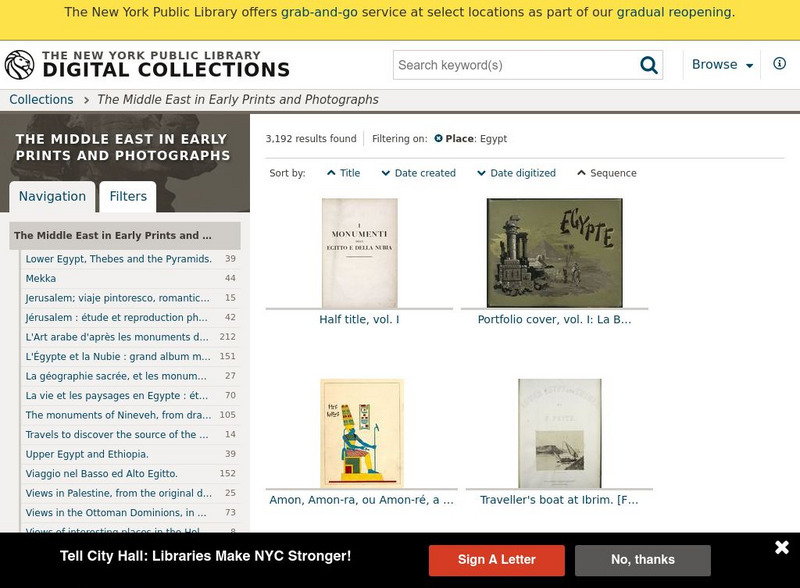
New York Public Library: The Middle East in Early Prints and Photographs: Egypt
A collection of digitized photographs, artworks, and documents on Egypt's history. Under 'Genre,' it is possible to filter them to isolate photographs, illustrations, etc.
University of Chicago
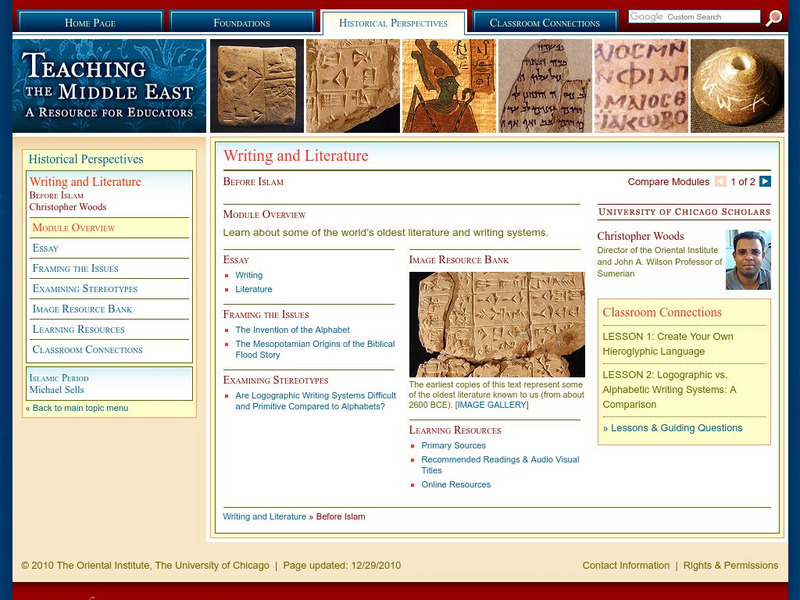
University of Chicago Library: Teaching the Middle East: Writing: Before Islam
Learning module considers the writing systems and literature of ancient Mesopotamia before the arrival of Christianity or Islam.
Internet History Sourcebooks Project
Fordham University: Medieval Sourcebook: Race and Slavery in the Middle East
This site from the Modern History Sourcebook of Fordham University provides a thorough discussion of the existence of slavery in early times giving the types of people who were taken as slaves and the work they performed. There were also...
Other
University of Illinois: The Early Centuries of the Greek Roman East
Read about the history of the Romiosini, or Greek Middle Ages and the development of the Greek-Roman east. The article is divided into two different sections. The first section includes the foundation of Constantinople as a means to...
History Teacher
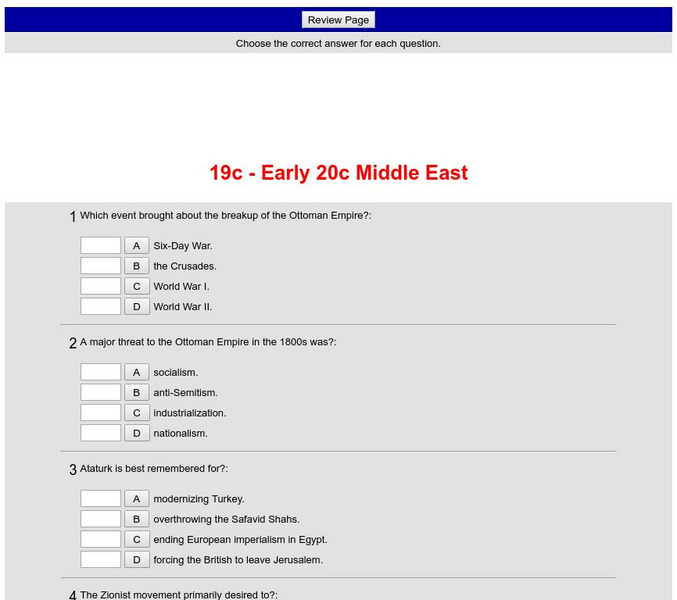
Historyteacher.net: Global Studies: 19c Early 20c Middle East Quiz
Ten multiple choice question quiz is immediately scored and provides review of Middle Eastern history.
Other
Islam Project: Maps
A series of historical and near-present-day maps that span Islamic history. Starting with A.D. 750, the maps illustrate both the spread of Islam (from Medina outward to Africa, the Middle East, Europe, and other parts of the world) and...