Hi, what do you want to do?






Illustrative Mathematics
Rounding to 50 or 500
In a six-problem learning activity, children are guided to solve word problems that involve rounding to the nearest ten and nearest hundred. A commentary and answer key provide different approaches that learners may take in solving the...

Charleston School District
Pre-Test Unit 7: Real Numbers
Don't be irrational! Use this pre-test to assess your classes' ability to work with all types of real numbers. The lesson asks learners to estimate value, evaluate roots, and order numbers. This begins a series of lessons on the real...

Illustrative Mathematics
Equivalent fractions approach to non-repeating decimals
Trying to get your class to think of decimals as fractions and vice versa can lead to interesting discussions. After all, we can usually understand quickly that 1/4 is .25 but why is 1/7 not so easy to convert? This activity looks...

EngageNY
Estimating Digits in a Quotient
Boiling down any division problem to a one-digit divisor problem sure makes estimation easy. The lesson shows how to estimate division problems by using place value understanding and basic arithmetic facts to simplify the division. Some...

EngageNY
Estimating Probabilities by Collecting Data
Take a spin to determine experimental probability. Small groups spin a spinner and keep track of the sums of the spins and calculate the resulting probabilities. Pupils use simulated frequencies to practice finding other probabilities to...

Los Angeles County Office of Education
Assessment For The California Mathematics Standards Grade 4
Have scholars show what they know with a 20-page assessment aligned to the California State Standards. The test covers concepts such as large and whole numbers, all four mathematical operations, fractions, decimals, geometric figures,...

EngageNY
Sampling Variability
Work it out — find the average time clients spend at a gym. Pupils use a table of random digits to collect a sample of times fitness buffs are working out. The scholars use their random sample to calculate an estimate of the mean of the...
Illustrative Mathematics
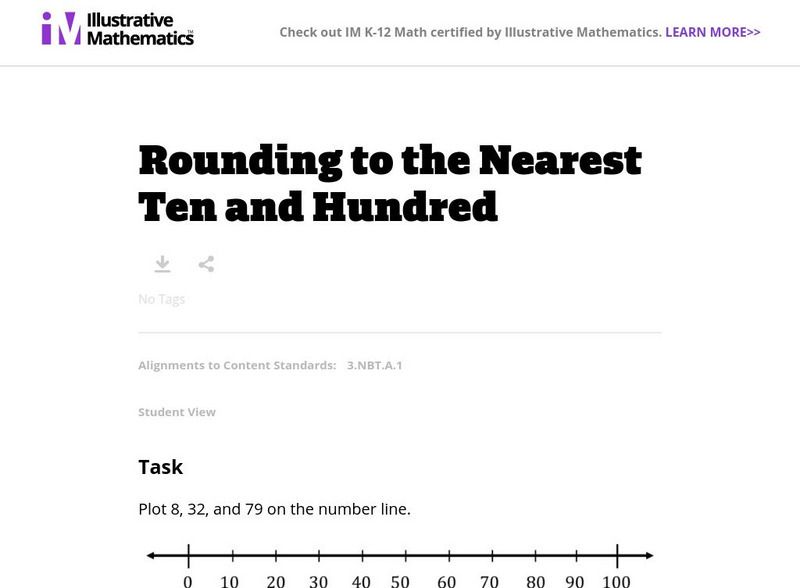
Illustrative Mathematics: 3.nbt Rounding to the Nearest Ten and Hundred
The purpose of this task is for students to practice rounding numbers to the nearest ten, connect the rules for rounding with location on the number line, and to introduce the idea of rounding to the nearest 100. Aligns with...
NumberNut
Number Nut: Rounding Numbers to the Nearest Ten
Practice your rounding skills through this online quiz. Round each number to the nearest ten, and select the correct answer of the three choices given. There are ten random questions. Immediate feedback is given.
NumberNut
Number Nut: Rounding Numbers to the Nearest Tenth
Practice your rounding skills in this online quiz. There are ten questions, and you select the correct answer by rounding to the nearest tenth.
Illustrative Mathematics
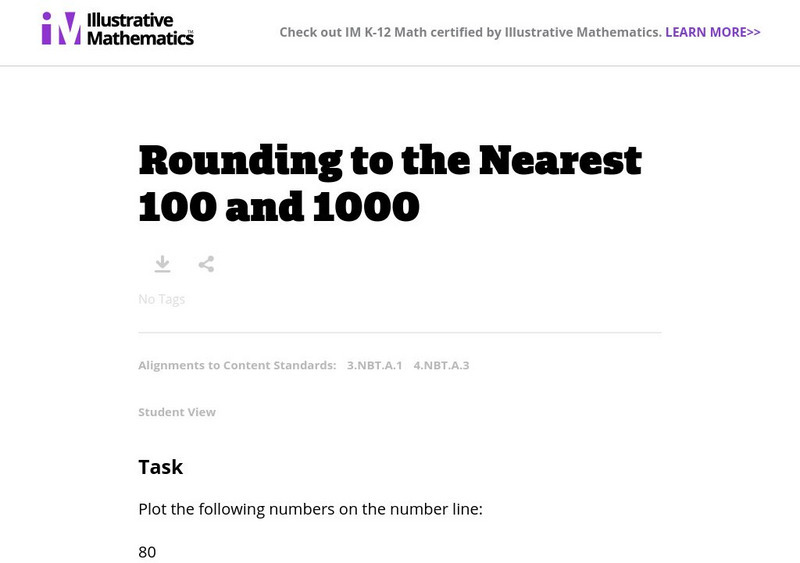
Illustrative Mathematics: 3.nbt, 4.nbt Rounding to the Nearest 100 and 1000
This task builds off of the skill of rounding to the nearest ten and hundred in third grade. Aligns with CCSS.Math.Content.3.NBT.A.1 Use place value understanding to round whole numbers to the nearest 10 or 100.
Illustrative Mathematics
Illustrative Mathematics: 3.nbt Rounding to 50 or 500
Students explore different rounding scenarios. Aligns with CCSS.Math.Content.3.NBT.A.1 Use place value understanding to round whole numbers to the nearest 10 or 100.
NumberNut
Number Nut: Rounding Numbers to the Nearest Hundred
Round each number to the nearest hundred. Select the correct answer of three choices. There are ten random questions.
Khan Academy
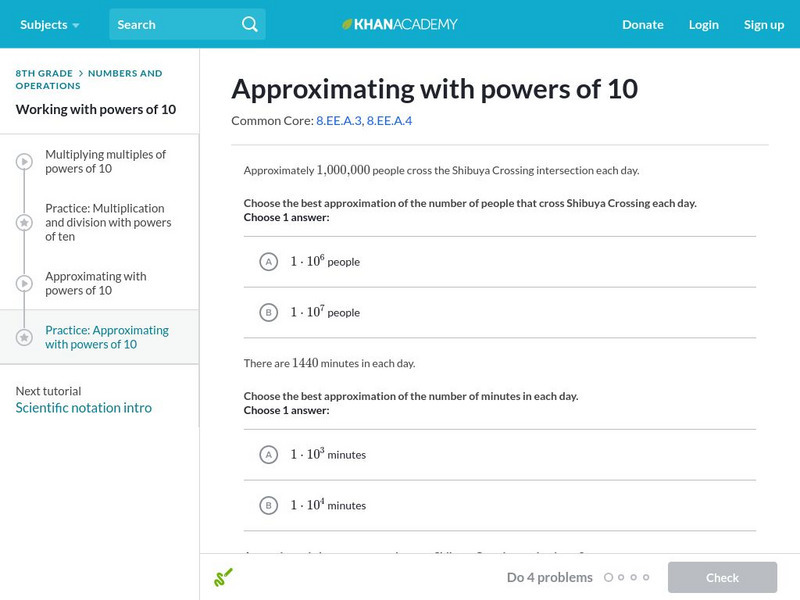
Khan Academy: Approximating With Powers of 10
Practice comparing two real-world quantities by approximating them using rounding and powers of 10. Students receive immediate feedback and have the opportunity to try questions repeatedly, watch a video, or receive hints.
Math Slice
Basic Math: Rounding
This resource covers whole number rounding where students can choose to round to the nearest tens to millions. After selecting parameters students are timed completing ten problems with instant feedback and an opportunity to practice again.