Hi, what do you want to do?






Curated OER
Rolling Twice
Rolling dice is the best way to show your learners how probability comes in to play. Although this lesson does not specify an activity, your mathematicians can try this probability with real dice to calculate their experimental...

Curated OER
Activity: An Experiment with Dice
Roll the dice with this activity and teach young mathematicians about probability. Record outcomes for rolling two number cubes in order to determine what is most likely to happen. Graph the data and investigate patterns in the results,...

Illustrative Mathematics
Tossing Cylinders
Everyone loves a instructional activity that involves throwing things around! To understand probability, your experimenters will predict how different cylinder-shaped objects will land when tossed. When the data is collected, they will...

Heidi Songs
Zoo Animal Probability Graph
Capture the engagement of your young mathematicians with a collaborative graphing activity. Using a deck of zoo animal picture cards, students select a picture from the deck, record the chosen animal on a graph,...

Illustrative Mathematics
Return to Fred's Fun Factory (with 50 Cents)
The penny arcade gets the statistics treatment in this fun probability investigation. A non-standard game of chance is described and then the class is set loose to find missing probabilities, determine common outcomes, and evaluate...

101 Questions
100-Hand Video Poker
You hit the jackpot with a fun lesson! Peak your pupils' interest with a lesson calculating the probability of poker hands. A video shows the different types of possible hands when given a specific hand and one card to draw.

Curated OER
Mathematics Activities from Diverse Cultures
Connect probability and odds with different games from around the world. Pick from games like Dreidel, Mancala, and a Navajo stick game called Ashbil. All 12 games include probability questions to encourage a discussion before or after...

Curated OER
Pi Day: The Other Math Holiday!
Happy Pi Day! This collection of games, experiments, and activities leads participants through an exploration of the many aspects and attributes of that mysterious quantity, pi. Activities range from using statistical...

Stats Monkey
Everything I Ever Needed to Learn about AP Statistics I Learned from a Bag of M and M's®
Candy is always a good motivator! Use this collection of M&M's® experiments to introduce statistics topics, including mean, standard deviation, nonlinear transformation, and many more. The use of a hands-on model with...

Howard Hughes Medical Institute
Human Impacts on Biodiversity
Have you always wanted to take your science class on an amazing field trip they will never forget? Now you can! Observe the wildlife in an African savanna through trail cameras with a five-part data analysis activity. Learners analyze...

Teach Engineering
Light vs. Heat Bulbs
Careful, that light bulb is hot! Compare heat and light energy using a simple light bulb. The exercise addresses energy conservation and presents actual calculations to determine the most cost-effective light bulb.

Illustrative Mathematics
Accuracy of Carbon 14 Dating II
The scientific issue of carbon-14 dating and exponential decay gets a statistics-based treatment in this problem. The class starts with a basic investigation of carbon content, but then branches out to questions of accuracy and...

Teach Engineering
Earthquakes Living Lab: Geology and the 1906 San Francisco Earthquake
We can learn from the past to protect the future. Pairs look at two historical earthquakes: San Francisco, Calif., and Kobe, Japan. Pupils compare the two earthquakes and their impacts, then determine how engineers may use the...
Texas Instruments
Texas Instruments: Graphing Calculator Investigation Probability Simulation
Students can use the random number generator to simulate a probability experiment and calculate experimental probabilities.
Texas Instruments
Texas Instruments: You're Probably Right, It's Wrong
In this activity, students perform a simulation to guess answers on a test and determine the experimental probability of passing the test. They then compare it with the theoretical probability.
Shodor Education Foundation
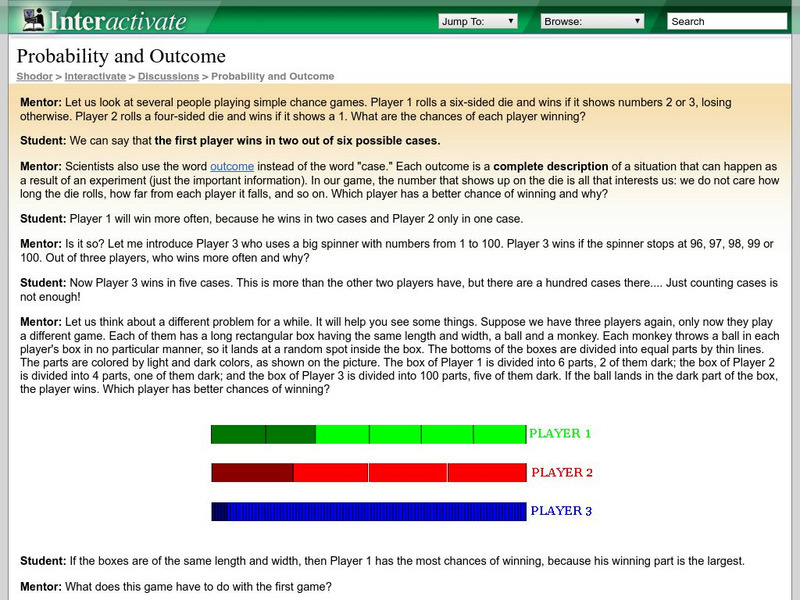
Shodor Interactivate: Probability and Outcome Discussion
This site is a virtual discussion between a teacher and student about probability and outcome. The virtual teacher poses wonderful questions for the students to think about. The virtual students then respond to the inquiries.
Texas Instruments
Texas Instruments: Plinko!
In this activity, students will simulate a popular game, find experimental probabilities, and then compare those probabilities to the corresponding theoretical probabilities.
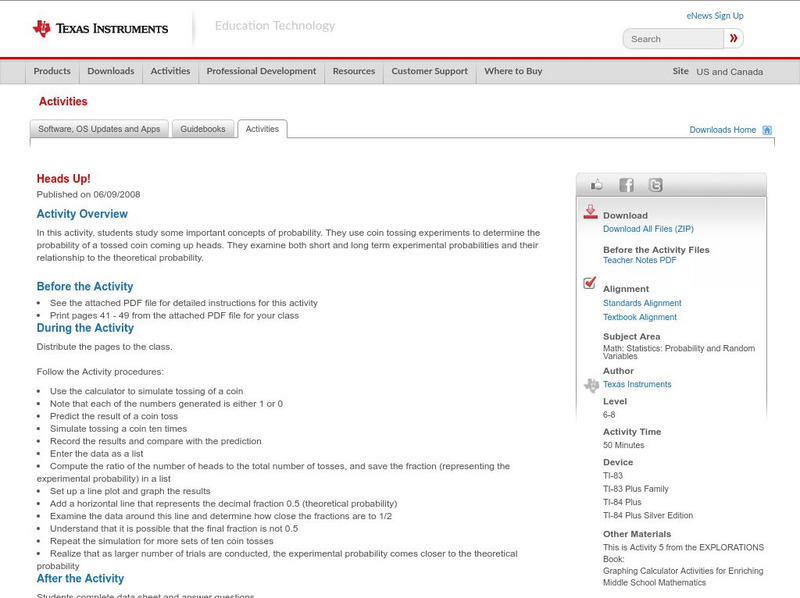
Texas Instruments
Texas Instruments: Heads Up!
In this activity, students study some important concepts of probability. They use coin tossing experiments to determine the probability of a tossed coin coming up heads. They examine both short and long term experimental probabilities...
![American Chemical Soc.: Best of Wonder Science: Give Probability a Chance! [Pdf] Activity](https://statictemp.lp.lexp.cloud/images/attachment_defaults/resource/large/FPO-knovation.png "American Chemical Soc.: Best of Wonder Science: Give Probability a Chance! [Pdf] Activity")
American Chemical Society
American Chemical Soc.: Best of Wonder Science: Give Probability a Chance! [Pdf]
A simple experiment to test the probability of finding an eraser placed under one of two cups.
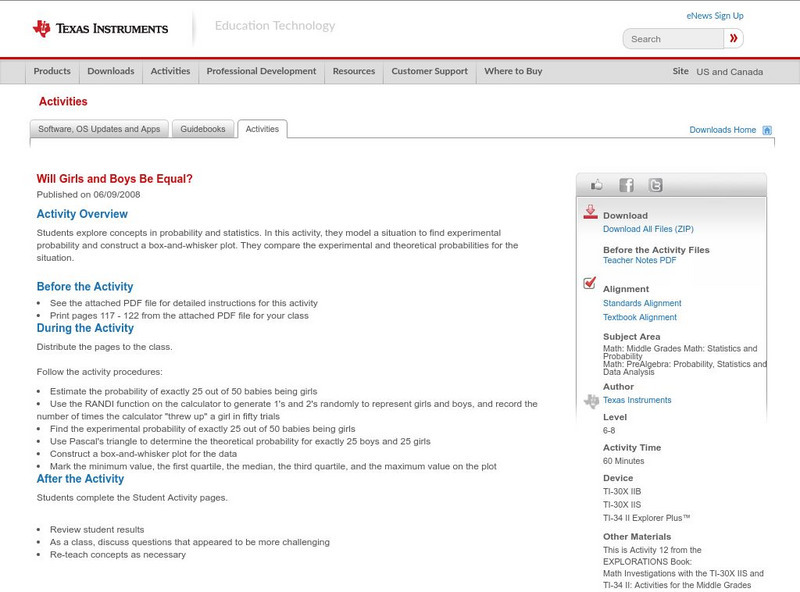
Texas Instruments
Texas Instruments: Will Girls and Boys Be Equal?
Students explore concepts in probability and statistics. In this activity, they model a situation to find experimental probability and construct a box-and-whisker plot. They compare the experimental and theoretical probabilities for the...
Annenberg Foundation
Annenberg Learner: Analyzing Binomial Probabilities
A tree diagram is a helpful tool for determining theoretical or mathematical probabilities. Toss a coin and watch as branches represent a toss of either head or tails.
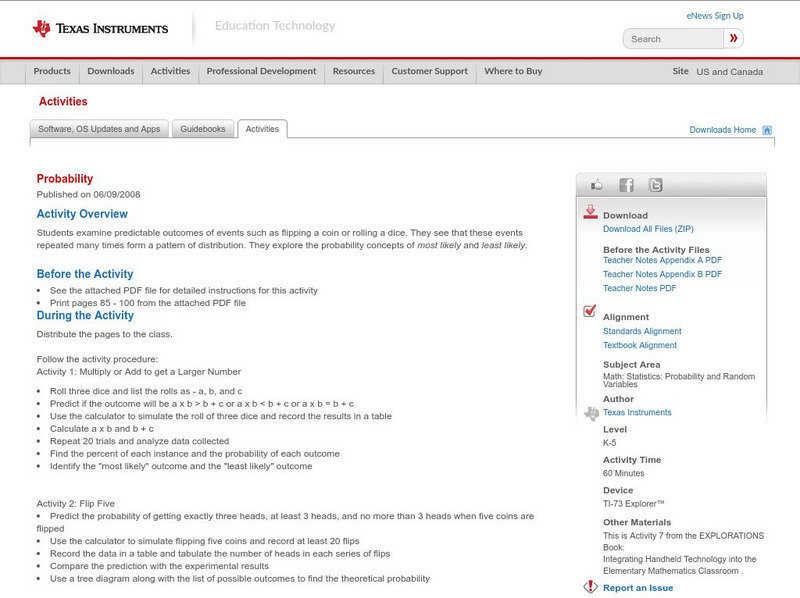
Texas Instruments
Texas Instruments: Probability
Students examine predictable outcomes of events such as flipping a coin or rolling a dice. They see that these events repeated many times form a pattern of distribution. They explore the probability concepts of most likely and least likely.
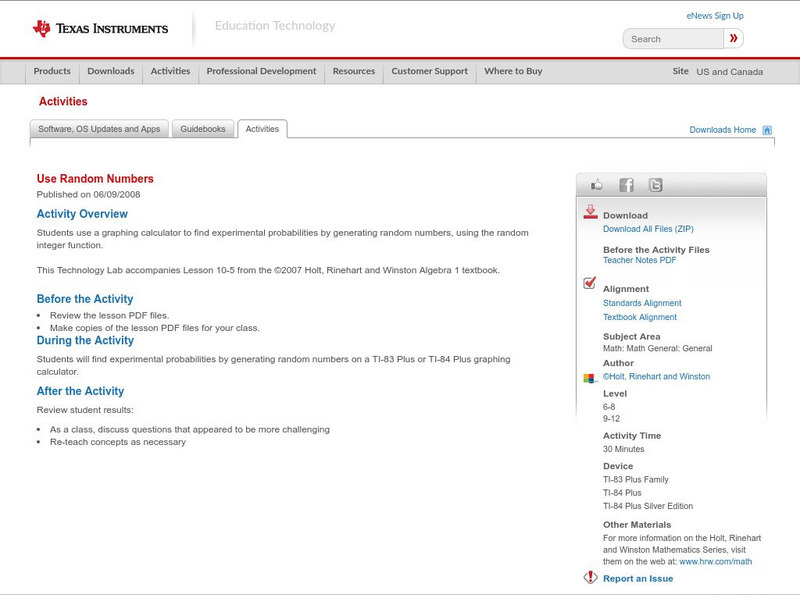
Texas Instruments
Texas Instruments: Use Random Numbers
Students use a graphing calculator to find experimental probabilities by generating random numbers, using the random integer function. This Technology Lab accompanies Lesson 10-5 from the 2007 Holt, Rinehart and Winston Algebra 1 textbook.
Texas Instruments
Texas Instruments: Law of Large Numbers: Equal Opportunities
In this activity, students can use the Probability Simulation application to roll a fair die and explore the Law of Large Numbers. They will conduct probability experiments that involve tossing a fair die, graph the results, compare the...