Hi, what do you want to do?






School Improvement in Maryland
Supreme Court Case Overview I
As part of a study of the 14th Amendment to the United States Constitution, class members examine four Supreme Court decisions—Gitlow v. New York, Mapp v. Ohio, Gideon v. Wainwright, and Griswold v. Connecticut—that incorporated the due...

Heritage Foundation
Procedural Amendments: Amendments III, IV, and V
So many US Constitution clauses, so little time. The 17th installment in a 20-part series teaches pupils about the Third, Fourth, and Fifth Amendments. Learning through activities such as group work, connecting to current events, and...

Curated OER
Hiibel vs. Sixth Judicial District Court of Nevada
Did Hiibel's arrest and conviction for not telling a police officer his name violate his rights? Have your learners read a short description of the case and answer the comprehension questions that follow. Resource links and...

Curated OER
What is Public Use?
Explore the Fifth Amendment by examining the meaning of "public use" as learners read a scenario and role play their assigned parts to determine "public use." They also read Supreme Court Cases regarding the amendment and present their...

Curated OER
"Whispering Wires": Public Law vs. Individual Civil Liberties
High school student love discussing controversial issues like those brought up in this fourth amendment case study. They examine the 1928 Olmstead vs. U.S. prohibition court case, applying the fourth amendment to determine whether...

State Bar of Texas
Miranda v. Arizona
You have the right to remain silent—but why? Scholars analyze the nature of what has become known as the Miranda Rights. A short video along with paired group work and discussion opens the issue of the rights of the accused upon arrest....

Curated OER
The Bill of Rights
Ninth graders examine various Supreme Court Cases. For this American Government lesson, 9th graders research a specific Supreme Court Case. Students create a multiple choice assignment based on their assigned case.

Curated OER
Bill Of Rights
Students examine Supreme Court cases. In this U.S. government lesson, students watch a video about the Bill of Rights and then research 4 Supreme Court cases using the noted web site. Students analyze the presented information and write...

Curated OER
Government Lesson Plan: Lesson Plan 8
Students analyze the Fourteenth Amendment. They discuss Reconstruction, read the provisions of the Fourteenth Amendment, define the provisions, and in small groups analyze a Supreme Court case that was impacted by the due process clause.

Curated OER
Honoring Property Rights
Students examine the issue of cheating. In this property rights lesson, students define honor and discuss intellectual property rights as they explore a case study.

Curated OER
Civil Liberties and War Powers: Korematsu v. United States
Eleventh graders compare and contrast Supreme Court decisions dealing with the application of civil rights during times of war, with emphasis on discrimination and detention. Working in groups, 11th graders review cases and analyze how...

Curated OER
Miranda v. Arizona (1966)
Learners examine Miranda v. Arizona. In this court decisions lesson plan, students analyze the self incrimination case and read other supplemental articles about police procedures and due process. Learners discuss the Supreme Court...

Curated OER
The Bill of Rights
High schoolers examine the intent Bill of Rights. In this American government instructional activity, students watch segments of the Discovery video "The Bill of Rights." High schoolers discuss and debate the 4 Supreme Court...

Curated OER
Due Process
Students explore the concept of due process. In this American law lesson, students view a 9-slide PowerPoint presentation on the topic and then respond to 3 discussion questions about the 5th and 14th amendments.

Curated OER
The Bill of Rights
Young scholars explore the Bill of Rights. In this philanthropy and citizenship lesson, students identify and explain how each of the first ten amendments protects the rights of citizens. Young scholars select one amendment to...

Curated OER
Japanese-Americans of World War II
Students research the internment of Japanese-Americans during World War II and Roosevelt's Executive Order. They listen to an audio file of the Fifth Amendment before holding a mock trial about the policy of internment of...

Curated OER
Constitution Web-lesson
Students examine multiple sources like america's founders, court cases, headilnes and more to learn about the Constitutional Convention of 1787

Judicial Branch of California
A “Commemorative” Bill of Rights
It's 1943, and Jewish people in Denmark are in hiding from the Nazis. What protection can the United States offer them? By examining the Constitution, specifically the Bill of Rights, scholars consider the protections afforded to those...

Curated OER
Philanthropic Movements in the United States To 1900: The Bill of Rights
Students translate the meanings of and draw illustrations depicting the Bill of Rights amendments. They discuss how philanthropy is enabled by the Bill of Rights.

Curated OER
Exploring United States vs. Hirabayashi
Students research the case of Gordon Hirabayashi vs. the United States. They research the case by completing a timeline activity and review the charges against him. Students review the entire case and discuss it from the perspective of...

Curated OER
Exploring United States V. Hirabayashi
Pupils discuss and examine the case of Gordon Hirabayashi.
Other
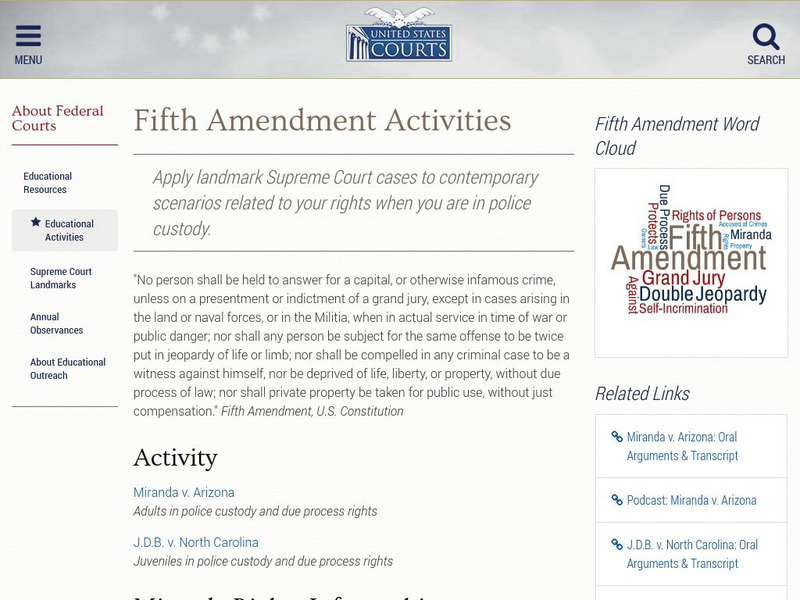
Us Courts: Fifth Amendment Activities
Two activities and lesson plan apply landmark Supreme Court cases on the Fifth Amendment and the right to due process or fair trial for adults and juveniles accused of a crime.
PBS
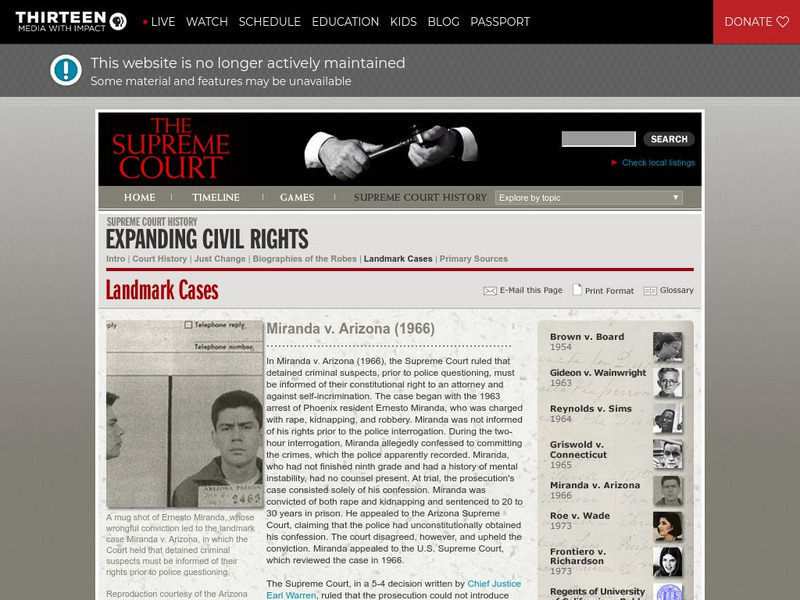
Wnet: Thirteen: The Supreme Court: Landmark Cases: Miranda v. Arizona (1966)
PBS presents a summary of the landmark Supreme Court case of Miranda v. Arizona which ruled that a person suspected of a crime must be informed of their constitutional rights before police questioning, becoming known as the "Miranda...
Thomson Reuters
Find Law: u.s. Supreme Court: Escobedo v. Illinois (1964)
A detailed description of the United States Supreme Court decision on the appeal of the case Escobedo v. Illinois, which ruled on the right to have counsel under the 6th and 14th Amendments to the Constitution.