Hi, what do you want to do?






Curated OER
Biography/Autobiography Book Report
In this book report worksheet, students select a biography or autobiography to read and then use the activities on the worksheet to complete a book report.

Curated OER
Say It with Meaning: Applying Sayings and Phrases
Students complete a unit of lessons on well known sayings and phrases. They create a journal, write paragraphs, sequence events, and analyze key vocabulary for various sayings and phrases throughout the school year.

Curated OER
Imagery
Ninth graders explore poems, various poetic devices, and identify imagery used in poetry. In groups, they examine poetic devices, define them, paraphrase and summarize poetry. Students study poetry by Robert Frost as they explore...

Curated OER
Our Global Community
First graders experience literature which shows how communities live around the world. For this global community lesson, 1st graders read books such as Whoever You Are, by Mem Fox and create a work of art based on their feelings about...

Curated OER
Daddy Questions
In this reading comprehension worksheet, students respond to 5 short answer and essay questions based on the poem "Daddy," by Sylvia Plath.

Curated OER
Computers: Get Plugged In!
Students examine the significance of learning to use the computer and the Internet. They watch and discuss a video, conduct Internet research on a celebrity or historical figure, and teach a lesson to a person about navigating the Internet.

Curated OER
Famous Person Admired
Learners research a famous person they admire. Students conduct Internet research to gather and store facts about the historic person in order to write essay, they also collect pictures for a collage.

William & Mary
Inferential Reading Comprehension Considerations Packet
Don't forget to read between the lines! Educators learn tips and activities to help scholars learn to infer to increase reading comprehension. Activities suggested include think alouds, backwards words, and who's who. the packet includes...

Museum of Tolerance
Influence of Media
We are bombarded with media images expressly designed to influence viewers. Learning how to analyze the intended effects of these images is essential and the focus of an activity that asks viewers to use the provided questions to guide...

Walters Art Museum
The Symbolism of Allegorical Art
Introduce learners to allegorical art with four bronze sculptures by Francesco Bertos. After modeling how to recognize bias and allegory in Bertos' Africa, class groups examine the other three sculptures in the series before creating...

Curated OER
Preparation and Transition to Two-Column Proofs
Students investigate proofs used to solve geometric problems. In this geometry lesson, students read about the history behind early geometry and learn how to write proofs correctly using two columns. The define terminology valuable to...

Curated OER
Chinese Dialect Exercise
Students are exposed to the obstacles in communication created by the presence of dialects, and made aware of the usefulness of a common writing system available to speakers of all dialect forms.

Curated OER
Poetry
Twelfth graders examine the main characteristics of poetry. They read and discuss a handout on the characteristics of poetry, read the poem, The Road Not Taken, discuss their interpretation of the poem, and research poetry on the Internet.

Curated OER
Chinese Dialect Lesson
Fourth graders are exposed to the obstacles to communication created by the presence of dialects. Students become aware of the usefulness of a common writing system available to speakers of all dialect forms.

Texas Education Agency
Texas Gateway: Importance of Figurative Language: Practice 3 (English I Reading)
This practice activity focuses on identifying figurative language, determining literal from figurative language, and connecting figurative language to settings. L.9-10.5 Fig Lang/nuances
Texas Education Agency
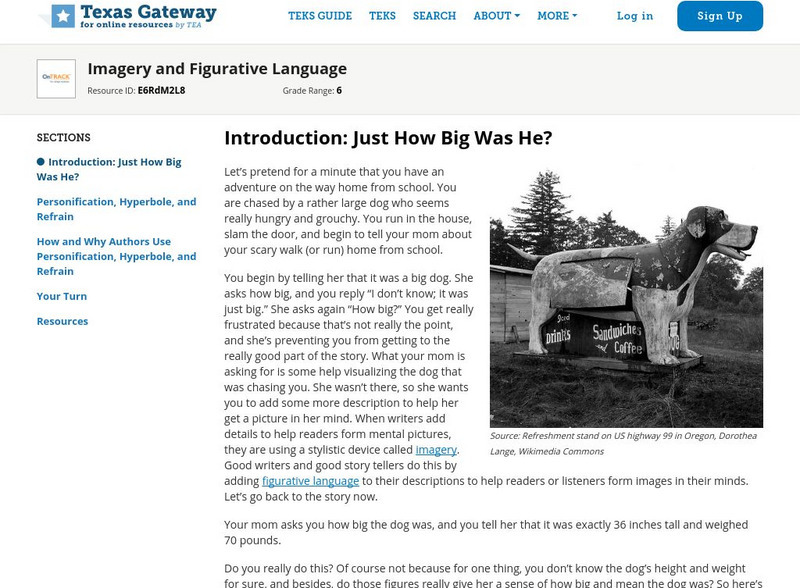
Texas Gateway: Imagery and Figurative Language (Grade 6)
This lesson focuses on the use of imagery and figurative language in writing to aid understanding and create images in the mind.
Read Works
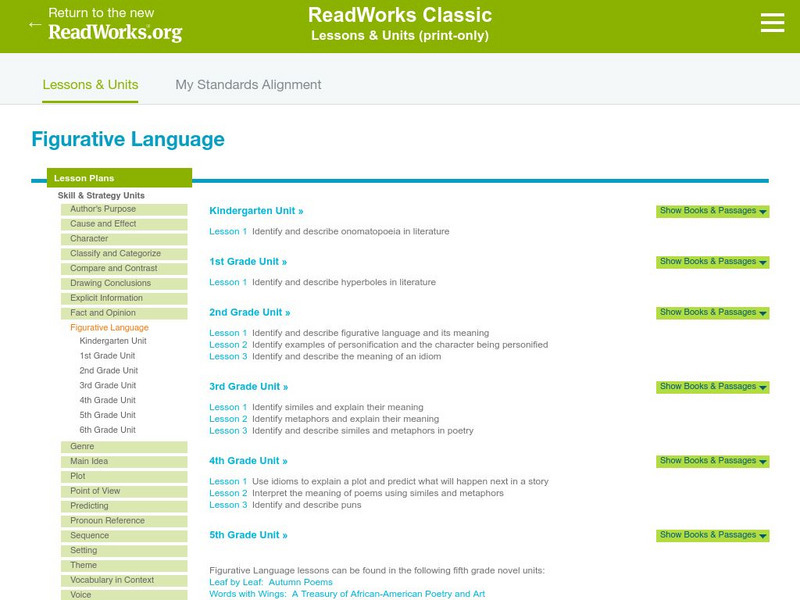
Read Works: Figurative Language
[Free Registration/Login Required] This site contains a collection of passage that include figurative language lessons. Each lesson includes questions to assess student understanding.
E Reading Worksheets
E Reading Worksheets: Figurative Language Worksheets
This learning module provides remediation and extra practice with identifying different types of figurative language. Reinforcement is provided through the worksheets, quizzes, video game links, and online sites for the following types...
E Reading Worksheets
E Reading Worksheets: Figurative Language Examples
Along with definitions for four types of figurative language, this learning module provides numerous examples. Similes, metaphors, personification, and hyperbole are the types of figurative language featured.
Better Lesson
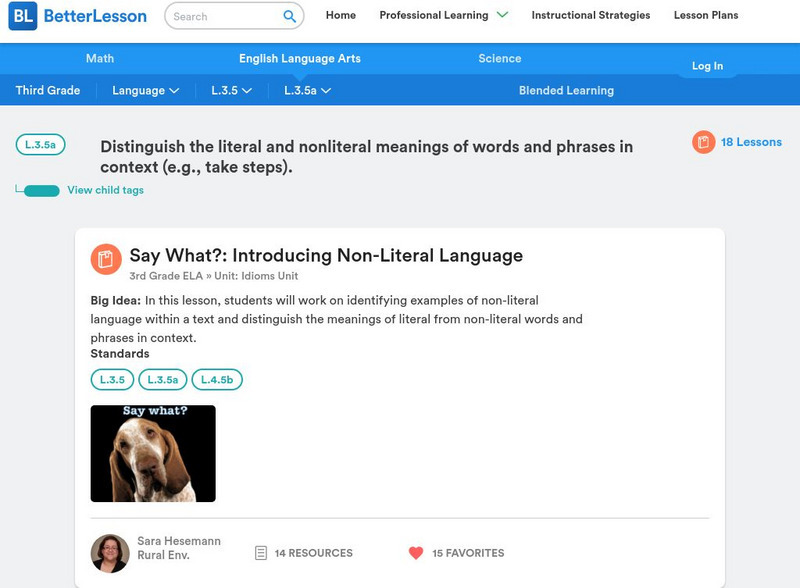
Better Lesson: L.3.5a: Distinguish Literal and Nonliteral Meanings of Words
Links to 18 lessons and activities that build student skills in standard L.3.5a: Distinguish the literal and nonliteral meanings of words and phrases in context (e.g., take steps).
Wikimedia
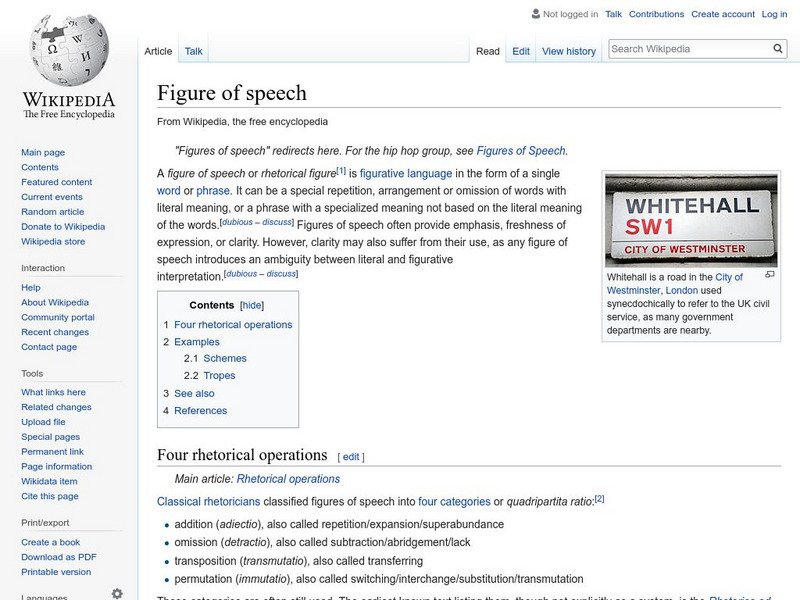
Wikipedia: Figure of Speech
Wikipedia provides a detailed definition of figure of speech, and then includes hyperlinks to different types of figures of speech.
Other
Class Tools: Choose Game Formats: Figurative Language
Pick a game format that you would like to play: "Matching Pairs", "Wordshoot", "Flashcards", "Manic Miner", or "CannonBall Fun". For each game, choose the literal meaning for the figurative language presented. Also available in formats...
E Reading Worksheets
E Reading Worksheets: Simile Worksheets
This site contains figurative language worksheets that assess students' understanding of similes in the context of sentence. After seeing an example, students will fill in the words that are compared in each simile. In addition, students...
E Reading Worksheets
E Reading Worksheets: Idiom Worksheets
This site provides seven worksheets to help students understand idioms and their figurative meanings better. In each exercise, students will explain the meaning of idioms that are embedded into sentences.