Hi, what do you want to do?






Laboratory for Atmospheric and Space Physics
The Planets and Scale
Scholars gain an insight into the relative size of planets and distance between inner and outer planets with the help of informational text, a data table, and a series of four questions.

Odell Education
Scientific Notation
Writing a number is all in the notation. The resource introduces the class to scientific notation. Pupils learn the process of taking a very large or small number in standard form and write it in scientific notation. To practice,...

International Technology Education Association
Tidy Up Those Sloppy Force Fields!
It is just magnetic. This resource presents the concept of Earth's and another planet's magnetic field and how spacecrafts detect them. Learners study a problem using magnetometers and participate in three experiments to come up with a...

International Technology Education Association
Pixel This!
Did the image I drew match the image you saw? By simulating a satellite and a ground station, teams of two transmit data in the form of pixels in order to recreate an image. They use four different levels of brightness, creating slightly...

Curated OER
The Planet Mars
In this worksheet on the planet Mars, students look at a picture of the planet and read accompanying facts, along with a brief paragraph.

Charleston School District
Exploring Linear Functions
What does a graph or equation say about a situation? Lots! The lesson uses the concepts explored in the previous four lessons in the series and applies them to problem solving situations. Learners create an equation from problems posed...

Code.org
The Internet Is for Everyone
What is this thing called the Internet? A KWL activity elicits what the class knows about how the Internet works. Then pupils read a copy of a memo about the need to keep the Internet open and accessible by everyone.

New York State Department of Environmental Conservation
Adaptations – Designs for Survival
What's the difference between behavioral adaptations and physical adaptations? Learn about the various ways that organisms adapt to their environment with a worksheet about the creatures of the Hudson River.

National Institute of Open Schooling
Water Pollution
Fifteen million children under the age of five die each year due to diseases in their drinking water. Water pollution is the topic of lesson 34 in the series of 36. Scholars, through reading and discussing, study numerous aspects of...

Oregon State
World Map of Plate Boundaries
Young geologists piece together the puzzle of plate tectonics in an earth science lesson. Given a physical map of the world, they search for land formations that indicate the location of different types of plate boundaries.

Curated OER
First Land Plants Found on Earth
In this first land plants worksheet, students read about the major events that allowed plants to evolve on Earth. Students read about the primary and secondary atmospheres, the formation of the ozone layer to protect from UV light and...
NASA
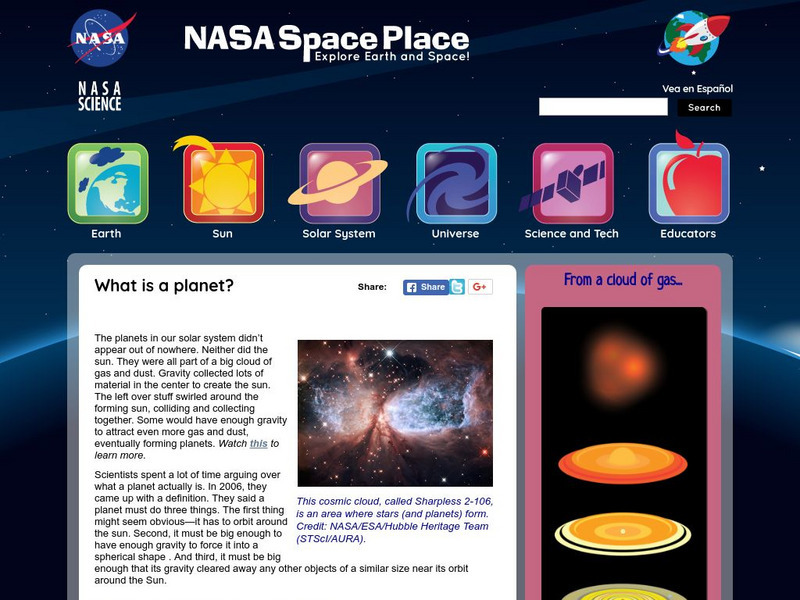
Nasa: Space Place: What Is a Planet?
Explore our solar system's planets- more specifically what planets are made of, and how they are formed.

Khan Academy
Khan Academy: How Our Solar System Formed
An article describing how the sun, planets, moons, and beyond Pluto was formed. Learn more about the beginning of our solar system.
Cosmos 4 kids
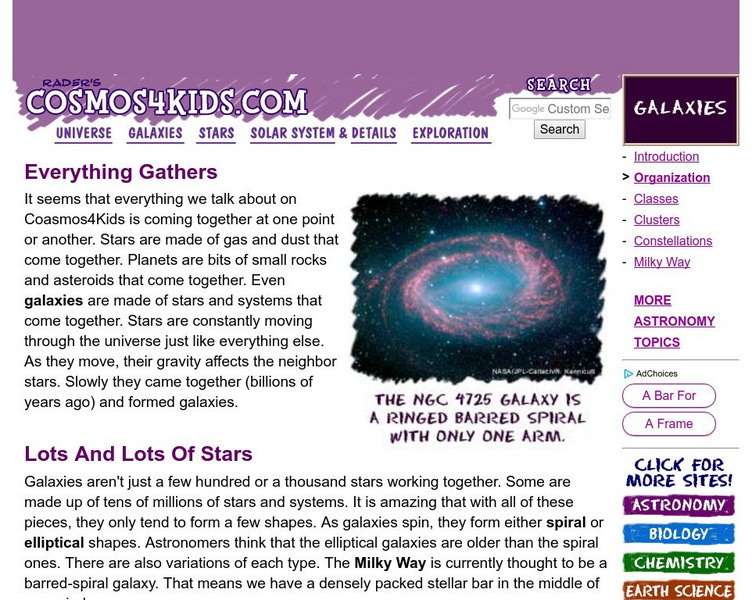
Cosmos4 Kids: Everything Gathers
Understand that smaller parts make up the larger parts of our solar system. See that gas and dust come together to form a star, small rocks and asteroids come together to form planets, and so on. This page is a reference page that...

Other
Monroe County Women's Disability Network: Maps & Globes: Water Forms
This site is provided for by the Monroe County Women's Disability Network. Some basic information about water on our planet and the various water forms that make up three-quarters of the earth's surface. Includes some simple quizzes to...
Georgia State University
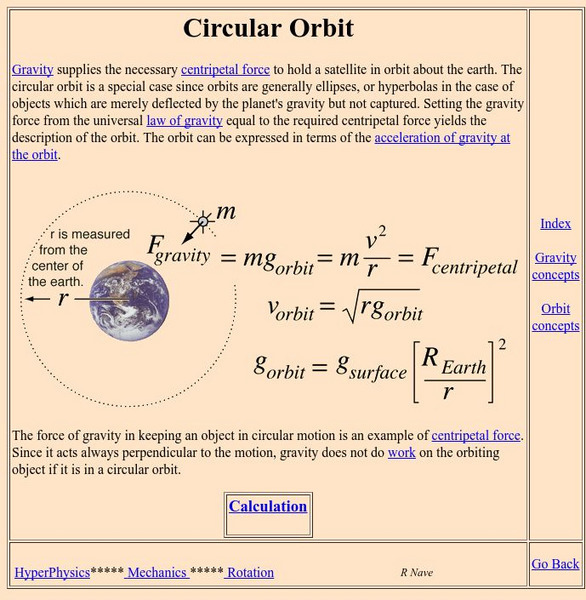
Georgia State University: Hyper Physics: Earth Orbits
An equation for the law of universal gravitation is stated. The weight equation (W=m*g) is related to the law. An interactive JavaScript form allows the user to practice determining the force of gravity and the acceleration of gravity...
Math Planet
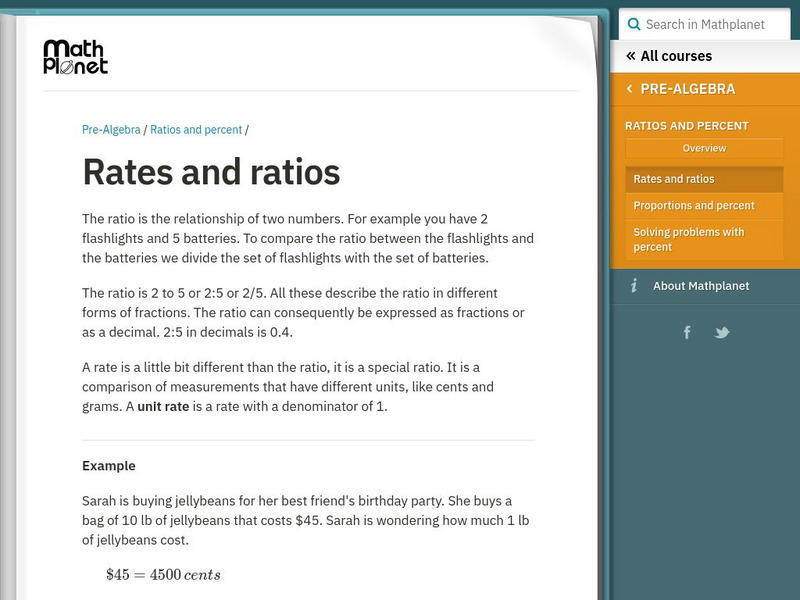
Math Planet: Pre Algebra: Ratios and Percent: Rates and Ratios
Explains what rates and ratios are and how they are different. Shows how to solve an example problem about ratios and presents a video demonstrating how to show a ratio as a fraction or a decimal. [1:52]
Other
Buzzle.com: Help Save Nature: Why Are Glaciers Melting and How Are We Responsible?
Explains what glaciers are and how they form, and discusses the reasons glaciers are melting faster today and what this means for the planet. Includes statistics on the loss of glaciers around the world.