Hi, what do you want to do?






Curated OER
Biotechnology
A continuous cascade of information comes through this PowerPoint on biotechnology. The topic is defined, a history is presented, and basic genetic engineering techniques are explained. The topic is covered in an objective manner,...

Curated OER
Green Genes: Genetically Modified Organisms in Our Food
Students investigate how and why genetically modified organisms are used as food crops. They identify the advantages and disadvantages of these crops through internet research then present their views and discuss them as a large group.

Agriculture in the Classroom
Farmland: GMOs and Organic Agriculture
Learn more about genetic modification, organic farming, and the role of biotechnology in agriculture by watching a documentary that shows how newly gained knowledge can be applied to specific situations involving farmers and the choices...

Curated OER
Food of the Future
Young scholars combine their knowledge of genetics, farming and nutrition to design a genetically engineered food. Students focus on how the food will be improved, how it differs from the original product, what types of modifications...

Curated OER
Kernels of Wisdom: Investigating Natural Variations in Corn
Here is a brain-popper! Corn, or more appropriately, maize, was intentionally domesticated by humans around 9,000 years ago and over a period of hundreds to thousands of years! Genetics and botany researchers have collaborated to find...

Curated OER
What is Biotechnology?
Young consumers explore the concept of biotechnology as it pertains to the foods they eat, economics, and agriculture. They watch several videos, explore a website, complete worksheets, and engage in class discussion. Son they'll know...

Curated OER
Edible GMOs?
The debate over genetically modified organisms is on! Young biologists imagine that they have been asked to choose which corn chips will be sold for a fundraiser, one made with GMOs or one without. This four-day lesson plan requires...

Curated OER
Biotechnology: Monster or Miracle
Students explore biotechnology. In this scenario-based lesson, students take a survey on what they know about genetic engineering, view a PowerPoint, and conduct a web quest. Students will then be placed in groups, and produce one of the...

Curated OER
Peanut Butter Broccoli
Fifth graders explore food production by viewing DNA presentations. In this genetic engineering lesson, 5th graders discuss the foods they typically eat at home and how many common foods are engineered in a way that can produce a bigger...

Curated OER
Plant Science Introduction
A unique PowerPoint explains the basics of plant science. It motivates viewers to study plant science and then lists different food products, biofuels, fibers, timber, and ornamental uses of plants. It concludes with lists of careers...

Curated OER
What is Biotechnology
Students discover the concept of biotechnology. In this biotechnology activity, students explore the history of biotechnology and its implications today.

Curated OER
Field Of Beans
Students investigate the concept of crop farming. They plant small fields to test different theories of agriculture. Students keep care over the fields, including pest and weed control. Students make and record daily observations to...

Popular Science
Popular Science: Something Funny Down on the Pharm
This article investigates the growing industry of pharming, or genetically engineering and growing crops in order to produce pharmaceutical drugs. While there is huge potential for this industry, the article concentrates on the...

CK-12 Foundation
Ck 12: Life Science: Biotechnology in Agriculture
[Free Registration/Login may be required to access all resource tools.] The majority of the corn in the United States is genetically engineered. Corn syrup is used to sweeten many things, like Coke. Corn is also fed to the cows. Learn...
PBS
Pbs Learning Media: Engineer a Crop: Transgenic Manipulation
You're the geneticist now. In this interactive feature developed for the companion Web site for NOVA/FRONTLINE: "Harvest of Fear," use the latest in genetic technology to engineer your own "supercrop" of tomatoes.
Other
Ota: Genetic Engineering and Agriculture
A Q&A published by the Organic Trade Association (OTA) about genetically modified organisms (GMOs). This page expresses many doubts, concerns, and assertions about the use of GMOs in agriculture.
PBS
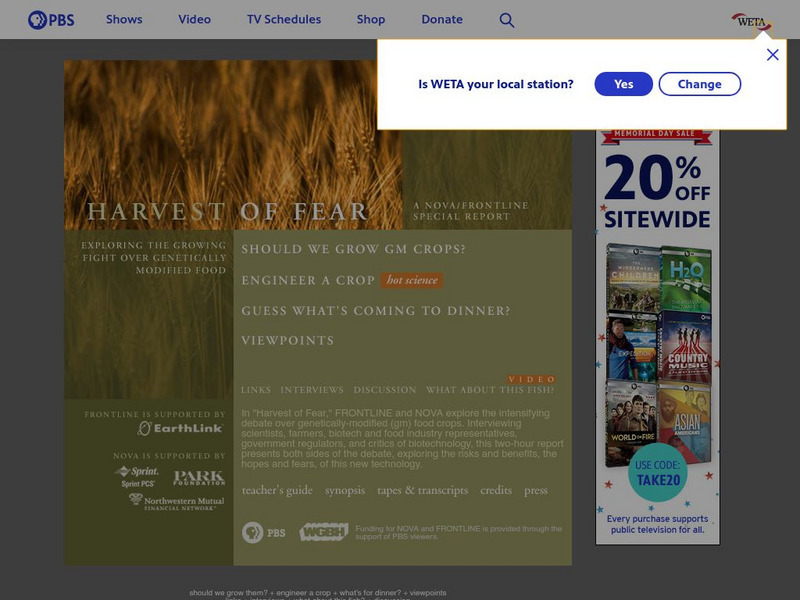
Frontline and Nova: Harvest of Fear
Review the risks, benefits, hopes, and fears associated with biotechnology and bioengineered food crops. Find in-depth interviews with genetic scientists, food industry representatives, farmers, and critics of biotechnology. Accompanying...
PBS
Pbs Teachers: Scientific American: Dragon Science: Food for Thought
Investigate how geneticists use selective breeding to capitalize on hybrid vigor by using colored chips to represent traits in succeeding generations. Use Explain why farmers must buy new hybrid seed each year.
PBS
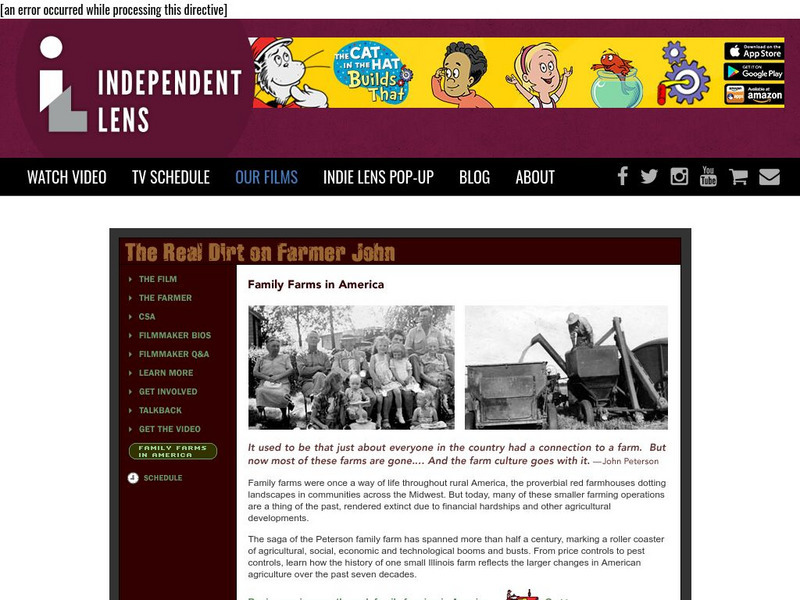
Pbs Teachers: The Real Dirt on Farmer John: Family Farms in America
Trace the evolution in American agriculture with this interactive timeline. Learn how the history of one small Illinois farm reflects the larger changes, decade by decade.

Other
Dna for Dinner?
This WebQuest is designed to help students answer the question, "Should genetically modified food crops be specifically labeled for consumers and why? In answering this questions students will also draft a law and explain their...
Genome British Columbia
Genome British Columbia: Terminator Technology for Gm Crops
In 1998, American scientists developed terminator seeds which grew into plants that were unable to reproduce. While this practice prevents the dangerous flow of genes to the wild, it has some disadvantages, for example, the added expense...
CK-12 Foundation
Ck 12: Life Science: 3.21 Agriculture
Learn how biotechnology can alter crops to change many different phenotypes of plants.