Hi, what do you want to do?






Illustrative Mathematics
The Geometry of Letters
Use the alphabet as a tool for teaching your class about geometric figures. Break apart capital letters into line segments and arcs. Classify angles as right, acute, or obtuse. Identify parallel and perpendicular lines. An excellent...

Curated OER
Congruent Segments
The task, should your class decide to take it, is to list a series of reflections that transfer a line segment from one position to another.

Concord Consortium
Short Pappus
It's all Greek to me. Scholars work a task that Greeks first formulated for an ancient math challenge. Provided with an angle and a point inside the angle, scholars develop conjectures about what is true about the shortest line segment...

Curated OER
Tangent Lines and the Radius of a Circle
Your Geometry learners will collaboratively prove that the tangent line of a circle is perpendicular to the radius of the circle. A deliberately sparse introduction allows for a variety of approaches to find a solution.

EngageNY
Fundamental Theorem of Similarity (FTS)
How do dilated line segments relate? Lead the class in an activity to determine the relationship between line segments and their dilated images. In the fourth section in a unit of 16, pupils discover the dilated line...

Virginia Department of Education
Angles, Arcs, and Segments in Circles
Investigate relationships between angles, arcs, and segments in circles. Pupils use geometry software to discover the relationships between angles, arcs, and segments associated with circles. Class members use similar triangles to...

Mathematics Assessment Project
Square
Don't be a square! Young mathematicians determine the slope and length of a line segment. They then prove whether four given coordinate points form a square.

Inside Mathematics
Circles in Triangles
Challenge the class with inscribed circles in triangles. The assessment task requests class members use their knowledge of circles and right triangles to prove two triangles are congruent. They go on to utilize their knowledge of...

Illustrative Mathematics
Dilating a Line
High School geometers verify through experimentation certain properties about dilations. This multi-step problem challenges them to construct examples of dilations to verify specific facts, the final step provides an opportunity to more...

EngageNY
Distance and Complex Numbers 2
Classmates apply midpoint concepts by leapfrogging around the complex plane. The 12th lesson in a 32 segment unit, asks pupils to apply distances and midpoints in relationship to two complex numbers. The class develops a formula to find...

Curated OER
Unit Squares and Triangles
This is an interesting geometry problem. Given the figure, find the area of a triangle that is created by the intersecting lines. The solution requires one to use what he/she knows about coordinate geometry, as well as triangle...

Inside Mathematics
Quadrilaterals
What figure is formed by connecting the midpoints of the sides of a quadrilateral? The geometry assessment task has class members work through the process of determining the figure inscribed in a quadrilateral. Pupils use geometric...

Curated OER
Inscribing a Square in a Circle
Inscribing a square in a circle brings up a number of interesting geometry topics including triangle congruence and how to prove a quadrilateral is a square. This activity is followed up by finding the area of the square and determining...

EngageNY
Mid-Module Assessment Task - Geometry (Module 2)
Challenge: create an assessment that features higher level thinking from beginning to end. A ready-made test assesses knowledge of dilations using performance tasks. Every question requires a developed written response.

Concord Consortium
Divisions
Divide and conquer the geometry problem. Young scholars consider how to subdivide triangles into smaller ones that have equal areas. They must apply their knowledge of medians to help accomplish the task.

EngageNY
Informal Proof of AA Criterion for Similarity
What does it take to show two triangles are similar? The 11th segment in a series of 16 introduces the AA Criterion for Similarity. A discussion provides an informal proof of the theorem. Exercises and problems require scholars to apply...

Curated OER
Point Reflection
Use this task as an exit ticket for your eight graders during the geometry unit. All they need to do is identify the coordinates of a point reflected over y=2000.

Curated OER
Circumcenter of a Triangle
Your geometry learners will discover and show the construction of the circumcenter of a triangle. Guided by the steps in the activity, they construct perpendicular bisectors of each side that have a point of concurrency called the...

Balanced Assessment
Shirts and Flags
Learn the importance of geometry to tailors. Given a shirt sewing pattern, scholars determine the actual size of the shirt. After which they answer questions that require problem solving and extending their understanding of scale.

EngageNY
What Lies Behind “Same Shape”?
Develop a more precise definition of similar. The lesson begins with an informal definition of similar figures and develops the need to be more precise. The class learns about dilations and uses that knowledge to arrive at a...

Illustrative Mathematics
Tangent to a Circle From a Point
Learners see application of construction techniques in a short but sophisticated problem. Combining the properties of inscribed triangles with tangent lines and radii makes a nice bridge between units, a way of using...

Illustrative Mathematics
Satellite
Learners practice relating rules of trigonometry and properties of circles. With a few simplifying assumptions such as a perfectly round earth, young mathematicians calculate the lengths of various paths between satellite and...

Curated OER
A Rectangle in the Coordinate Plane
A quadrilateral is drawn on the coordinate plane, and eighth grade geometers find the length of each side and the diagonals by applying the Pythagorean theorem.
Mr. Martini's Classroom
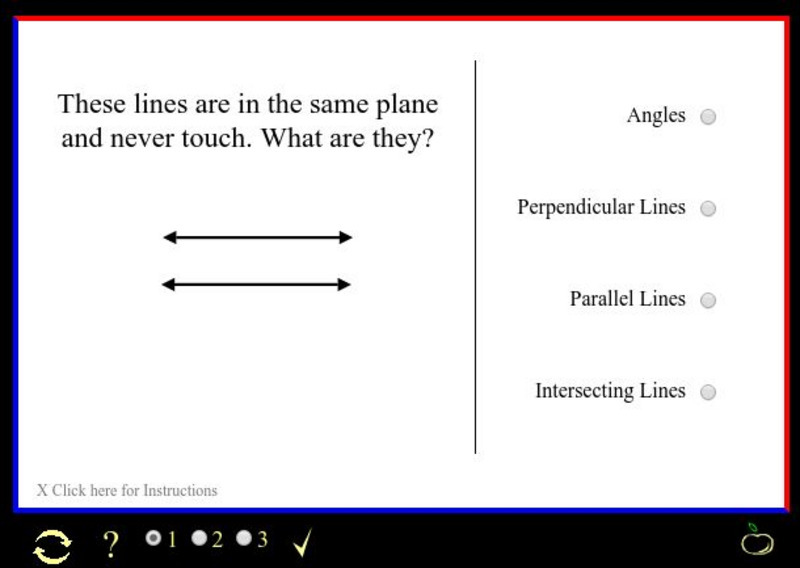
Mr. Martini's Classroom: Basic Geometry: Points, Lines, and Angles
Students can review basic geometric terms using these self-check, multiple choice questions. Three levels of questions are provided.