Hi, what do you want to do?






Texas State Energy Conservation Office
Investigation: Insulation
Youngsters compare the heat-holding abilities of three different cans by insulating two with different materials and measuring the temperature change of hot water over a 20-minute period.

PBS
Insulation Station
It's all about the material. Learners experiment with different substances as they try to keep an ice cube from melting. They draw conclusions by answering a set of questions about the types and amount of material that had the best result.

Curated OER
Heat: The Transfer of Thermal Energy
In this heat worksheet, students complete experiments with heat and answer short answer questions about the transfer of thermal energy. Students complete 4 questions, one chart, and one bar graph.

DiscoverE
Keep-a-Cube
Waxed paper, newspaper, or aluminum foil? Keeping an ice cube from melting may require one or more of these materials. Learners design a box that will provide insulation so an ice cube stays intact for at least 90 minutes.

Discovery Education
Cool It!
Adjust the melting time of ice without varying the temperature! Learners experiment with different materials to decide how the materials affect the rate an ice cube melts. They then connect their findings to the conductivity of each...

DiscoverE
At Home: Keep a Cube Activity
Let cooler heads prevail. Future engineers first learn about heat transfer and insulation. They then design and build a contraption that will prevent an ice cube from melting for as long as possible.

DiscoverE
Aviary Architect
Groups of two to four work collaboratively to engineer a birdhouse that will stay cool in the summer heat. Teams examine several different-colored roofs, testing the efficiency of each with a heat lamp. Then, groups sketch their ideas,...

Texas State Energy Conservation Office
Investigation: Conservation of Energy
By rolling marbles down a six-foot length of track, physical scientists determine how much energy is lost to heat. It is recommended that you opt for the foam pipe insulation track because more friction slows the marble, allowing...

DiscoverE
Squishy Circuits
Make electricity flow through Play-Doh. Individuals create animals or other creatures using Play-Doh. The engineering aspect? Eyes that light up and Play-Doh that conducts electricity.

Discovery Education
It's Melting!
It's a race to the finish! Which ice cube will melt the fastest? Scholars discover the effect thermal energy has on melting ice. They experiment with melting ice cubes on different materials and learn that even at a consistent...

American Museum of Natural History
Rubber Blubber Gloves
Using gloves, shortening, tape, and a lot of ice, participants experience the feeling of having blubber. The experiment's eight steps follow an informative page about blubber and animals that have it.

Parenting Exchange
Snow Activities Let Children Explore the Wonders of Weather
Just because there's snow on the ground, it doesn't mean you can't go out and play. Take full advantage of the wonderful winter weather with this collection of fun snow day activities.
TeachEngineering
Teach Engineering: What Is the Best Insulator: Air, Styrofoam, Foil, or Cotton?
That heat flows from hot to cold is an unfortunate truth of life. People have put a lot of effort into stopping this fact, however all they have been able to do is slow the process. Working in groups of three to four, students will...
TeachEngineering
Teach Engineering: Insulation Materials Investigation
Students test the insulation properties of different materials by timing how long it takes ice cubes to melt in the presence of various insulating materials. Students learn about the role that thermal insulation materials can play in...

Science Buddies
Science Buddies: Which Is the Better Insulation Material?
You've probably noticed that the price of gasoline can fluctuate a great deal from one year to the next. Using good insulation material is one way to conserve energy and save money. Learn here which insulation materials work better than...
TeachEngineering
Teach Engineering: Stop Heat From Escaping
One way to conserve energy in a building is to use adequate insulation. Insulation helps keep the hot or cool air inside or outside of a building. Inefficient heating and cooling of buildings is a leading residential and industrial...
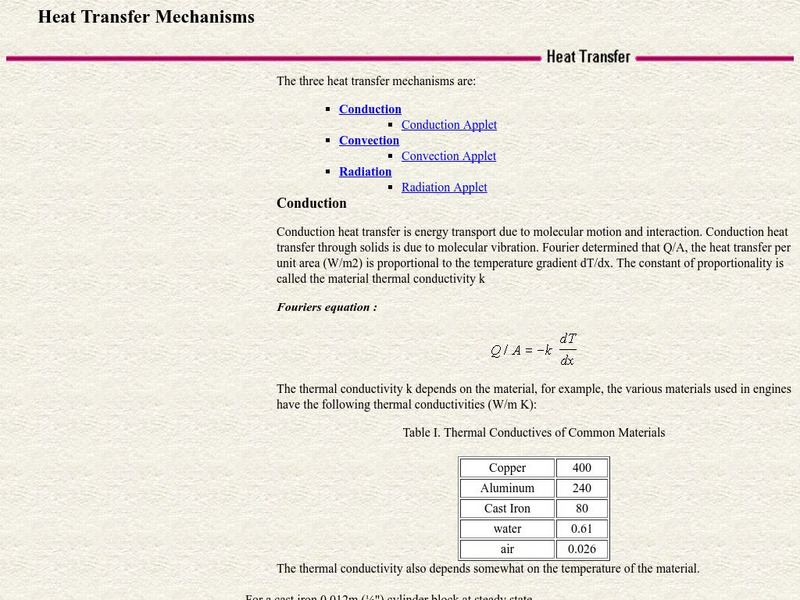
Colorado State University
Csu: Heat Transfer Mechanisms
An excellent page from the Colorado State University with a heavy mathematical emphasis. Each form of heat transfer--conduction, convection, and radiation--is defined, compared, and contrasted. Mathematical equations governing the rates...
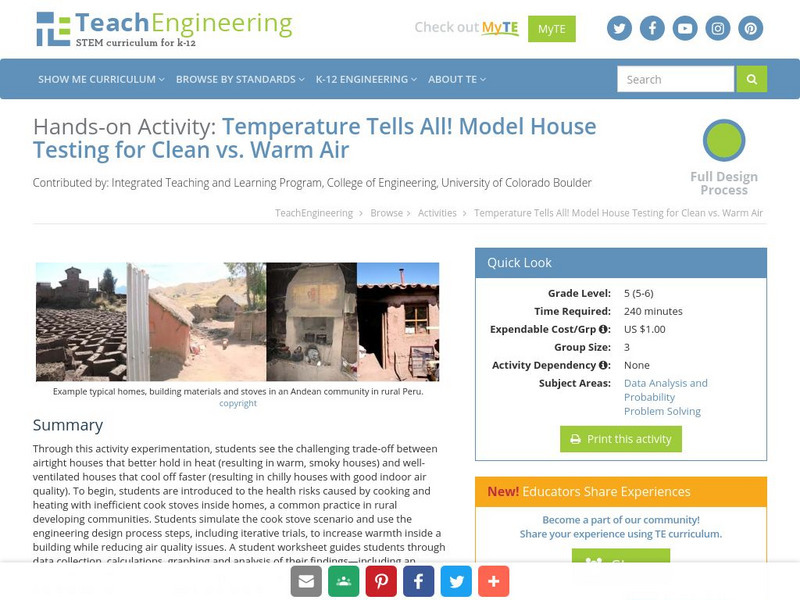
TeachEngineering
Teach Engineering: Temperature Tells All!
Students are introduced to the health risks caused by cooking and heating with inefficient cook stoves inside homes, a common practice in rural developing communities. Students simulate the cook stove scenario and use the engineering...
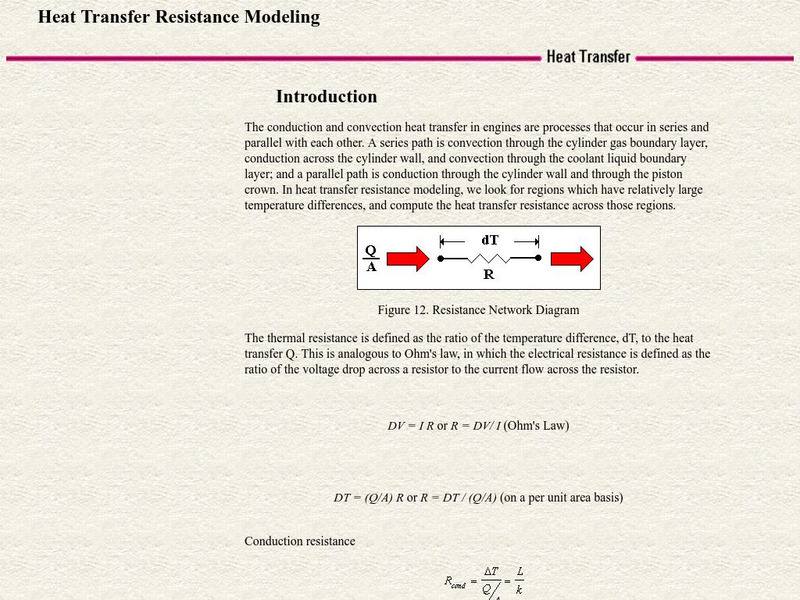
Colorado State University
Colorado State Univ.: Heat Transfer Resistance Modeling
This site from the Colorado State University discusses the tranfer of heat by conduction and convection. Discussion centers around the application of these two heat transfer mechanisms to engines. The variables that effect the resistance...

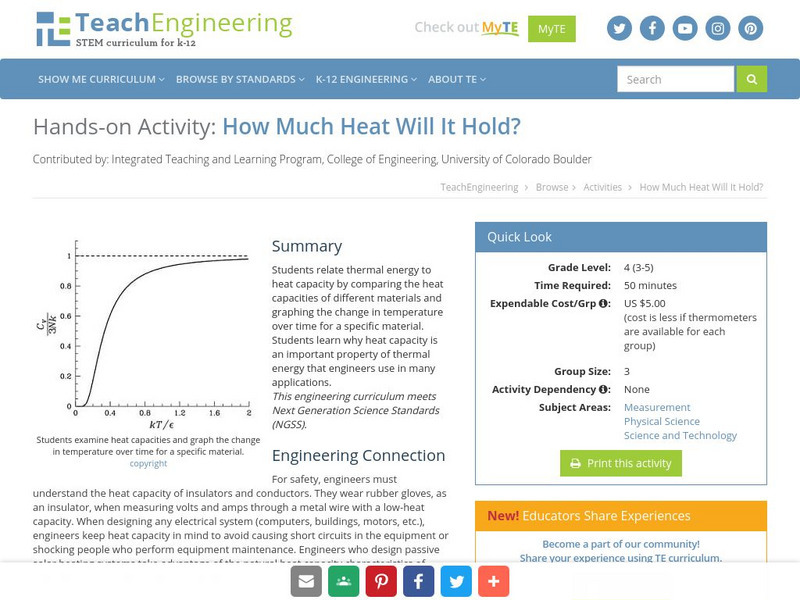
TeachEngineering
Teach Engineering: How Much Heat Will It Hold?
Students relate thermal energy to heat capacity by comparing the heat capacities of different materials and graphing the change in temperature over time for a specific material. Students learn why heat capacity is an important property...
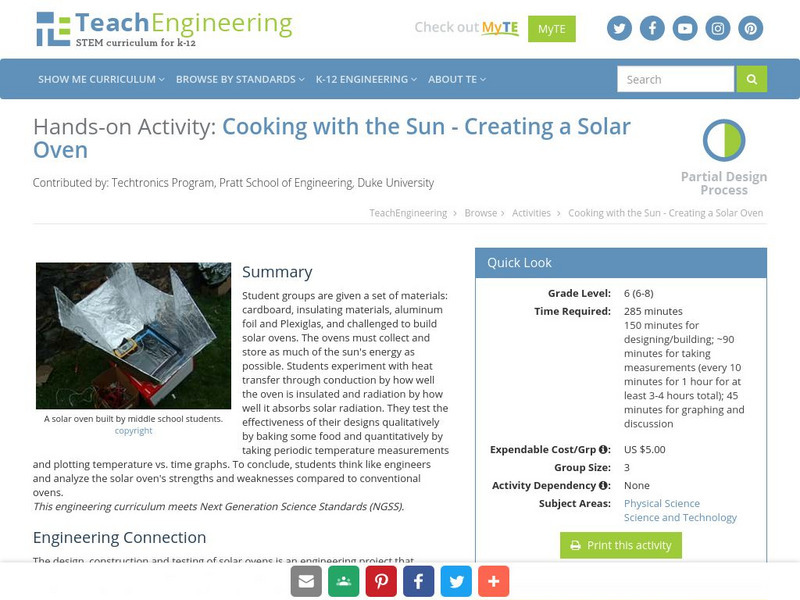
TeachEngineering
Teach Engineering: Cooking With the Sun Creating a Solar Oven
For this activity, students will be given a set of materials: cardboard, a set of insulating materials (i.e. foam, newspaper, etc.), aluminum foil, and Plexiglas. Students will then become engineers in building a solar oven from the...
TeachEngineering
Teach Engineering: Zero Energy Housing
Students investigate passive solar building design with a focus solely on heating. They learn how insulation, window placement, thermal mass, surface colors, and site orientation play important roles in passive solar heating. They use...
TeachEngineering
Teach Engineering: Keep It Hot!
Student teams design insulated beverage bottles in this challenge, and test them to determine which materials work best at insulating hot water to keep it warm for as long as possible.