Hi, what do you want to do?






Curated OER
Kernels of Wisdom: Investigating Natural Variations in Corn
Here is a brain-popper! Corn, or more appropriately, maize, was intentionally domesticated by humans around 9,000 years ago and over a period of hundreds to thousands of years! Genetics and botany researchers have collaborated to find...

Curated OER
1950’s American Culture: Television, Fashion, and Music
Sixth graders investigate the impact of popular culture on Americans. In this 1950's America lesson, 6th graders view television clips, listen to audio clips, and look over fashion photographs from the decade. Students then discuss...

University of Northern Iowa
Clothing
As part of an investigation of the folk traditions of their area, class members research the articles of clothing worn at earlier times, the fibers and materials, and the machinery used to produce these items. In addition, class...

Curated OER
Levittown, Automobiles, and Cultures of the 1950's
Young scholars investigate the impact of the automobile on Americans. In this 1950's America lesson, students listen to audio clips, read about Levittown, and explore the Interstate Highway Act from the decade. Young scholars then...

Curated OER
Radio Program #7: The Impact of Early Radio
Pupils examine and interpret the experiences of persons who lived in the early days of radio. identify the technology, program content, and social aspects of early radio listeners. They interview parents for their experiences. Students...

Curated OER
South Carolina Crazy Paper Quilt of Facts
Third graders listen as the teacher reads a book about quilts, before they discuss the craftsmanship used in making quilts. They study the regions and symbols associated with their state. They make a quilt square using one of the facts...

Curated OER
The Farmer Cares for the Land
Learners explore farming by creating visual demonstrations. In this agriculture instructional activity, students read assigned text about a farmer's duty and identify the events that have taken place in the history of agriculture....

Curated OER
Fly, Fly Away
Learners use materials from their own environment to design a kite. In this kite design lesson, students research the history of kites and obtain a formal mathematical definition of a kite. Learners sketch kite designs after discovering...

Curated OER
The Magic Apple
A fun and delicious lesson can help your kids learn about plural nouns and story sequencing. After reading The Magic Apple by Rob Cleveland, kids match pictures to story segments and add s to nouns to make them plural....

Council for Economic Education
Did You Get the Message?
Students investigate how advertising gets the buyer's attention and how it influences buying decisions. They then create a print ad for "Burp Cola" and for one of their favorite books.

Curated OER
Distinguish Communities by Their Architecture
Students distinguish between a rural community and a city community by observing the architecture in each one. They observe and discuss pictures of buildings. Students write a paragraph explaining the purpose of a particular building....

Curated OER
VH1 Classic Presents: Paul McCartney: Chaos and Creation in the Backyard, Lesson 1
Students explore the role and responsibilities of a music producer in music production. They listen to two versions of Paul McCartney's"The Long and Winding Road," and describe the differences between them in terms of their production. ...

Curated OER
Prints and Patterns
Students learn the art of lifting a fingerprint and write about the procedure.

Curated OER
Shopping Bag Challenge
Students design a shopping bag that will allow the consumer to immediately identify the store and understand the product that is being sold. They create an advertisement for a new shopping bag. Students choose their type of business to...

Curated OER
Trekking to Timbuktu: The Search for Timbuktu
Learners explore the factors that contributed to the decline of Timbuktu and the myths and misconceptions about the city. Students study the obstacles that made a journey to Timbuktu a difficult one as well as discover the first European...

Curated OER
FINANCE AND RESPONSIBLE LENDING.
Students study the role of banks, lending and their services. In this analysis lesson, students learn about savings, checking accounts and lending and the importance of banks as financial intermediaries.

Curated OER
The Day Before
Students explore the impact a major event has on people and on history as their team selects an event and publishes their own magazine to recreate the times in which such an event occurred.

Curated OER
Cashton Community Quilters
Fourth graders create and construct a fabric quilt symbolizing the heritage of the Wisconsin community of Cashton. They research Wisconsin historical symbols and use math skills to calculate the number and sizes of the quilt squares. ...

Curated OER
Energy Crossword Puzzle
In this energy crossword worksheet, students read 36 clues pertaining to energy conservation. Students fit their answers in a crossword puzzle. There is no word bank.

Library of Congress
Loc: Television Advertising: A Brief History
Discusses the history of television advertising. Includes the following sections: "Radio Precedents," "The Single-sponsor Era," and "The Triumph of the Magazine Concept."

A&E Television
History.com: What's the Real History of Black Friday?
The retail bonanza known as Black Friday is now an integral part of many Thanksgiving celebrations, but this holiday tradition has darker roots than you might imagine. This article discusses several myths as to the term Black Friday....

Library of Congress
Loc: Today in History: August 19: British Troops Land in Maryland & Television
An account from the Library of Congress of the famous burning of Washington where Dolley Madison saved priceless treasures from the White House minutes before the British entered the city as well as other historical events, including...
Other
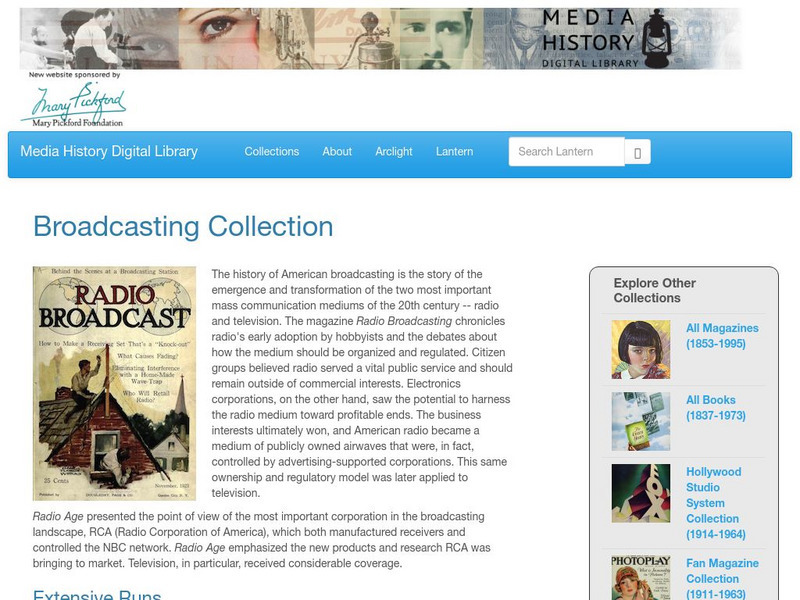
Media History Digital Library: Broadcasting and Recorded Sound Collection
A large collection of original magazines that document the evolution of the American broadcasting industry from 1896 to 1964, covering radio, television, and motion pictures.
National High Magnetic Field Laboratory
Magnet Academy: Iconoscope 1923
American inventor Vladimir Zworykin, the "father of television," conceived two components key to that invention: the iconoscope and the kinescope.