Curated OER
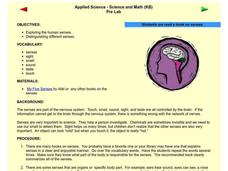
My Five Senses
Students investigate the five senses. In this senses instructional activity, students explore the nervous system. Students examine how the body receives information through the five senses.
Curated OER
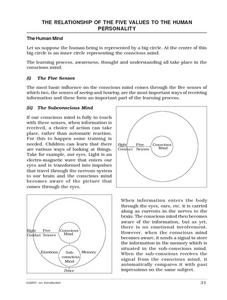
The Relationship of the Five Values to the Human Personality
Students are introduced to the five senses and how they are sorted throughout the brain. After reading about each type of mind, they discuss ways in which they can focus on each one on a daily basis. As a class, they discover ways in...

Curated OER
Seeing the Seafloor Using Sound - Multibeam Sidescan Sonar
Students are told that sound is not just stuff that our ears hear. They are explained that it is a tool for measuring and looking at objects in a new way. Students are introduced to sound waves and sonar imaging. They are explained...
Curated OER
Genetic Research: Decisions to be Made
Students examine the genetics involved in the human genome. They brainstorm the advantages and disadvantages to this discovery. They research different experts opinion and write a case study which addresses an ethical dilemma.
Curated OER
Developing Environmental Awareness Through Problem Solving
Students examine the relationships among living and non-living parts of the environment. Using their senses, they identify the objects in their classroom. In groups, they participate in experiments to discover where electricity comes...

Curated OER
Marine Mammal Diving Reflex
Tenth graders discuss marine mammal diving reflex, and measure pulse rate while holding their breath under three conditions: control, warm water, and ice water to determine if humans exhibit marine mammal diving reflex.
Curated OER
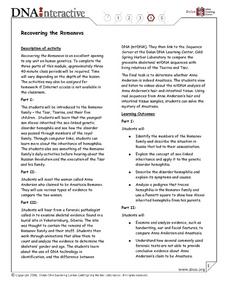
Recovering the Romanovs
Students use DNA to solve an identity mystery. In this biology activity, students use the Internet to gather information about sex-linked disorders and complete a Punnett square for hemophilia, then examine a handwriting analysis, ear...
Curated OER
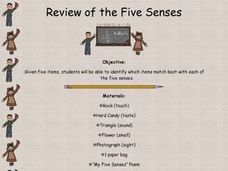
Review of the Five Senses
Students investigate the five senses. In this human biology activity, students are given five items and identify which items match best with each of the senses. Students use objects such as a rock, hard candy, and a flower.
Curated OER
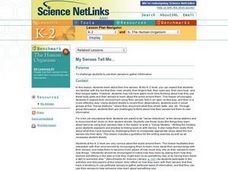
My Senses Tell Me...
Students explore how to use their sense to draw conclusions. In this human biology lesson, students use their senses to observe various objects in learning centers. The centers include tasting salt, touching sandpaper, hearing bells...

Kenan Fellows
Evaluating Sensors and the Impacts of Physiological Stress: Designing a Wearable Device for Rescue Workers
A long-term project has scholars consider ways in which sensors help monitor physiological stress levels of rescue workers. They design and create a portable device for this purpose. Techies to the rescue!
Curated OER
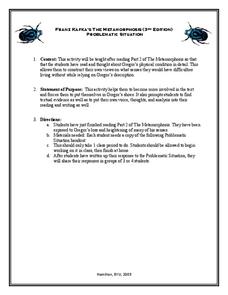
The Metamorphosis: Problematic Situation
Are you enjoying the use of all five senses? Imagine that you have to lose one of them; you can choose which one, but it's gone forever. Work through a lesson based on Franz Kafka's The Metamorphosis that asks class...

Curated OER
Portrait Part Collage
Fifth graders study the concept of self-potraiture using examples. They create their own portraits that are put into a class collage. The skills of working cooperatively with art and appreciation of classmate's work is practiced.
Curated OER
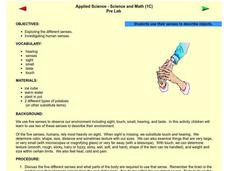
Applied Science - Science and Math Pre Lab
Students explore human senses. In this applied Science lesson, students utilize their senses to distinguish various objects. Students explain their descriptions.
Curated OER
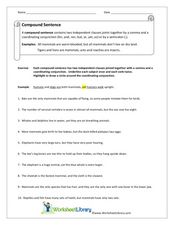
Compound Sentence
In this sentence structure worksheet, students review a definition and examples of compound sentences prior to responding to 10 questions that require them to label the parts of compound sentences.
Curated OER
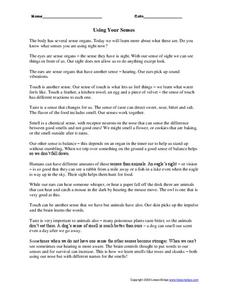
Using Your Senses
In this using your senses worksheet, students read a 1 page article on senses and then connect 6 body parts to their actual senses by drawing a line from one to the other.

Curated OER
Hair and Eye Color
In this human biology interactive worksheet, students identify the color of hair and eyes in each illustration by choosing the appropriate color from the drop down menu. There are four questions to complete, as well as a crossword puzzle.
Curated OER
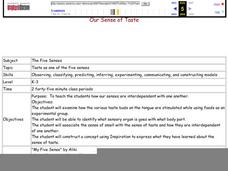
Our Sense of Taste
Students explore the relationship between the senses of taste and smell using a blindfold taste test. In partners, they taste different foods with their noses plugged and unplugged. They create a life size outline of the human body to...
Curated OER
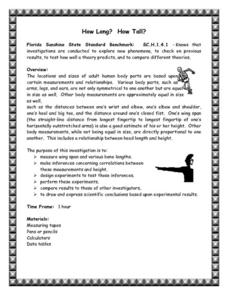
How Long? How Tall?
Seventh graders investigate the parts of the human body and examine the symmetry of body parts like arms and legs. They measure the body parts and take individual height and weight to compare the quantities. Student examine whether the...
Curated OER
Future Body
Young scholars explain the benefits of cyborg augmentation. In this technology lesson plan, students research how the nervous system works. They create posters and present them to class.

Curated OER
Simple and Complete Subjects
In this grammar practice worksheet, students respond to 5 fill in the blank and 13 short answer questions that require them to identify simple and complete subjects and predicates.
Curated OER
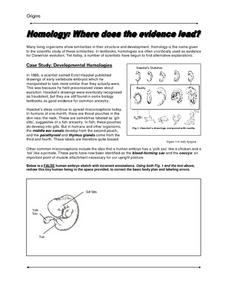
Homology: Where Does The Evidence Lead
High schoolers are introduced to the topic of homology. In groups, they read a case study and compare different drawings of early vertebrate emryos. They work together to answer discussion questions and label the various parts of each...
Curated OER
Music
Third graders study sound waves and vibrations. They sing a silly round in three parts.

Curated OER
Digestive System
In this digestive system worksheet, students answer a list of true/ false questions. The students answer questions based on their knowledge of each process of the digestive system.

Curated OER
Sound Waves
Using a karaoke machine, a guitar, and other devices, learners explore the way sound waves travel. Using this hands on approach, learners can get a better understanding of wavelength, frequency, and more.