Hi, what do you want to do?






Foundation for Water & Energy Education
How is Flowing Water an Energy Source? Activity A
Here is a fun little exploration of the potential energy potential of falling water. Learners drop water from various heights using a straw, and they analyze the diameter of the splash. Pair this with two more activities of the same...

Foundation for Water & Energy Education
How Can Work Be Done with Water Power? Activity B
In this second of three activities, energy engineers plan and create a hydropower dam as they learn how hydroelectric power plants generate electricity. A hydropower puzzle is also included, which can be worked on by teams that finish...

Foundation for Water & Energy Education
How Can Work Be Done with Water Power? Activity C
Third in a set of lessons regarding reservoirs, dams, and hydropower, this involves a two-day hydropower plant simulation. Collaborative groups build, maintain, and finance the plant. The transparency of the reservoir setup can be...

Foundation for Water & Energy Education
How Can Work Be Done with Water Power? Activity A
Environmentally friendly engineering teams construct a water wheel and experiment with its speed and the resulting amount of weight it can lift. Consider following this activity with two more of the same title by the same publisher when...

Foundation for Water & Energy Education
How is Flowing Water an Energy Source? Activity B
Explore the world's water without leaving the classroom! In this second of three uncomplicated but wonderful activities, physical science learners feel the pressure of water. They discover that the deeper the water, the stronger the...

Foundation for Water & Energy Education
How is Flowing Water an Energy Source? Activity C
Can the force of falling water through a tube vary by altering the diameter of the tube or its height? That is what physical scientists aim to discover in this activity, the third in successively more revealing activities on the power of...

Teach Engineering
Win that Bid! Selling Your Power Solution
Power up! Class members research a type of power production using a great resource featuring a real-world problem. Groups select a type of power generation and pretend that they represent an engineering firm for their chosen power type....

Society of Petroleum Engineers
Renewable and Nonrenewable Energy
Energize an environmental science unit on natural resources with this collection of instructional materials. From simple coloring sheets for primary grade children, to guiding questions for a high school research...

Forest Foundation
The Sustainable Forest
As part of their examination of forest ecosystems, class members examine how foresters, biologists, botanists, geologists, and hydrologists work to together to develop a management plan for sustainable forests.

Texas State Energy Conservation Office
Investigation: Kinetic and Potential Energy
A well-developed lab sheet guides physical science learners through an investigation of kinetic and potential energy. In small groups, collaborators discover whether or not the ramp height or mass of an object has an effect on the...

DiscoverE
Working with Watermills
Water is a powerful force; harness it through watermills. The task at hand is to create a simple watermill that functions in flowing water for at least three minutes. Scholars work together in teams to design and construct such a...

Smarter Balanced
Renewable Energy
Renewable and non-renewable energy sources are the focus of a series of activities that prepare learners for a performance task assessment on energy. Groups identify the various sources of energy and classify these sources as either...
US Department of Energy
U.s. Department of Energy: Water Power Program: Types of Hydropower Plants
Learn about the three types of hydroelectric power plants used to capture the energy from water at a hydropower dam site.

Science Buddies
Science Buddies: Put Your Water to Work: Using Hydropower to Lift a Load
Water creates a lot of energy, just look at the Grand Canyon. In this science fair project, you will demonstrate the power of water by converting the kinetic energy in moving water to mechanical energy, which will lift a small weight.
TeachEngineering
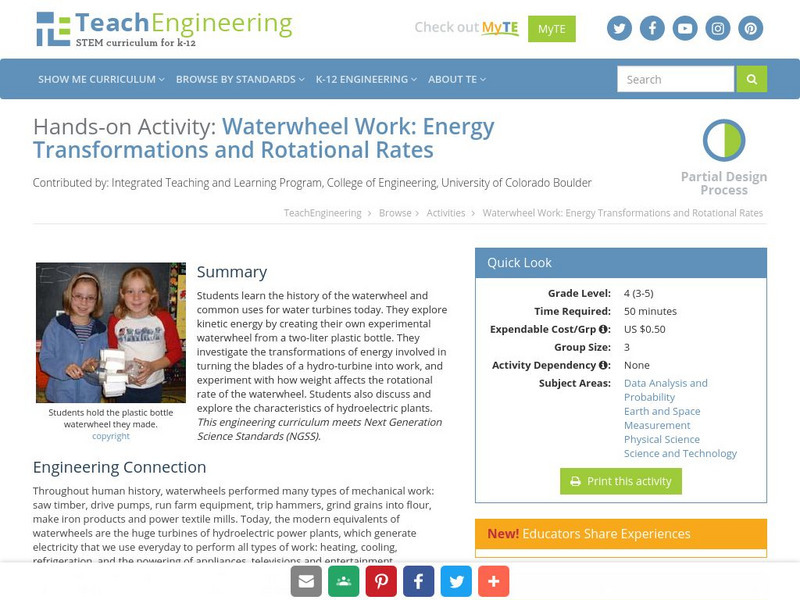
Teach Engineering: Waterwheel Work
Students learn the history of the waterwheel and common uses for water turbines today. They explore kinetic energy by creating their own experimental waterwheel from a two-liter plastic bottle. They investigate the transformations of...

TeachEngineering
Teach Engineering: Falling Water
Students drop water from different heights to demonstrate the conversion of water's potential energy to kinetic energy. They see how varying the height from which water is dropped affects the splash size. They follow good experiment...

Technovation
Curiosity Machine: Challenges: Build a Hydroelectric Waterwheel
Can you generate electricity from the flow of water by designing a waterwheel? In this challenge, students will be using everyday objects to create their waterwheel. This site contains a lesson plan, tips, and a place for students to...
Science Buddies
Science Buddies: Leaky Clues to Dam Design: How Reservoir Height Affects Hydroel
It's hard to believe that the same water that you use every day to quench your thirst, cook with, bathe in, swim in, and wash your clothes and dishes, is capable of another trick-it can make electricity. Electricity can be generated...
TeachEngineering
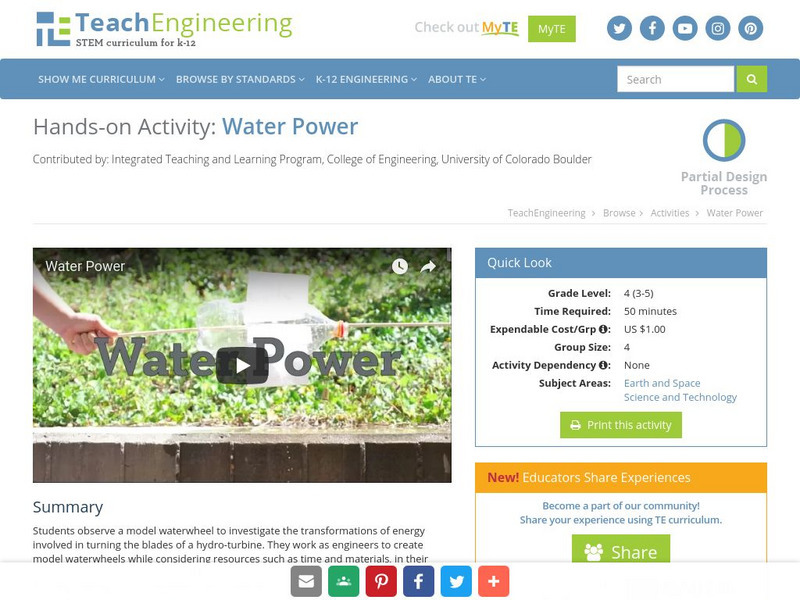
Teach Engineering: Water Power
In this activity, students observe a model of a waterwheel to investigate the transformations of energy involved in turning the blades of a hydro-turbine into work. Students work as engineers to create a model for a new waterwheel while...
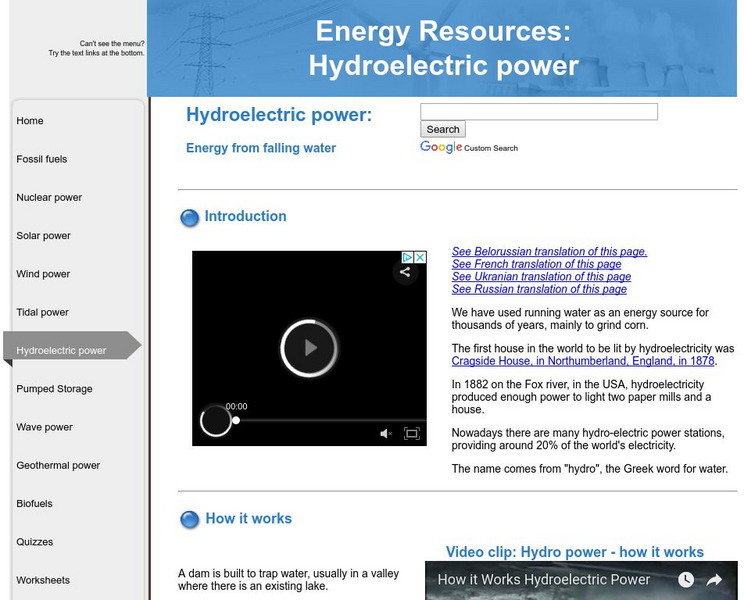
Other
Energy Resources: Hydro Electric Power
Alternative forms of energy site showcases Hydro-electric power. Discover how it works, it's advantages and disadvantages as well as whether or not it's considered to be a renewable resource.
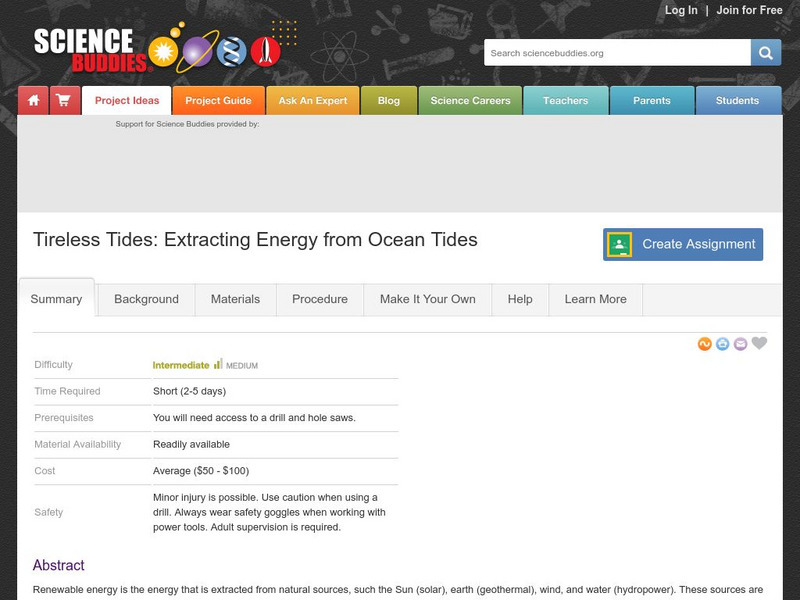
Science Buddies
Science Buddies: Tireless Tides: Extracting Energy From Ocean Tides
Renewable energy is the energy that is extracted from natural sources, such the Sun (solar), earth (geothermal), wind, and water (hydropower). These sources are renewable because they can be replenished by the same natural sources within...
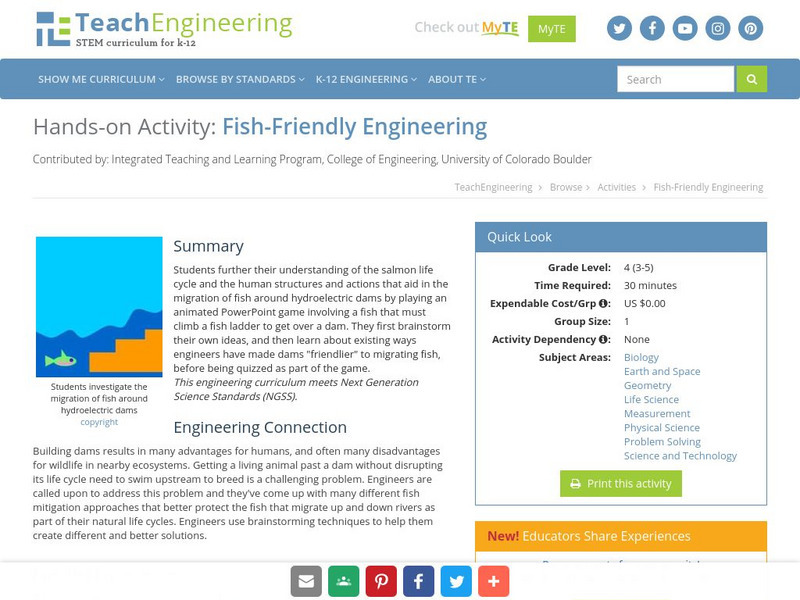
TeachEngineering
Teach Engineering: Fish Friendly Engineering
Students further their understanding of the salmon life cycle and the human structures and actions that aid in the migration of fish around hydroelectric dams by playing an animated PowerPoint game involving a fish that must climb a fish...
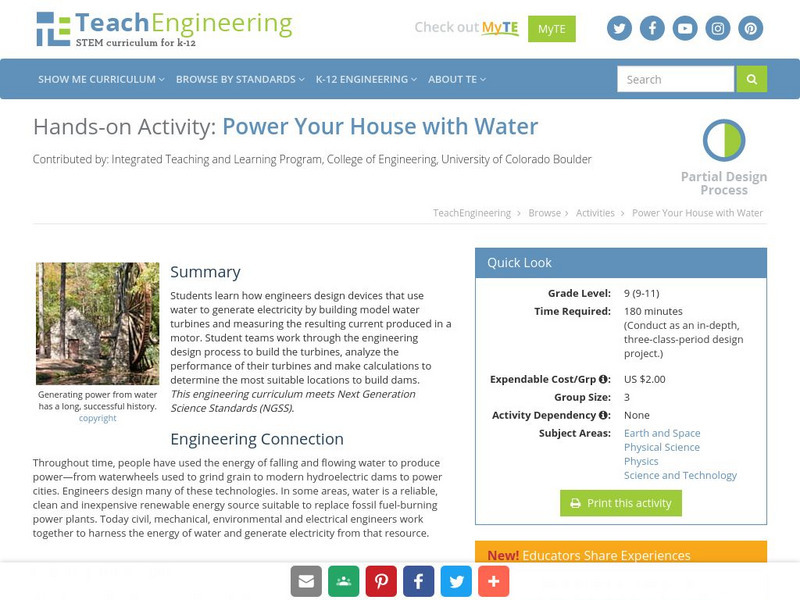
TeachEngineering
Teach Engineering: Power Your House With Water
Students learn how engineers design devices that use water to generate electricity by building model water turbines and measuring the resulting current produced in a motor. Students work through the engineering design process to build...
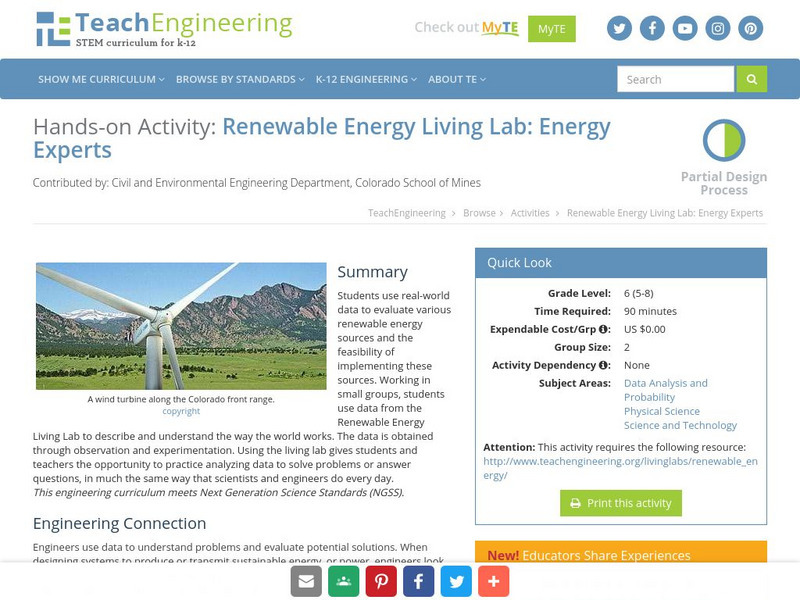
TeachEngineering
Teach Engineering: Renewable Energy Living Lab: Energy Experts
Students use real-world data to evaluate various renewable energy sources and the feasibility of implementing these sources. Working in small groups, students use data from the Renewable Energy Living Lab to describe and understand the...