Hi, what do you want to do?






Curated OER
Planetary Orbits
Middle schoolers explore space science by completing a solar system identification worksheet. In this planets lesson, students discuss the different planets in our star system and identify their traits. Middle schoolers complete an...

Curated OER
Vectors
Students describe motion by the use of adding vectors. They identify the difference between the x and y components of vector quantities. Students are given the Paper Bridge Building handout and the instructions as to where to perform...

Curated OER
Can Races
Students participate in an experiment dealing with kinetic energy. They predict which cans they believe will win the can race and why. They answer questions based on the experiment.

Curated OER
3-2-1 Blast Off!
Fifth graders work cooperatively in groups to assemble and launch a rocket.

Curated OER
Skateboard Science
Students investigate how skaters can turn in midair. In this physics lesson, students relate Newton's Laws to skateboarding. They carry out the maneuver with the help of their classmate.

Sharp School
Newton’s Laws of Motion Project
After a review of all three of Newton's laws, physical scientists complete a choice project. They can create a book in which they collect pictures where the laws of motion are depicted, produce a PowerPoint presentation, or produce a...

Curated OER
Newton's Law Vocabulary
In this Isaac Newton worksheet, students analyze ten words in a word box that pertain to Newton's Law. Students match these words to their definitions.

Curated OER
Air: It's a Gas!
Students investigate the properties of air through hands-on activities in conjunction with the demonstrations in a 3-2-1 Contact Video.

Curated OER
Science Quiz-Grade 6
In this grade 6 science quiz worksheet, 6th graders complete a 15 question multiple choice quiz covering a variety of grade 6 concepts.

Curated OER
How Do Things Move?
In this motion worksheet, students will use a word bank to fill in the definition of Newton's three laws of motion. Then students will complete 4 short answer questions giving examples of Newton's three laws of motion.

Physics Classroom
The Physics Classroom: Newton's Laws: Inertia and Mass
Through illustrated examples and interactive practice problems, students explore the relationship of inertia and mass.
Physics Classroom
The Physics Classroom: Inertia and Mass
This is part of a lesson on Newton's Laws of Motion that focuses on inertia and mass. It restates Newton's first law of motion. The lesson also gives a helpful visual description concerning friction.

Texas Education Agency
Texas Gateway: Dynamics of Rotational Motion: Rotational Inertia
By the end of this section, you will be able to understand the relationship between force, mass, and acceleration; study the turning effect of force; study the analogy between force and torque, mass and moment of inertia, and linear...
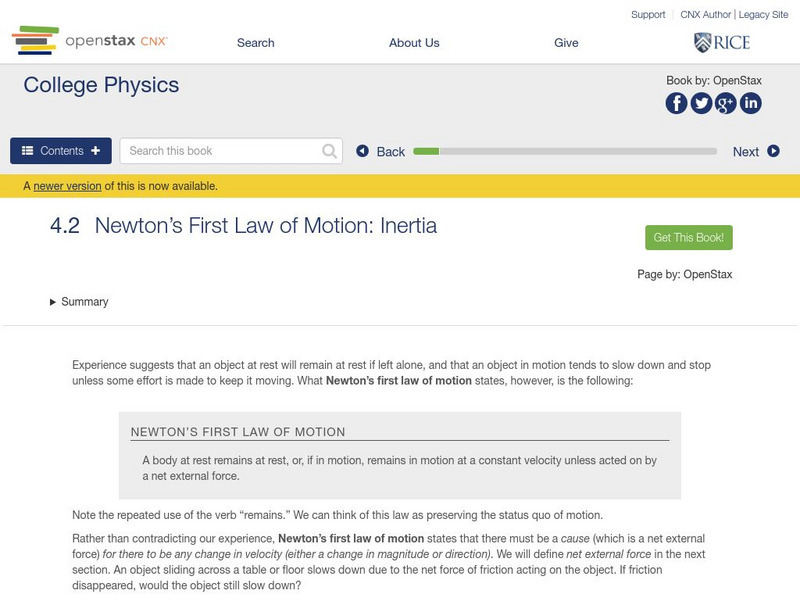
OpenStax
Open Stax: Newton's First Law of Motion: Inertia
In the following interactive students will begin to define mass and inertia and understand Newton's first law of motion.
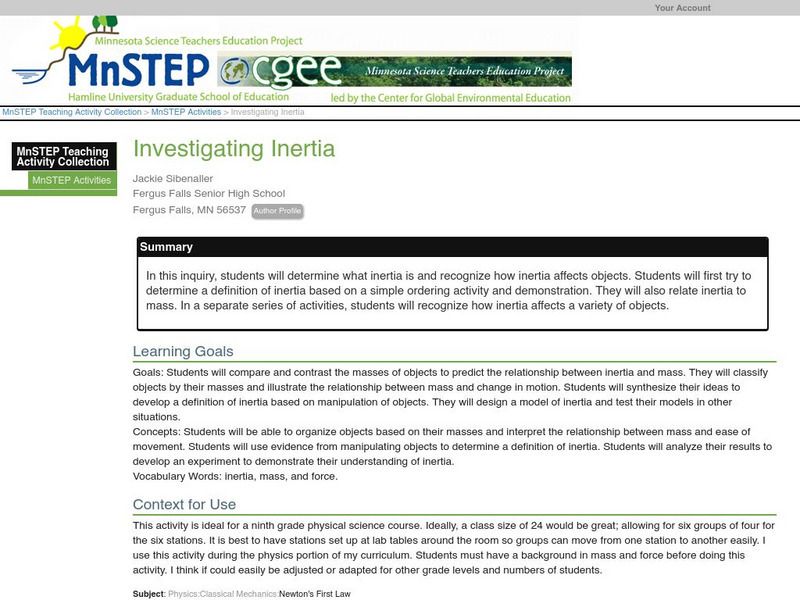
Science Education Resource Center at Carleton College
Serc: Investigating Inertia
In this investigation, students will perform a simple ordering activity and demonstration to determine what inertia is and recognize how inertia affects objects. They will compare and contrast the masses of objects to predict the...
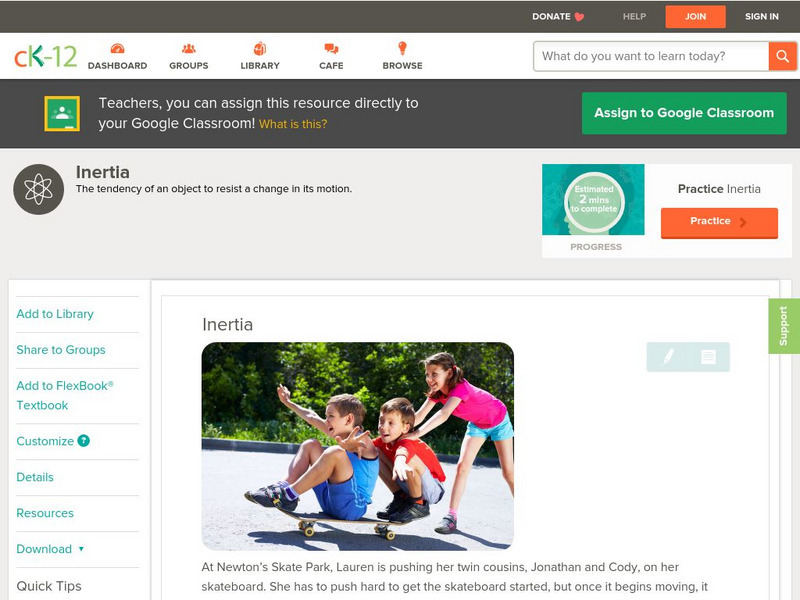
CK-12 Foundation
Ck 12: Physical Science: Inertia
[Free Registration/Login may be required to access all resource tools.] Explains inertia and how it affects motion, the relationship between inertia and mass, and how to overcome inertia.
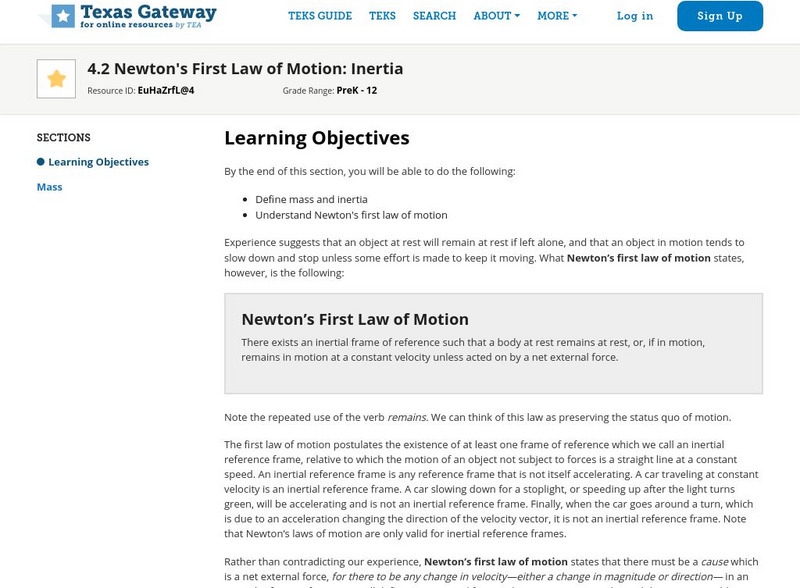
Texas Education Agency
Texas Gateway: 4.2 Newton's First Law of Motion: Inertia
By the end of this section, you will be able to define mass and inertia and to understand Newton's First Law of Motion: There exists an inertial frame of reference such that a body at rest remains at rest, or, if in motion, remains in...
Physics Aviary
Physics Aviary: Moment of Inertia of Pulley
This lab is designed to have students learn how the size, mass and mass distribution of a pulley influences the rate at which a mass attached to the pulley will accelerate. The pulley is frictionless and the string's mass is negligible.
Other
Bscs: Forces and Motion Content Background Document
In this document, we will try to answer a fundamental question of physical science, "Why do things start to move, slow down, speed up, stop moving or change direction?" In answering these core questions we can develop concepts that can...

Open Curriculum
Open Curriculum: Velocity and Relative Motion
An illustrated article helps physics students learn about center of mass and velocity, and define the concept of inertia.
Exploratorium
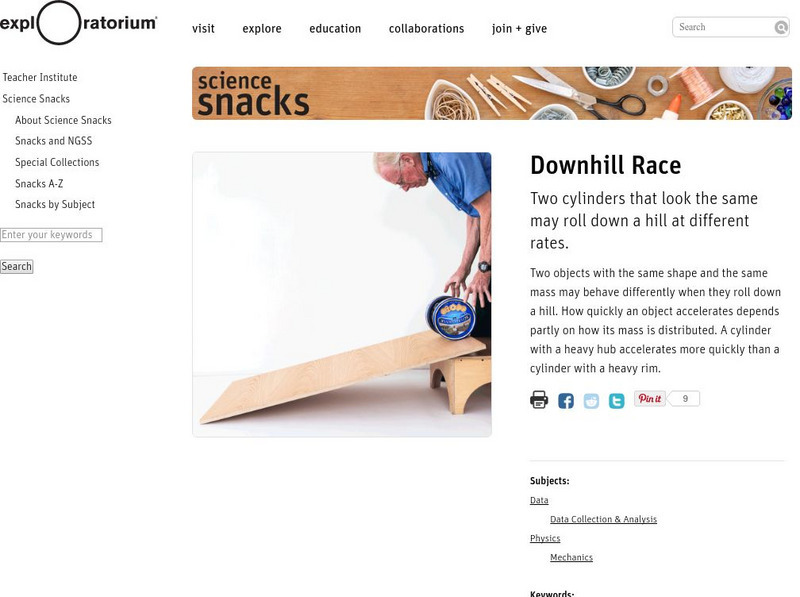
Exploratorium: Science Snacks: Downhill Race
An activity that explores how two cylinders that are identical in shape and mass may travel down a hill differently due to how their mass is distributed. Learn how the distribution of mass in an object can affect its translational...
Texas Education Agency
Texas Gateway: Newton's First Law
Within this resource, you will learn more about Newton's first law and real-world applications of this law.
Texas A&M University
Texas A&m University: Moments of Inertia
This site is from the Math department of the Texas A&M University and contains wonderful information on Centers of mass and moments of inertia. Pictures, charts, graphs along with great text is all included.
TeachEngineering
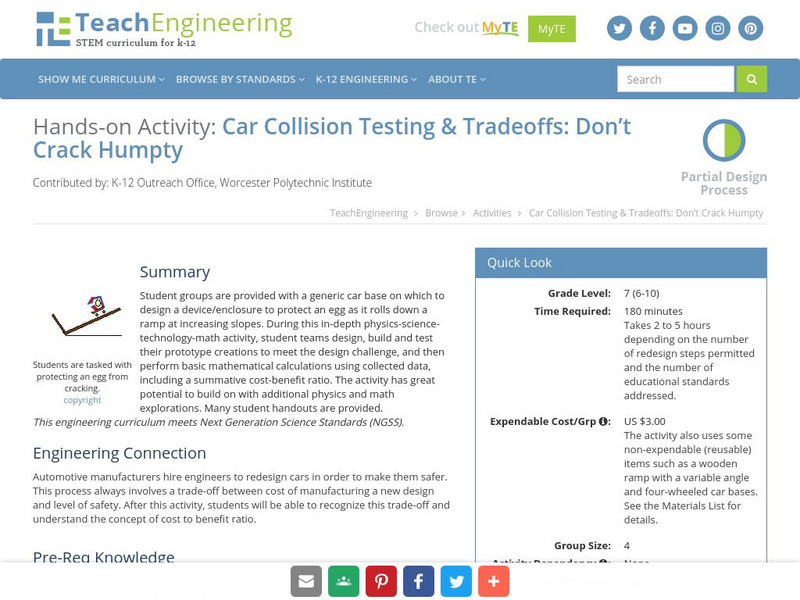
Teach Engineering: Car Collision Testing & Tradeoffs: Don't Crack Humpty
Student groups are provided with a generic car base on which to design a device/enclosure to protect an egg as it rolls down a ramp at increasing slopes. During this activity, student teams design, build and test their prototype...