Hi, what do you want to do?





TeachEngineering
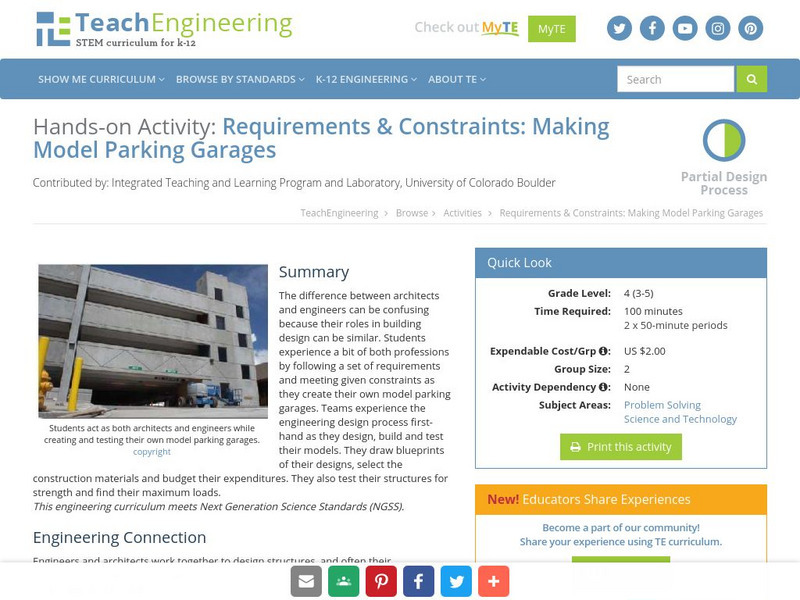
Teach Engineering: Requirements & Constraints: Making Model Parking Garages
The difference between an architect and an engineer is sometimes confusing because their roles in building design can be similar. Students experience a bit of both professions by following a set of requirements and meeting given...
TeachEngineering
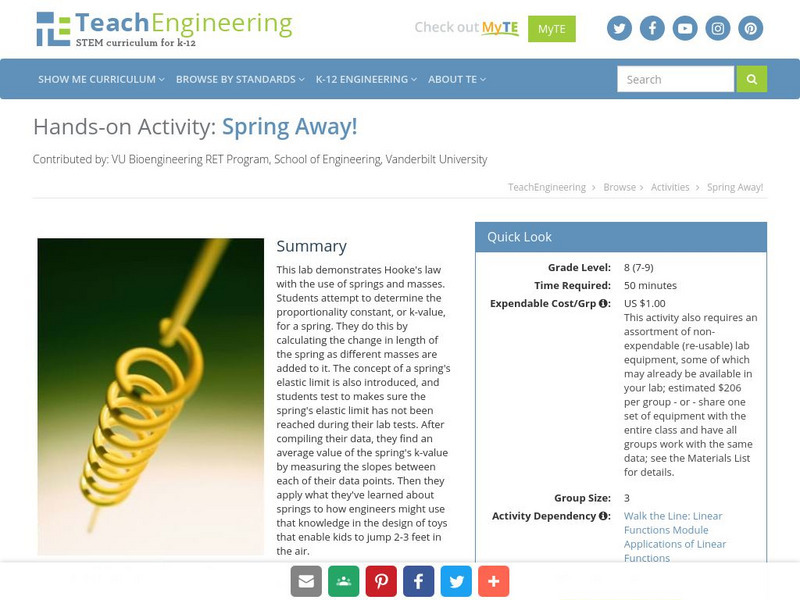
Teach Engineering: Spring Away!
This lab demonstrates Hooke's Law with the use of springs and masses. Students attempt to determine the proportionality constant, or k-value, for a spring. They do this by calculating the change in length of the spring as different...
TeachEngineering
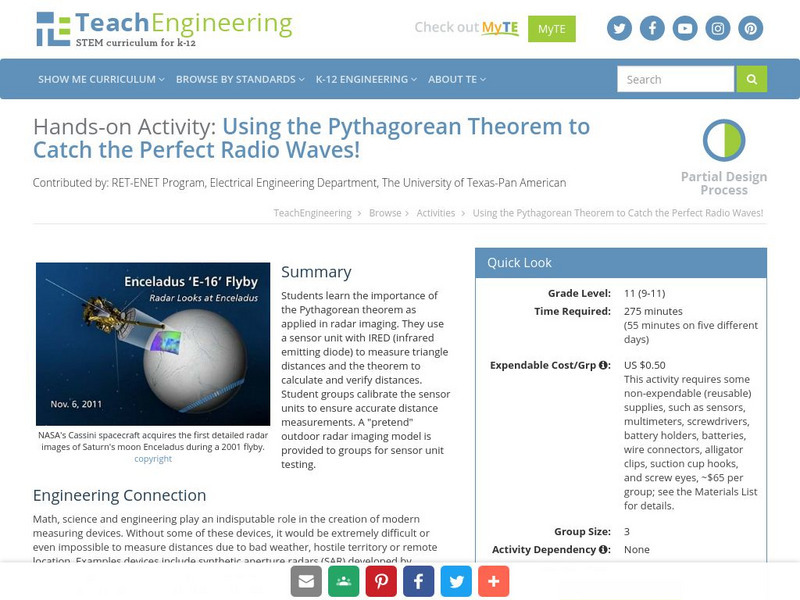
Teach Engineering: Catching the Perfect Sar Waves!
Students learn the importance of the Pythagorean theorem as applied in radar imaging. They use a sensor unit with IRED (infrared emitting diode) to measure triangle distances and the Pythagorean theorem to calculate and verify distances....
TeachEngineering
Teach Engineering: Home, Sweet Home!
In this activity, the students will use wax paper shaped as leaves and kite string to build a shelter to protect them from the rain. The students will then test the shelters for durability and water resistance.
TeachEngineering
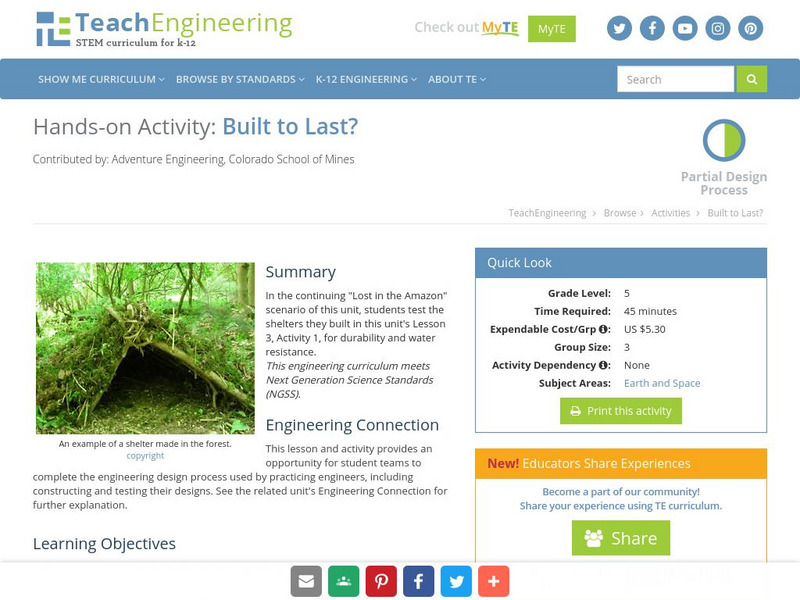
Teach Engineering: Built to Last?
In this activity, the students test the shelters they built in Lesson 3, Activity 1 for durability and water resistance.
TeachEngineering
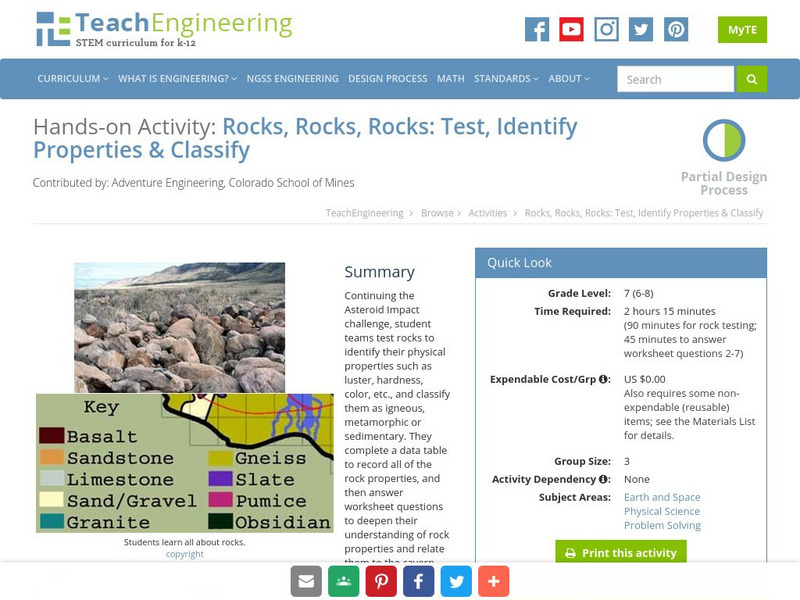
Teach Engineering: Rocks, Rocks, Rocks
Students test rocks to identify their physical properties (such as luster, hardness, color, etc.) and classify them as igneous, metamorphic or sedimentary. They complete a worksheet table to record all of the rock properties, and then...

TeachEngineering
Teach Engineering: What's Hiding in the Air?
Students develop an understanding of the effects of invisible air pollutants with a rubber band and hanger air test and a bean plant experiment. They also learn about methods of reducing invisible air pollutants.
TeachEngineering
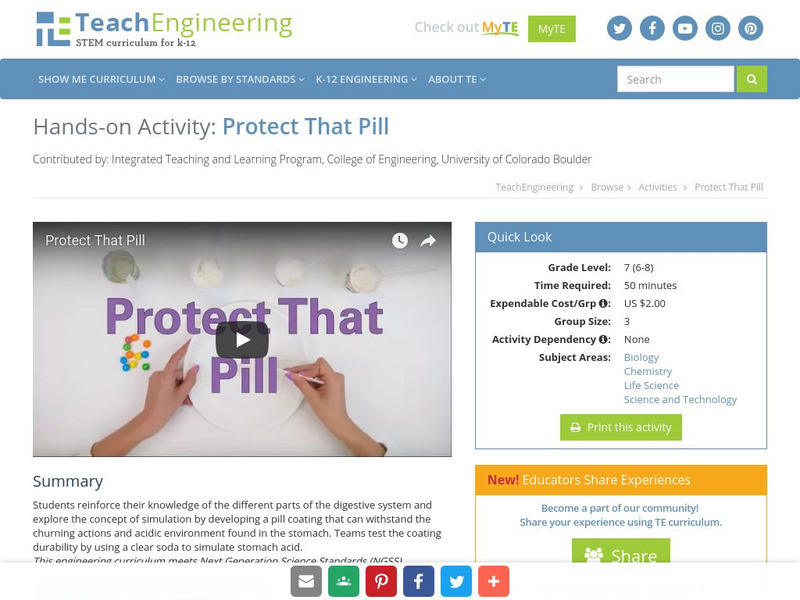
Teach Engineering: Protect That Pill
Students reinforce their knowledge of the different parts of the digestive system and explore the concept of simulation by developing a pill coating that can withstand the churning actions and acidic environment found in the stomach....
TeachEngineering
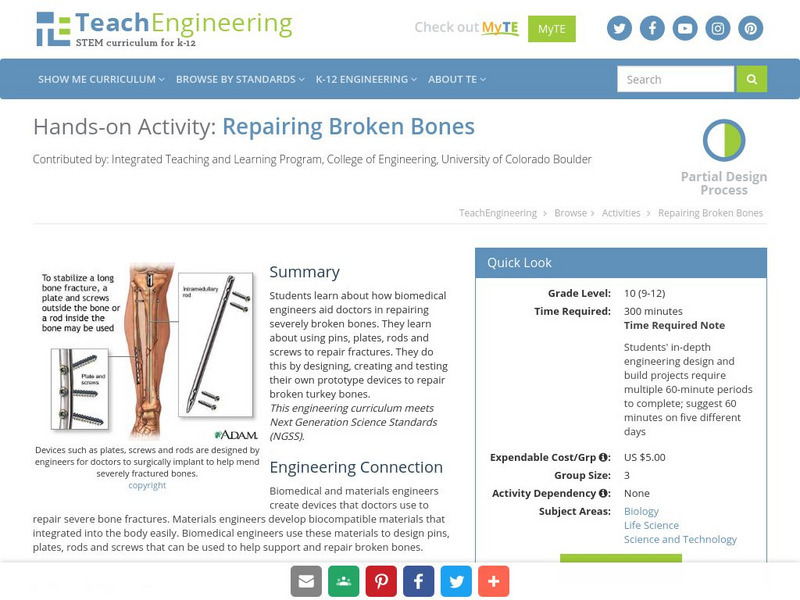
Teach Engineering: Repairing Broken Bones
Students learn about how biomedical engineers aid doctors in repairing severely broken bones. They learn about using pins, plates, rods and screws to repair fractures. They do this by designing, creating and testing their own prototype...
TeachEngineering
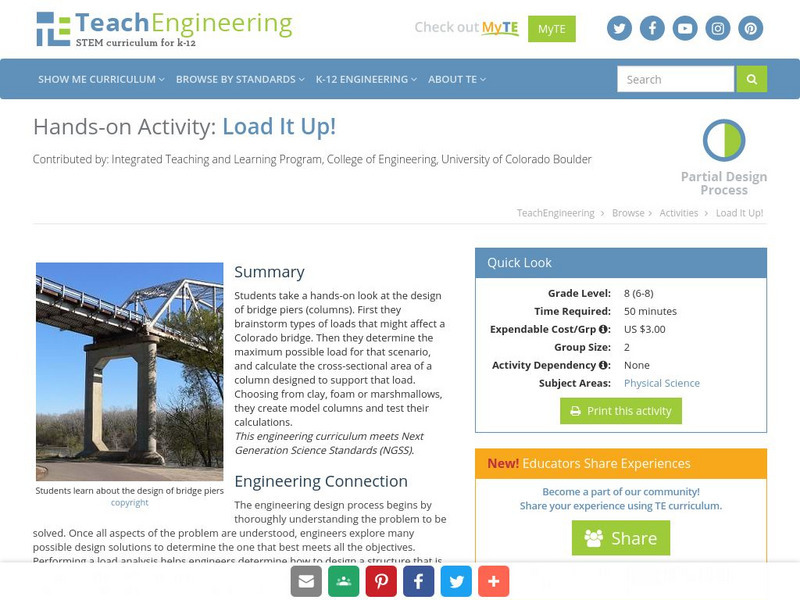
Teach Engineering: Load It Up!
Students take a hands-on look at the design of bridge piers (columns). First they brainstorm types of loads that might affect a Colorado bridge. Then they determine the maximum possible load for that scenario, and calculate the...

TeachEngineering
Teach Engineering: Breaking the Mold
In this math activity, students conduct a strength test using modeling clay, creating their own stress vs. strain graphs, which they compare to typical steel and concrete graphs. They learn the difference between brittle and ductile...
TeachEngineering
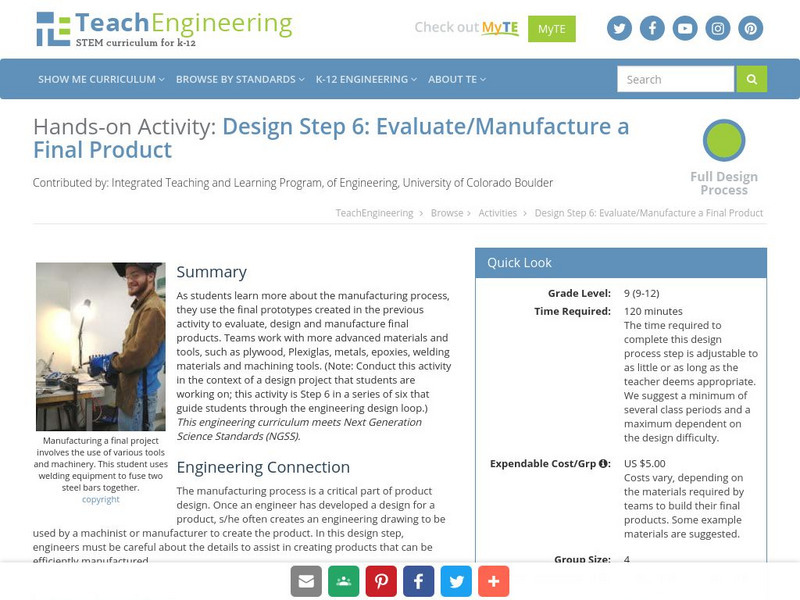
Teach Engineering: Design Step 7: Improve and Redesign/manufacture a Product
As students learn more about the manufacturing process, they use what they learned from testing their designs in the previous activity to continue to improve and redesign. Students also have the opportunity to manufacture their final...
TeachEngineering
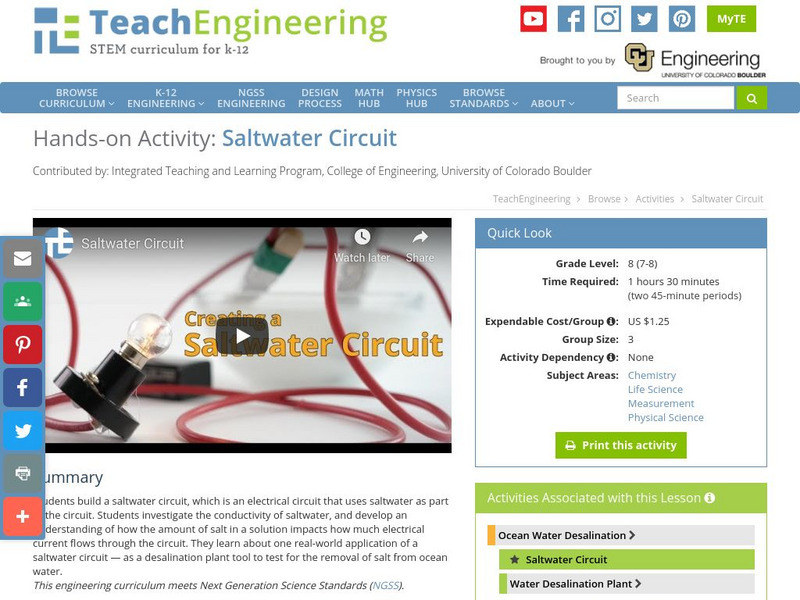
Teach Engineering: Saltwater Circuit
Students build a saltwater circuit, which is an electrical circuit that uses saltwater as part of the circuit. Students investigate the conductivity of saltwater, and develop an understanding of how the amount of salt in a solution...
TeachEngineering
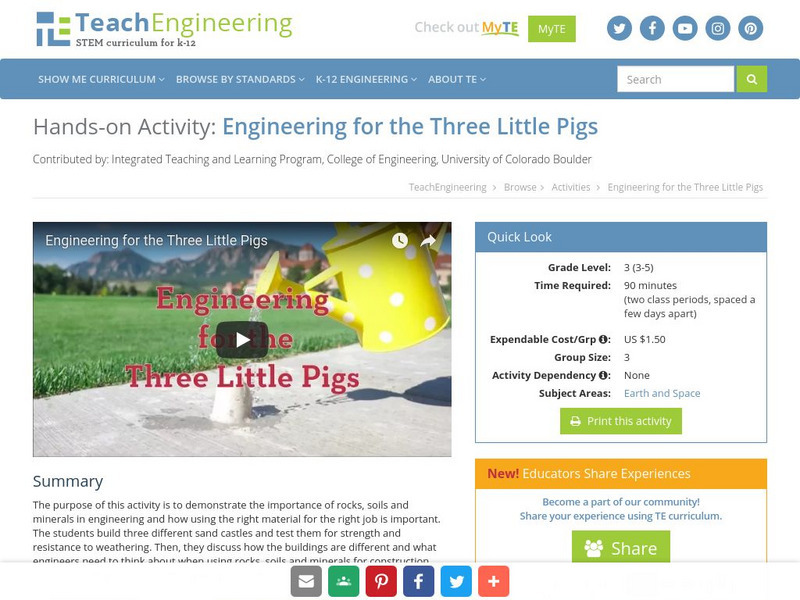
Teach Engineering: Engineering for the 3 Little Pigs
The purpose of this activity is to demonstrate the importance of rocks, soils and minerals in engineering and how using the right material for the right job is important. The students build three different sand castles and test them for...

TeachEngineering
Teach Engineering: Conductivity
Students make a simple conductivity tester using a battery and light bulb. They learn the difference between conductors and insulators of electrical energy as they test a variety of materials for their ability to conduct electricity.
TeachEngineering
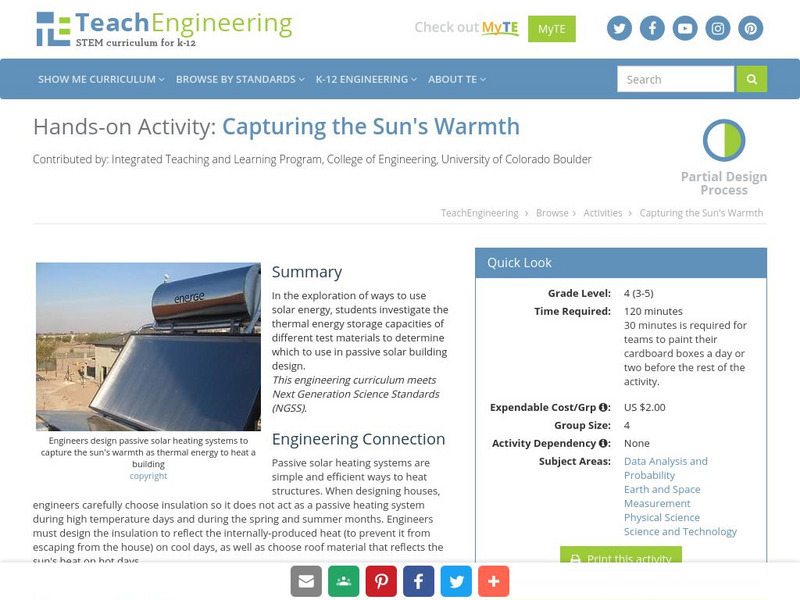
Teach Engineering: Capturing the Sun's Warmth
In the exploration of ways to use solar energy, students investigate the thermal energy storage capacities of different test materials to determine which to use in passive solar building design.
TeachEngineering
Teach Engineering: Saving a Life: Heart Valve Replacement
Students use their knowledge about how healthy heart valves function to design, construct and implant prototype replacement mitral valves for hypothetical patients' hearts. Building on what they learned in the associated lesson about...
TeachEngineering
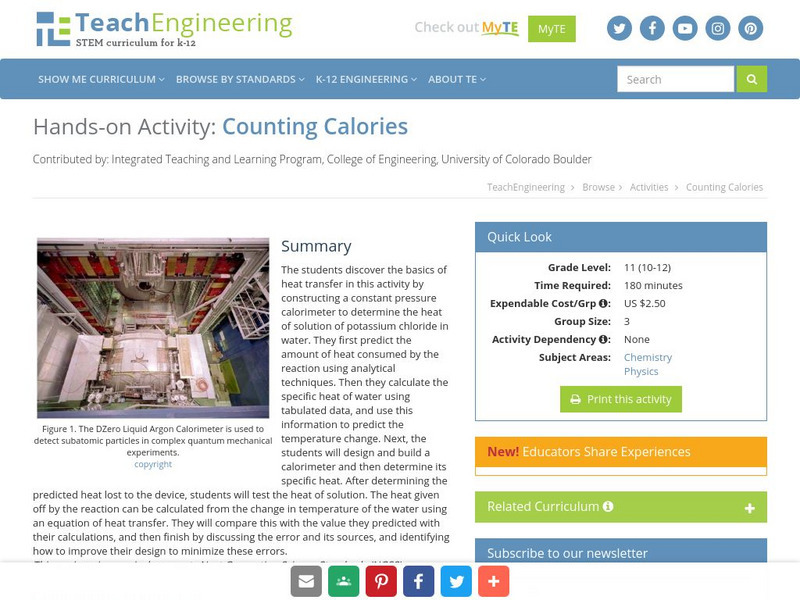
Teach Engineering: Counting Calories
The students discover the basics of heat transfer in this activity by constructing a constant pressure calorimeter to determine the heat of solution of potassium chloride in water. They first predict the amount of heat consumed by the...
TeachEngineering
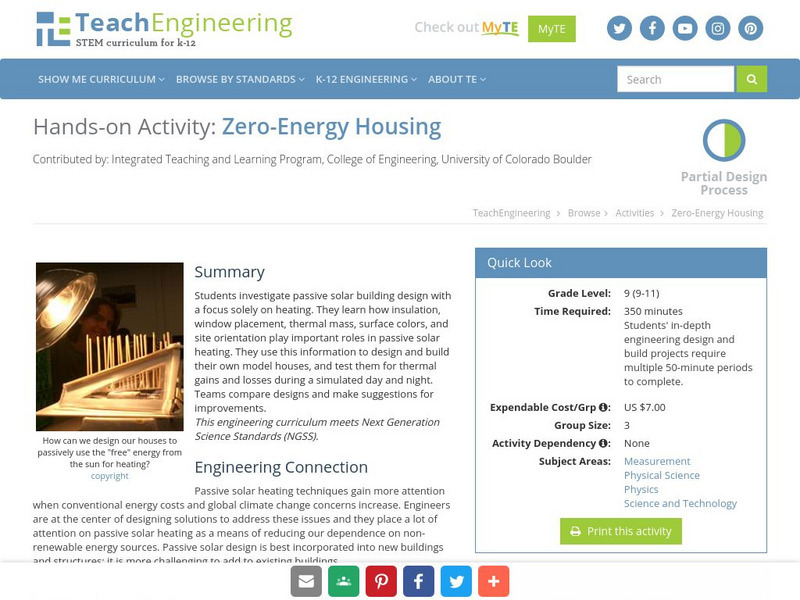
Teach Engineering: Zero Energy Housing
Students investigate passive solar building design with a focus solely on heating. They learn how insulation, window placement, thermal mass, surface colors, and site orientation play important roles in passive solar heating. They use...
TeachEngineering
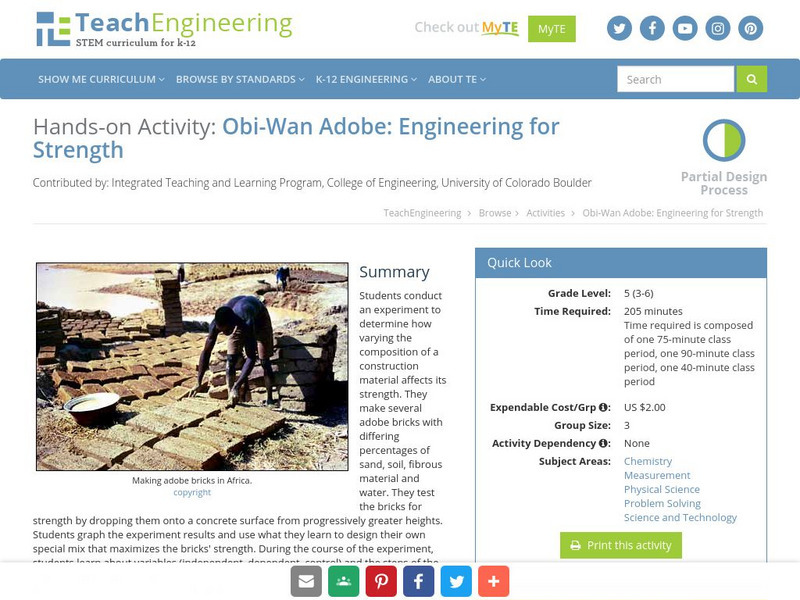
Teach Engineering: Obi Wan Adobe: Engineering for Strength
Students conduct an experiment to determine how varying the composition of a construction material affects its strength. They make several adobe bricks with differing percentages of sand, soil, fibrous material and water. They test the...
TeachEngineering
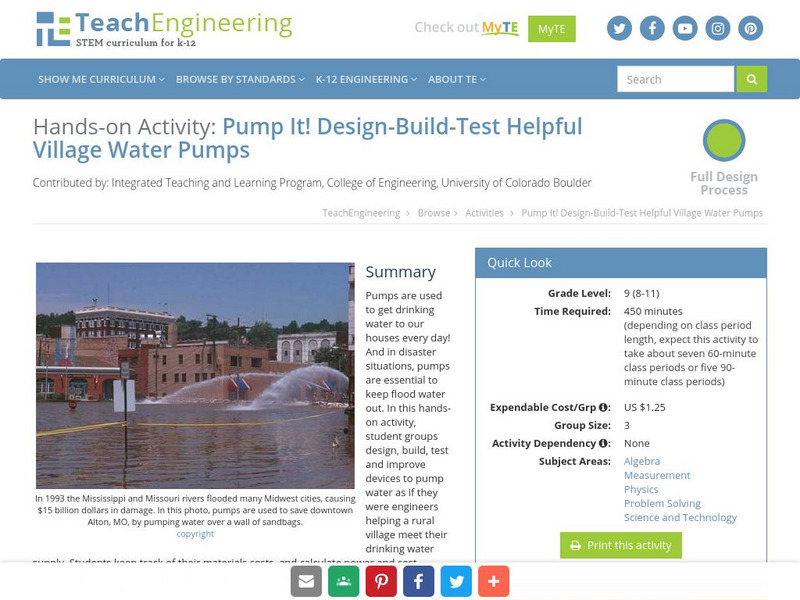
Teach Engineering: Pump It!
Pumps are used to get drinking water to our houses every day! And in disaster situations, pumps are essential to keep flood water out. In this hands-on activity, student groups design, build, test and improve devices to pump water as if...
TeachEngineering
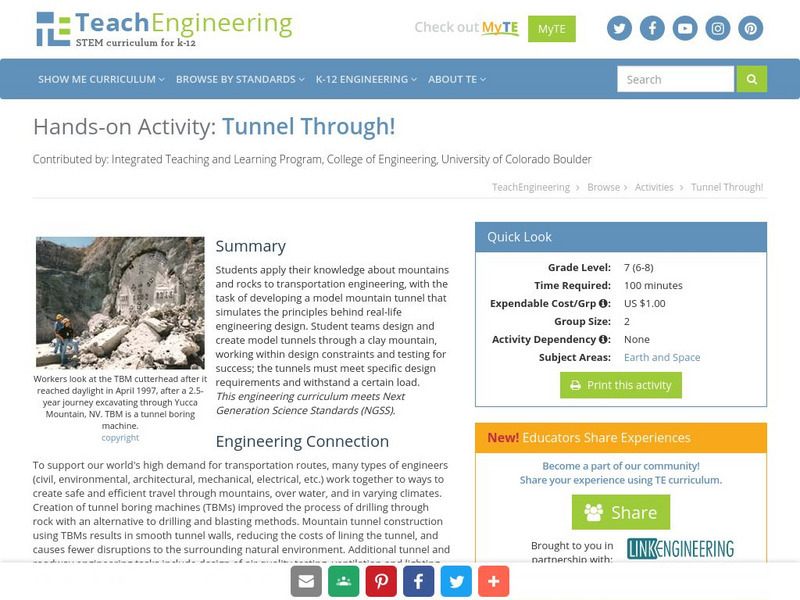
Teach Engineering: Tunnel Through!
Students apply their knowledge about mountains and rocks to transportation engineering, with the task of developing a model mountain tunnel that simulates the principles behind real-life engineering design. Student teams design and...
TeachEngineering
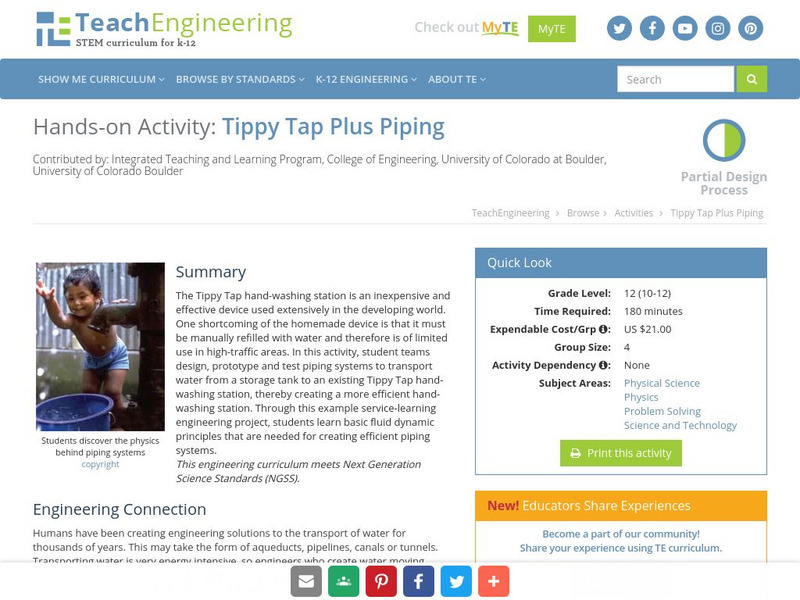
Teach Engineering: Tippy Tap Plus Piping
The Tippy Tap hand-washing station is an inexpensive and effective device used extensively in the developing world. One shortcoming of the homemade device is that it must be manually refilled with water and therefore is of limited use in...
TeachEngineering
Teach Engineering: Solar Water: Heat It Up!
Students explore energy efficiency, focusing on renewable energy, by designing and building flat-plate solar water heaters. They apply their understanding of the three forms of heat transfer (conduction, convection and radiation), as...