Hi, what do you want to do?





Curated OER
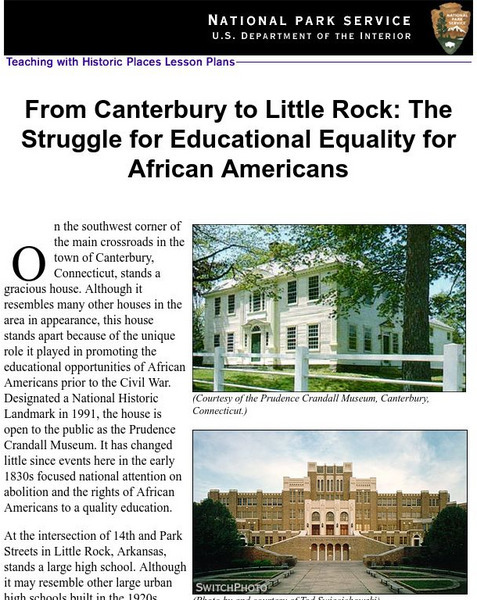
National Park Service: The Struggle for Education Equality for African American
"Canterbury, Connecticut, and Little Rock, Arkansas, are links in a chain of events representing the long struggle for equal educational opportunities for African Americans. This lesson plan highlights two important historic places and...
Lumen Learning
Lumen: Evaluating Sources: Craap Analysis of Online Sources
This lesson focuses on evaluating online sources using the CRAAP Analysis: Currency, relevance, authority, accuracy, and purpose. A practice exercise is provided. SL.9-10.2 eval & integrate sources
ReadWriteThink
Read Write Think: Mail Time! An Integrated Postcard and Geography Study
Contains plans for five cross-curricular lessons that teach about geography, reading, and writing by having students send postcards to relatives and asking them to send postcards back. In addition to objectives and standards, this...

US National Archives
National Archives: Congress at Work: Presidential Veto
The veto process is an integral part of our checks and balances. Introduce the power of the presidential veto and override to a class using an example from President Nixon's administration. Materials include the Constitution, worksheets,...
Other
Kodak: Social Studies Lesson Plans
This Kodak site has twelve lesson plans submitted by teachers from every grade level. Each activity integrates photography into the lesson plan.
Utah Education Network
Uen: Budgeting & Checking Activity Financial Literacy
This is a simulation for students to integrate several concepts on saving and banking into one project.
University of Arizona
Math Lesson: Calculating Parts Per Million: Do We Have a Problem Here?
Twelfth graders test solutions to determine the parts per million and whether a lake is contaminated.
John F. Kennedy Center
The Kennedy Center: Arts Edge: Nureyev: The Unconquerable Will
Lesson on creative expression and dance in light of the social, cultural, and political climate in Russia.
ReadWriteThink
Read Write Think: A Picture's Worth a Thousand Words: Image to Narrative
This lesson, which can be adapted to fit with any picture you choose, works for middle schoolers of all levels.
TeachEngineering
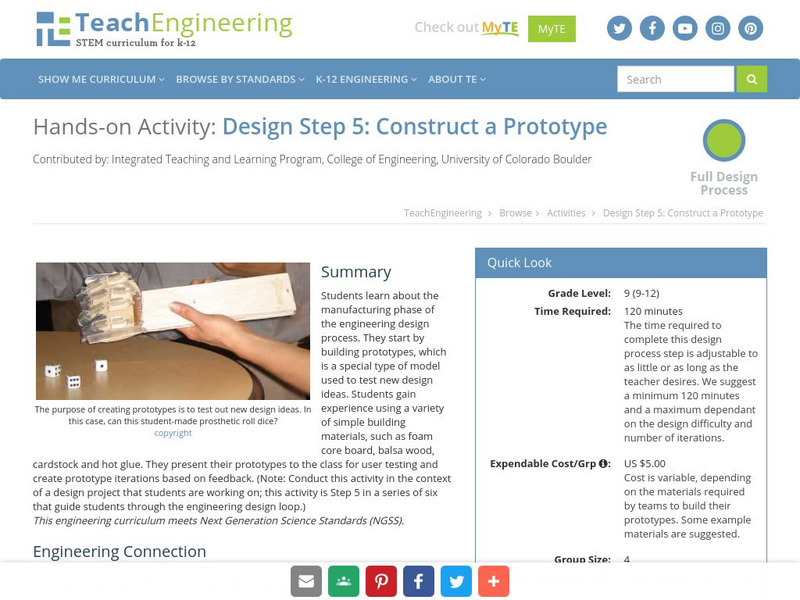
Teach Engineering: Design Steps 5 and 6: Create and Test a Prototype
Students learn about the importance of creating and testing prototypes during the engineering design process. They start by building prototypes, which is a special type of model used to test new design ideas. Students gain experience...
TeachEngineering
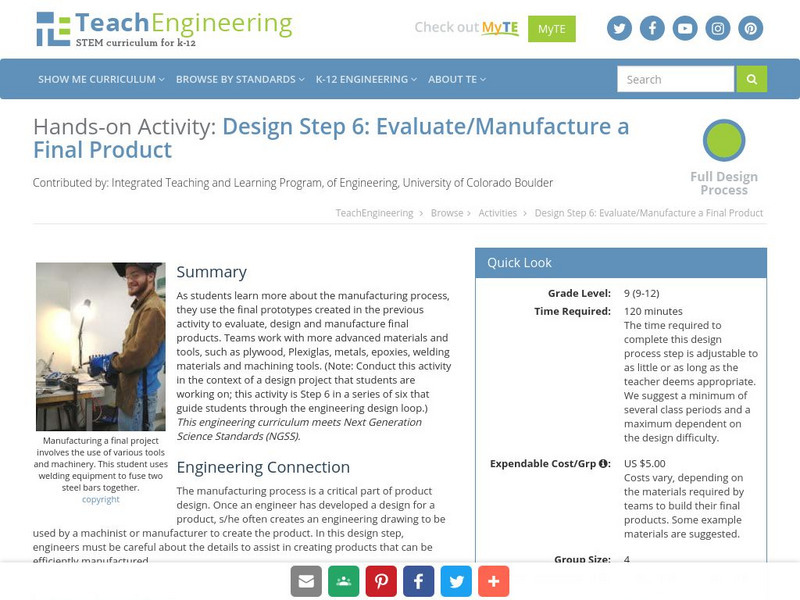
Teach Engineering: Design Step 7: Improve and Redesign/manufacture a Product
As students learn more about the manufacturing process, they use what they learned from testing their designs in the previous activity to continue to improve and redesign. Students also have the opportunity to manufacture their final...
TeachEngineering
Teach Engineering: Save a Life, Clean Some Water!
Student teams practice water quality analysis through turbidity measurement and coliform bacteria counts. They use information about water treatment processes to design prototype small-scale water treatment systems and test the influent...
TeachEngineering
Teach Engineering: My Mechanical Ear Can Hear!
Young scholars are introduced to various types of hearing impairments and the types of biomedical devices that engineers have designed to aid people with this physical disability.
TeachEngineering
Teach Engineering: Just Plane Simple
This lesson introduces students to three of the six simple machines used by many engineers. These machines include the inclined plane, the wedge and the screw. In general, engineers use the inclined plane to lift heavy loads, the wedge...
TeachEngineering
Teach Engineering: Levers That Lift
This lesson introduces students to three of the six simple machines used by many engineers: the lever, the pulley, and the wheel-and-axle. In general, engineers use the lever to magnify the force applied to an object, the pulley to lift...
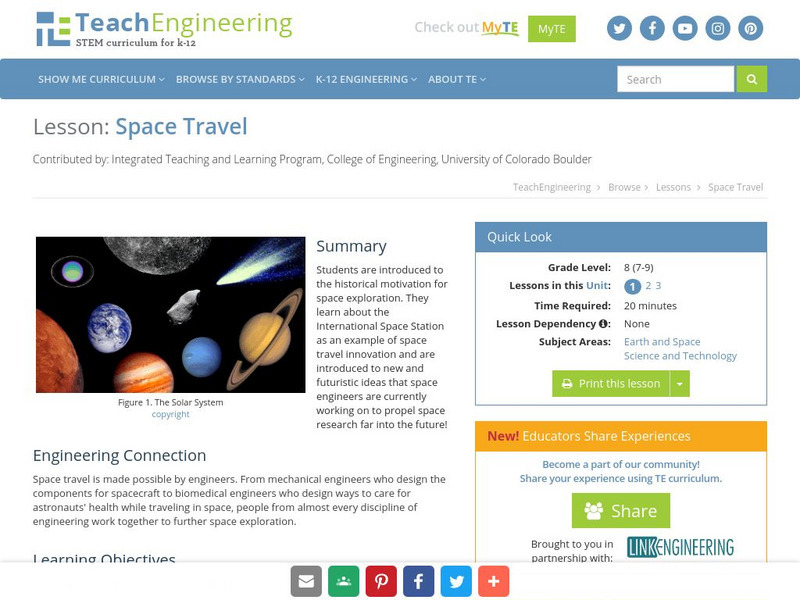
TeachEngineering
Teach Engineering: Space Travel
Students are introduced to the historical motivation for space exploration. They learn about the International Space Station as an example of space travel innovation and are introduced to new and futuristic ideas that space engineers are...
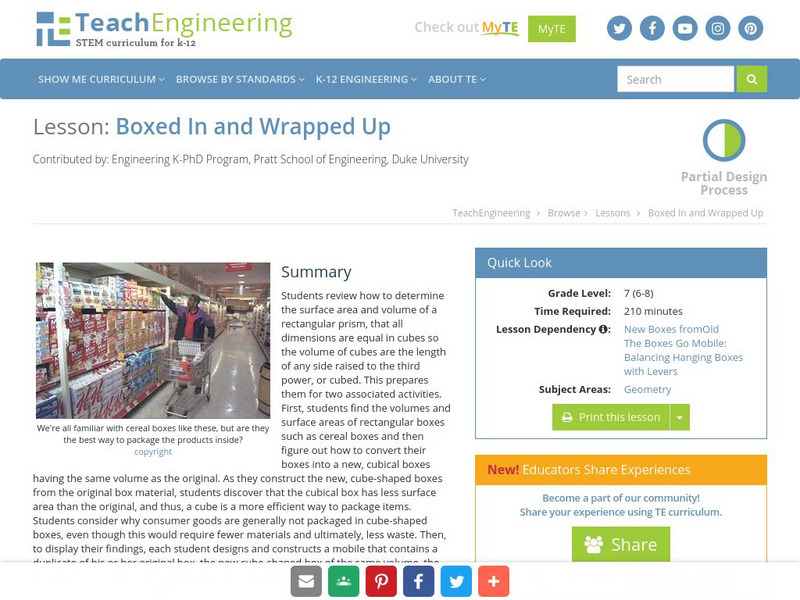
TeachEngineering
Teach Engineering: Boxed in and Wrapped Up
Students find the volume and surface area of a rectangular box (e.g., a cereal box), and then figure out how to convert that box into a new, cubical box having the same volume as the original. As they construct the new, cube-shaped box...
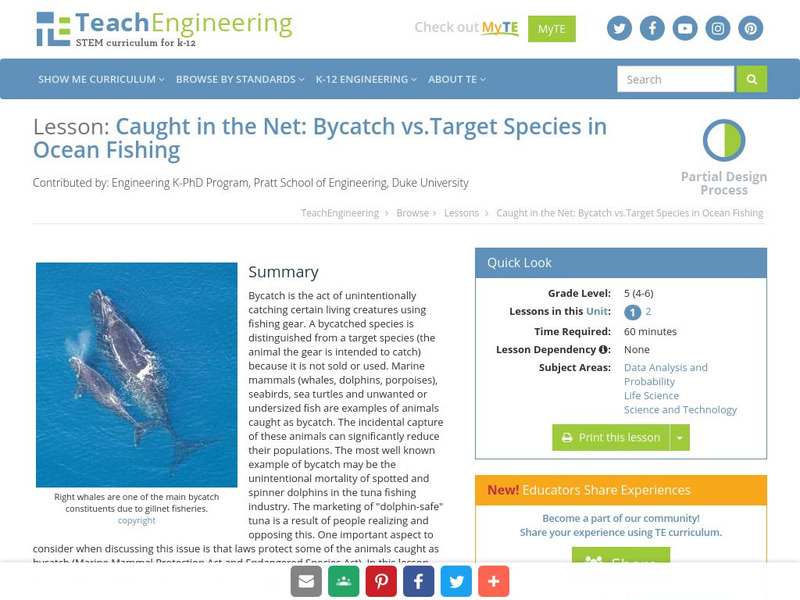
TeachEngineering
Teach Engineering: Caught in the Net
Bycatch can be defined as the act of unintentionally catching certain living creatures using fishing gear. A bycatched species is distinguished from a target species (the animal the gear is intended to catch) because it is not sold or...
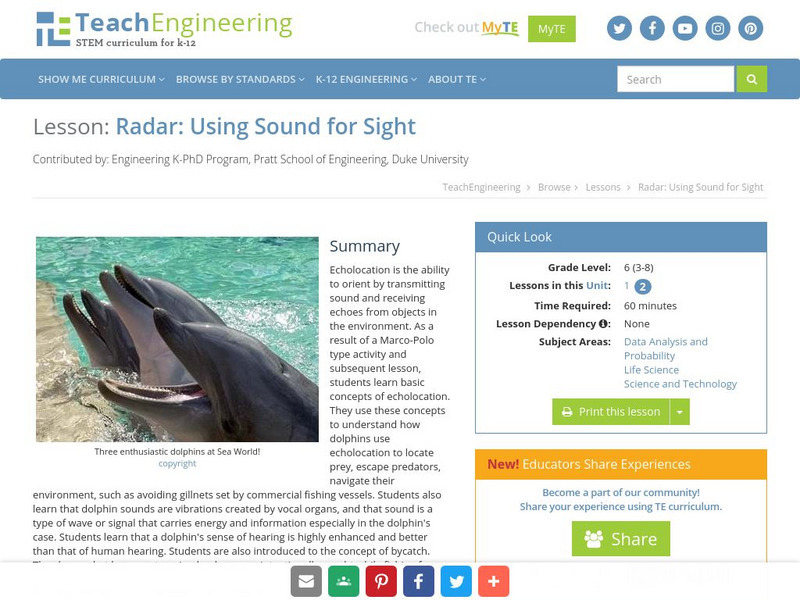
TeachEngineering
Teach Engineering: Sound for Sight
Echolocation is the ability to orient by transmitting sound and receiving echoes from objects in the environment. As a result of a Marco-Polo type activity and subsequent lesson, students learn basic concepts of echolocation. They use...
TeachEngineering
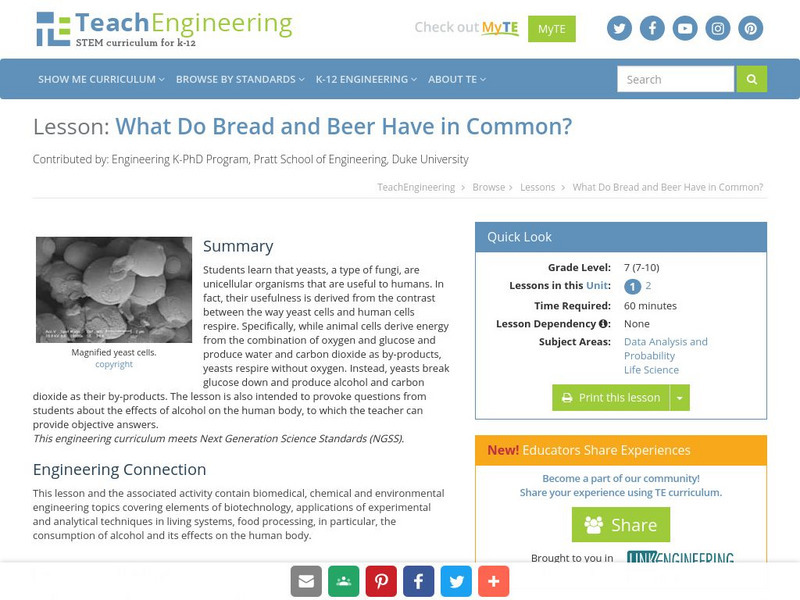
Teach Engineering: What Do Bread and Beer Have in Common?
Students are presented with information that will allow them to recognize that yeasts are unicellular organisms that are useful to humans. In fact, their usefulness is derived from the contrast between the way yeast cells and human cells...
TeachEngineering
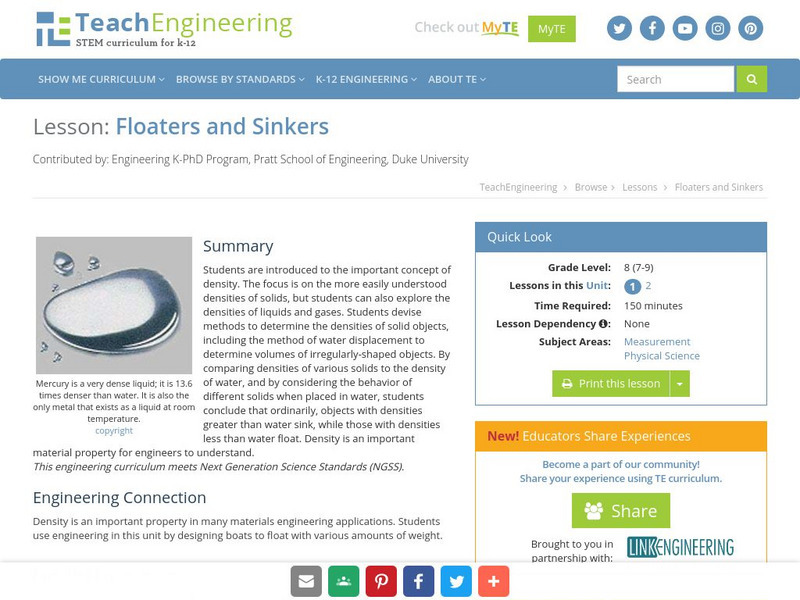
Teach Engineering: Floaters and Sinkers
This lesson introduces students to the important concept of density. The focus is on the more easily understood densities of solids, but students can also explore the densities of liquids and gases. Students devise methods to determine...
TeachEngineering
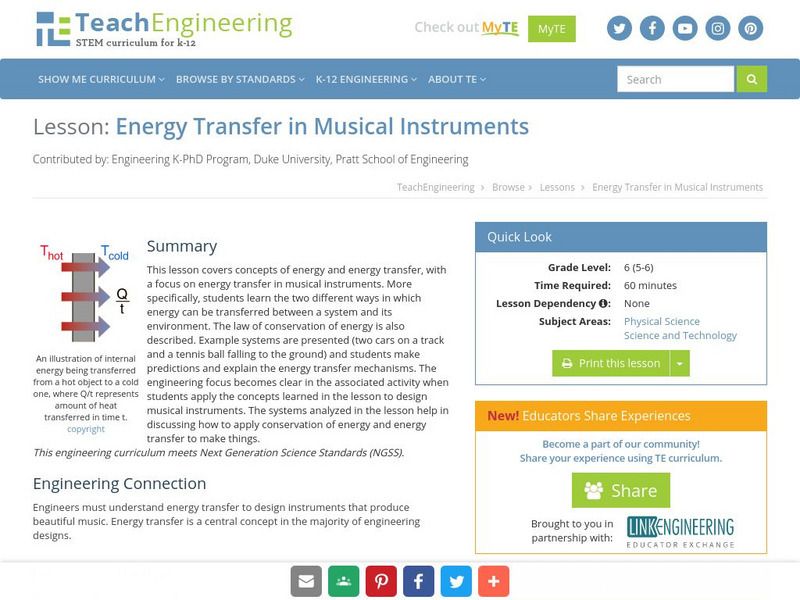
Teach Engineering: Energy Transfer in Musical Instruments
This lesson covers concepts of energy and energy transfer utilizing energy transfer in musical instruments as an example. More specifically, the lesson explains the two different ways in which energy can be transferred between a system...

TeachEngineering
Teach Engineering: What Floats Your Boat?
Students use modeling clay, a material that is denser than water and thus ordinarily sinks in water, to discover the principle of buoyancy. They begin by designing and building boats out of clay that will float in water, and then refine...
TeachEngineering
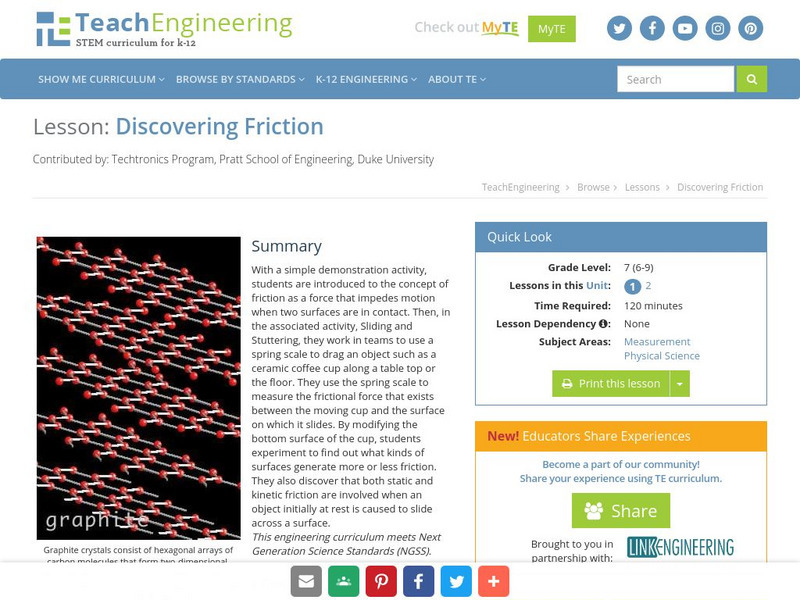
Teach Engineering: Discovering Friction
With a simple demonstration activity, students are introduced to the concept of friction as a force that impedes motion when two surfaces are in contact. Then, in the Associated Activity (Sliding and Stuttering), they work in teams to...
Other popular searches
- Fairness and Integrity
- Honesty Integrity
- Academic Integrity
- Novel Study Integrity
- Lesson Plans on Integrity
- Sexual Integrity
- Integrity Cheating
- Integrity Lesson
- Kindness. Integrity
- Intellectual Integrity
- Personal Integrity
- Work Ethic Honesty Integrity