Hi, what do you want to do?






Intel
Insects: The Good, The Bad, The Ugly
What would the world be like with no insects? Ponder this question using a research-based STEM unit that encourages scholars to investigate insects from both a beneficial and hazardous perspective. They learn about insect behaviors,...

Cornell University
Insect Anatomy
Young entomologists discover insect anatomy in a very detailed unit plan. Offering background information for teachers about various insects, class members explore the differences between bugs and insects—and yes, there are many...

Core Knowledge Foundation
Insects Tell It Again!™ Read-Aloud Anthology
A read-aloud anthology explores the world of bees, wasps, beetles, termites, ants, fireflies, and more. Scholars listen to stories and discuss topics and practice word work. Extension opportunities keep the learning going in and out of...

Curated OER
Ladybugs, Ladybugs, Ladybugs
Those lovely ladybugs are so cute, and so very useful! Use a short unit to explore insect anatomy, the ladybug life cycle, and the help ladybugs provide organic farmers. The unit is comprised of four short thirty-minute lesson plans that...

Curated OER
Insects
Students construct a viable insect collecting apparatus. Students determine the effectiveness of the instrument he has designed by collecting specimens.

Curated OER
Interesting Insects
Students discover the characteristics of insects. They explore insects through cooperative learning, group projects, hands on activities, and poetry. They gain knowledge of insect life cycles, habitat, and physical characteristics.

Roald Dahl
James and the Giant Peach Lesson Plans
Immerse yourself in the world of giant bugs, rolling peaches, and brave little boys with an interdisciplinary unit on James and the Giant Peach. Young readers focus on the scientific themes of Roald Dahl's classic novel with bug hunts,...

National Park Service
Biodiversity—Bee Week
If you want scholars to fall in love with bees, this is the unit for you! Celebrate bees with a full week of material—designed for the Next Generation Science Standards—that addresses the importance of pollination and fertilization....

Curated OER
Insects: Bugs, Science, Entomology
In this lesson, insects are explored through reading of children's literature, classifying insects versus non-insects, drawing and painting various insects, and learning how to clap to certain rhythms while reciting insect names.

CK-12 Foundation
Ck 12: Third Grade Science: Life Science: Insect Reproduction and Life Cycles
[Free Registration/Login may be required to access all resource tools.] Compares and contrasts the major stages in insect life cycles, such as those that undergo incomplete and complete metamorphosis.
CK-12 Foundation
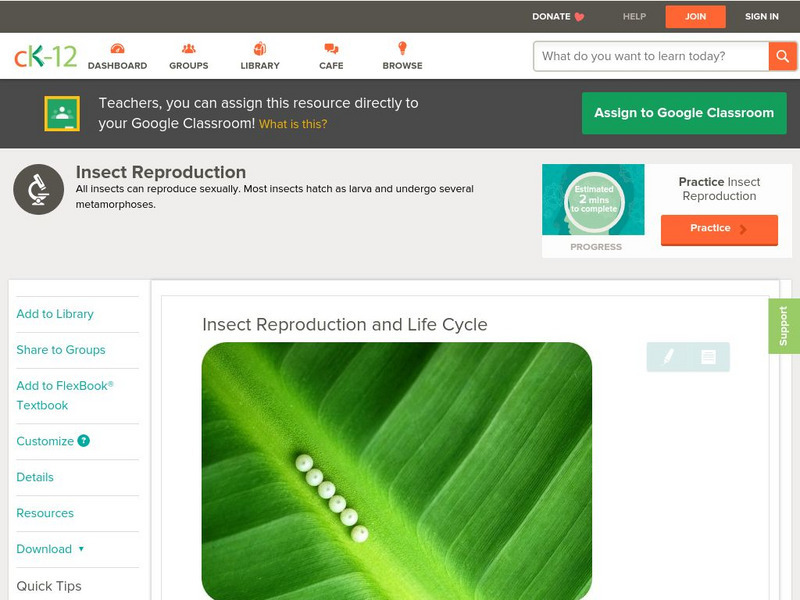
Ck 12: Life Science: Insect Reproduction and Life Cycle
[Free Registration/Login may be required to access all resource tools.] Most insects can reproduce quickly within a short period of time, which means they evolve faster and can adjust to environmental changes. Most reproduce by sexual...
CK-12 Foundation
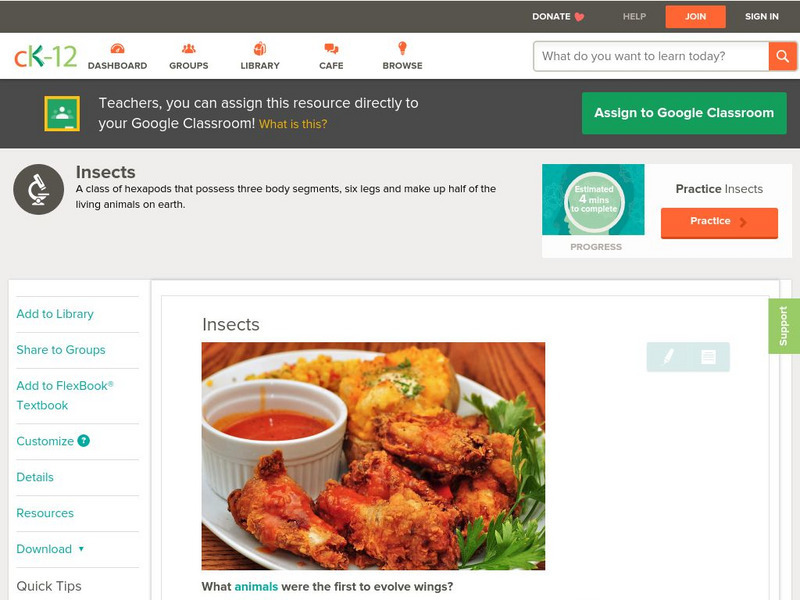
Ck 12: Life Science: Insects
[Free Registration/Login may be required to access all resource tools.] Insects, with over a million described species, are the most diverse group of animals on Earth. They may be found in nearly all environments on the planet. No matter...
CK-12 Foundation
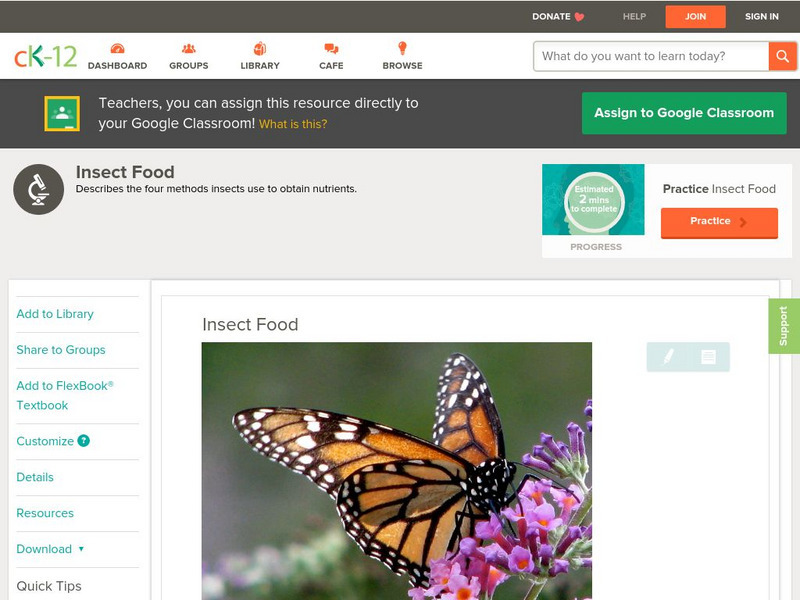
Ck 12: Life Science: Insect Food
[Free Registration/Login may be required to access all resource tools.] Insects have different types of appendages adapted for capturing and feeding on prey. They also have special senses that help them detect prey. Furthermore, insects...
CK-12 Foundation
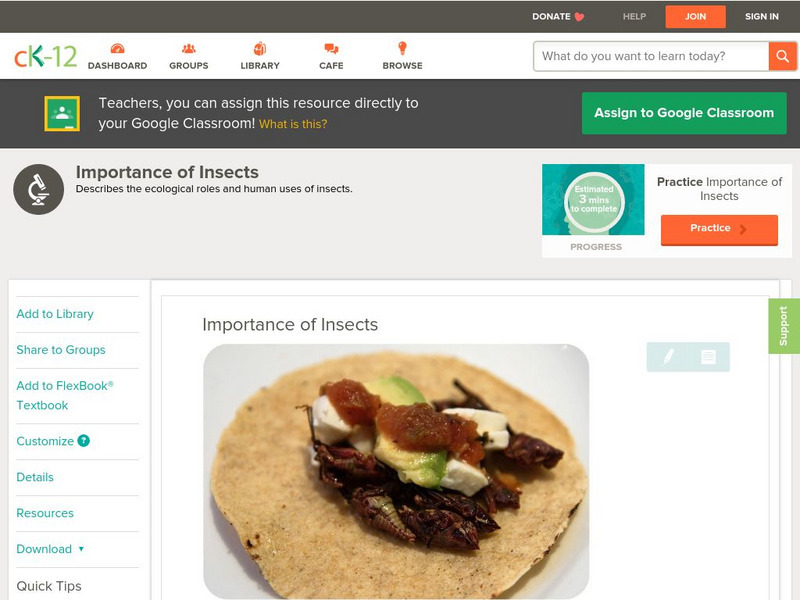
Ck 12: Life Science: Importance of Insects
[Free Registration/Login may be required to access all resource tools.] Many insects are considered to be pests by humans. However, insects are also very important for numerous reasons. Learn more about the importance of insects in this...
CK-12 Foundation
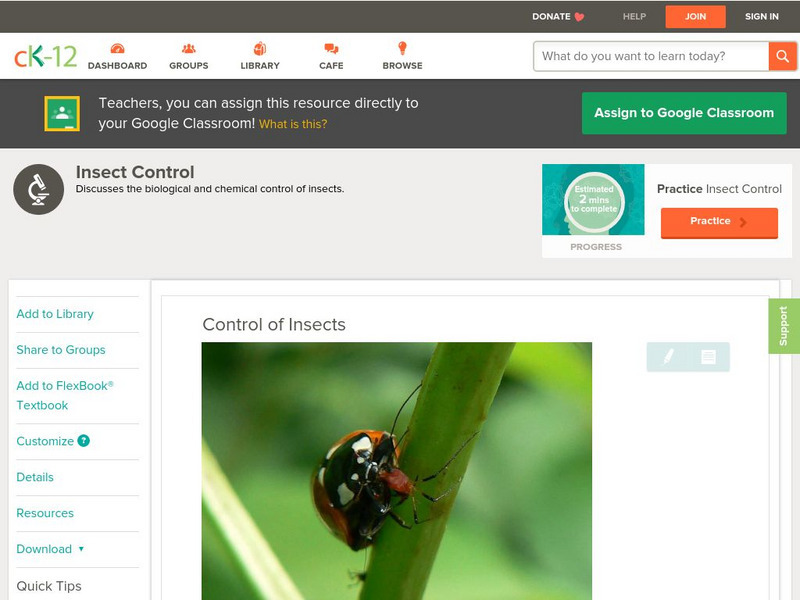
Ck 12: Life Science: Control of Insects
[Free Registration/Login may be required to access all resource tools.] Ladybugs won't hurt you. But they are dangerous to some other insects! Ladybugs eat plant-harming bugs known as aphids. Since they have an appetite for aphids,...
CK-12 Foundation
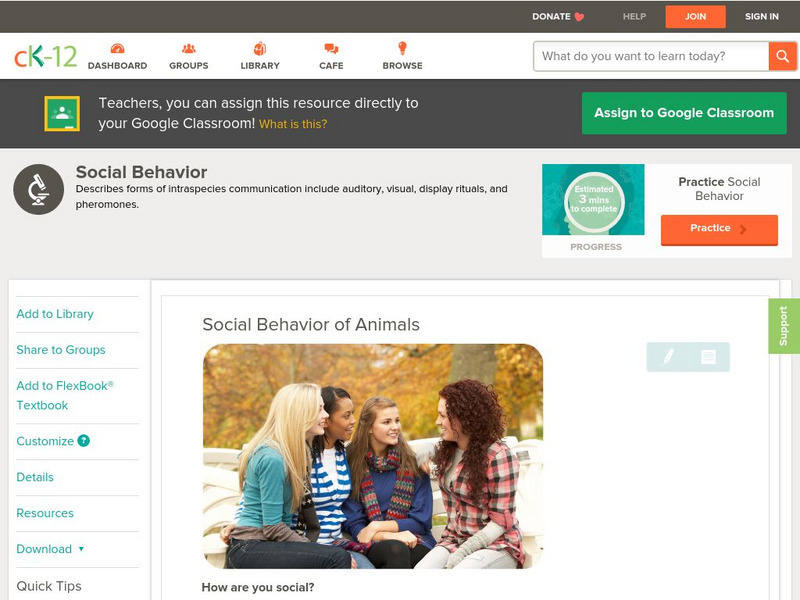
Ck 12: Life Science: Social Behavior of Animals
[Free Registration/Login may be required to access all resource tools.] Why is animal communication important? Without it, animals would not be able to live together in groups. Animals that live in groups with other members of their...
CK-12 Foundation
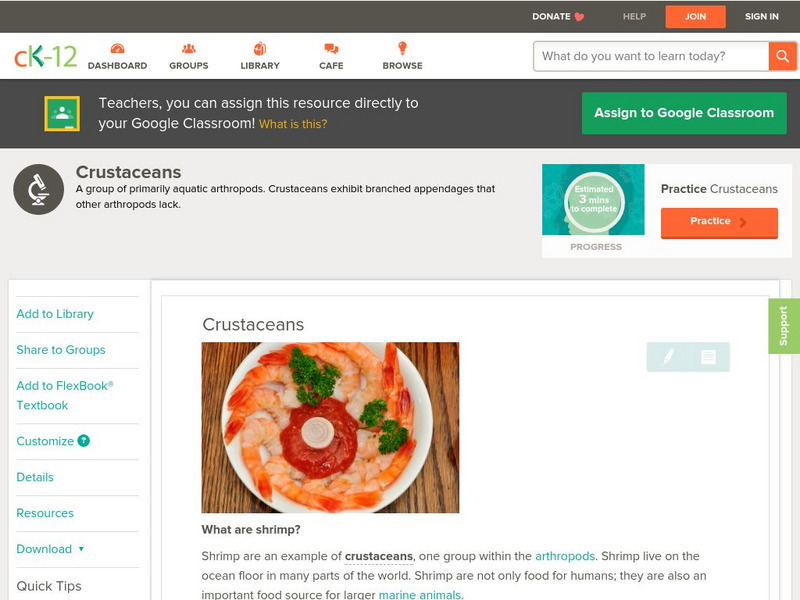
Ck 12: Life Science: Crustaceans
[Free Registration/Login may be required to access all resource tools.] Crustaceans are a large group of arthropods, consisting of almost 52,000 species. The majority of crustaceans are aquatic. A few groups have adapted to living on...