Hi, what do you want to do?






Code.org
Encoding Color Images
Color me green. The fourth lesson in a unit of 15 introduces the class to color images and how to encode color images using binary code and hexadecimal numbers — and they will quickly notice that it is easier to code the...

Teach Engineering
Quantum Dots and Colors
Introduce teams to quantum dot solutions with an activity that has them expose solutions to a blacklight, observe the colors, and take measurements. Groups graph the data and analyze the dependence between particle size and...

Carnegie Mellon University
Consumer Preferences in Lighting
What is a watt? This tongue-twisting, mind-bending question and others are answered through this lesson on the different lighting options available. With the support of a PowerPoint, teach your physical science class about units of...

Teach Engineering
Skin and the Effects of Ultraviolet Radiation
Though UV radiation can damage skin, it isn't all bad. The third installment in a six-part series allows the class to study the structure and function of skin. They learn about the different types of skin cancer and the SPF rating...

University of Colorado
Designing an Open Spectrograph
Take the class over the rainbow. Pairs or small groups follow directions to create a spectrograph. The pupils measure the angles formed by the different colors of the spectrum along with calculating the lengths formed by the spectrum and...

University of Colorado
Designing a Spectroscopy Mission
Design a mission over the rainbow. Small groups spend several weeks together determining a mission related to spectroscopy. The teams build spectrographs and analyze the design to determine whether it will carry out the mission. At the...

Teach Engineering
What Does Light See?
The second installment of a seven-part series focuses on the refraction of light and how it affects the colors we see. Learners consider how this concept connects to biosensors for cancer detection.

Curated OER
Light Week
First graders experiment with prisms to explore sequence of colors of light created.

Teach Engineering
Bubbles and Biosensors
Bubbles aren't just for children. In the third installment of a seven-part series, teenagers use bubble solution to create bubbles and observe patterns of refraction on the bubble surfaces. Application of this concept to thin films in...

Teach Engineering
Glowing Flowers
What a bright idea! Young scientists conduct an experiment on flowers to finish the last of a six-lesson unit on Cells. Putting the stems into dye-injected water and leaving it overnight results in flowers that glow. This is to simulate...

Teach Engineering
Flame Test: Red, Green, Blue, Violet?
Let the true colors shine through. Pupils conduct a flame test to identify an unknown element. Class members calculate and prepare specific molarity solutions of three chemicals. Using their observations of the colors emitted, they...
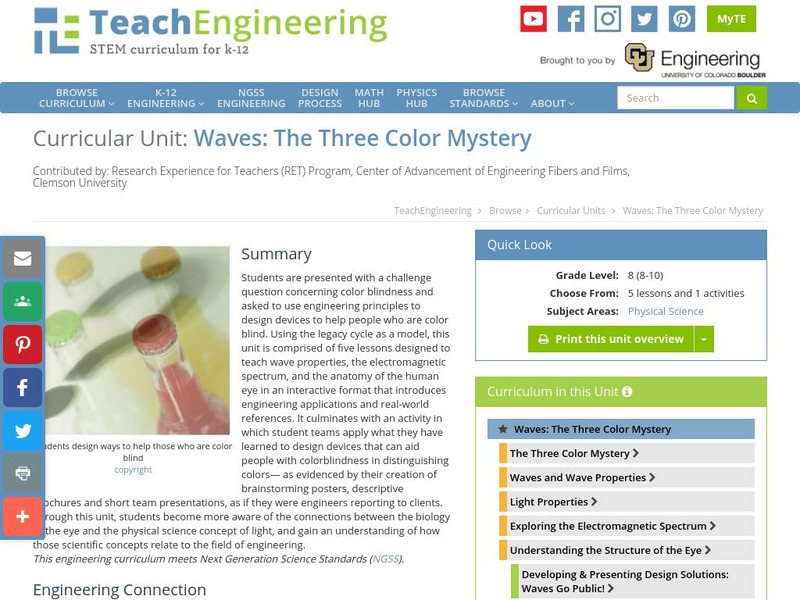
TeachEngineering
Teach Engineering: Waves: The Three Color Mystery
Students are presented with a challenge question concerning color blindness and asked to use engineering principles to design devices to help people who are color blind. Using the legacy cycle as a model, this unit is comprised of five...
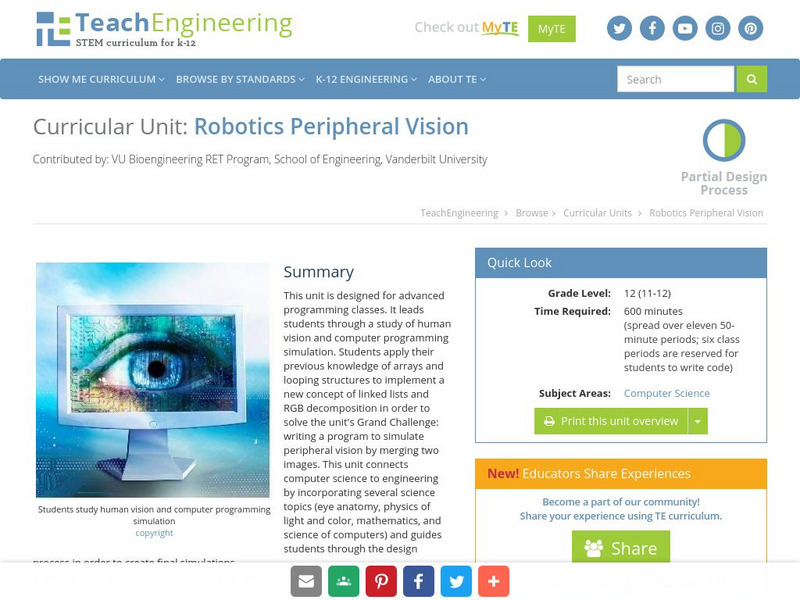
TeachEngineering
Teach Engineering: Robotics Peripheral Vision
This unit is designed for advanced programming classes. It leads students through a study of human vision and computer programming simulation. Students apply their previous knowledge of arrays and looping structures to implement a new...