Hi, what do you want to do?






Multiverse
Rainbows of Light: The Visible Light Spectrum
Rainbows can teach us about the visible light spectrum. Learners observe multiple items that clearly display a rainbow to develop better connections. The lesson plan then explains wavelength using a rope to make...

American Chemical Society
Isolation of Phytochrome
Why do soybean plants that are planted weeks apart in the spring mature simultaneously in the fall? Four independent activities cover the history of phytochrome research, scientist collaboration, the electromagnetic spectrum, and...

It's About Time
Identifying Matter
High schoolers test wood splints that have been soaked in mystery solutions to identify the different colors it produces when lit. The lesson concludes with a reading passage and analysis questions.

Curated OER
Reflection and Refraction
What is a prism? A place for light waves that commit minor refractions! The thorough resource includes three hands-on investigations covering light reflection and refraction; mirrors, lenses, and images; and optical systems. Subject...

Towson University
The Crucial Concentration
Which sports drink provides the best pick-me-up after the big game or grueling workout? It may not be the one you'd think! Food science is the focus in a surprising lab activity. Pupils use colorimetry to determine the amount of protein,...

NASA
Nasa: Tour of the Electromagnetic Spectrum: Visible Light
Visible light waves are the only electromagnetic waves we can see. We see these waves as the colors of the rainbow. Each color has a different wavelength. Red has the longest wavelength and violet has the shortest wavelength. When all...
Khan Academy
Khan Academy: Light and Photosynthetic Pigments
What is light energy? Here we'll learn about the properties of light and how pigments such as chlorophylls absorb light energy.
Physics Classroom
The Physics Classroom: Light Waves and Color
The behavior of light waves is introduced and discussed. Also, polarization, color, diffraction, and interference are introduced and discussed thoroughly as supporting evidence of the wave nature of light.
Other
Fluorescent Mineral Society: The Ultraviolet Spectrum
This resource presents a discussion of the nature and properties of ultraviolet light. The manner in which minerals emit UV light is described and explained.
Science Struck
Science Struck: Wavelength of Visible Light Spectrum
Explains where visible light fits into the electromagnetic spectrum and the wavelengths for the different colors we see.
Science Struck
Science Struck: Color Spectrum Chart With Frequencies and Wavelengths
Read about the visible light spectrum and learn the frequencies and wavelengths for each of the primary and secondary colors.
NASA
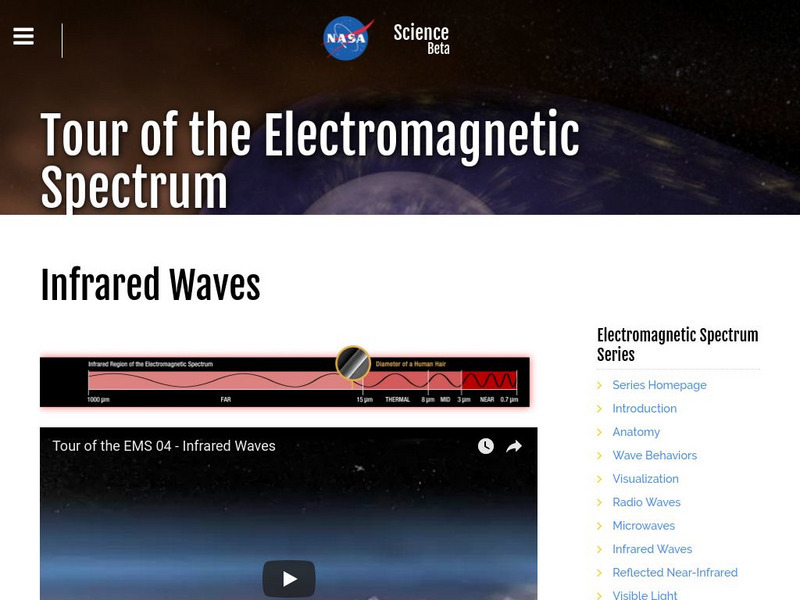
Nasa: Mission: Science: Electromagnetic Spectrum: Infrared Waves
Infrared light lies between the visible and microwave portions of the electromagnetic spectrum. Infrared light has a range of wavelengths, just like visible light has wavelengths that range from red light to violet.
Johns Hopkins University
The Electromagnetic Spectrum
NASA related site shows the entire Electromagnetic Spectrum. Provides a brief description of the expansive colored spectrum as well as a related link that provides more details.
NASA
Nasa: Space Place: The Electromagnetic Spectrum
Find out how energy, frequency, and wavelength are related in terms of the electromagnetic spectrum.
Georgia State University
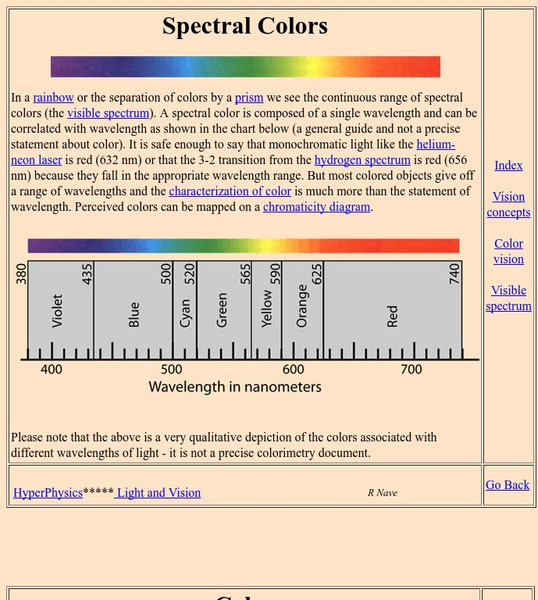
Georgia State University: Hyper Physics: Color
This site from Georgia State University discusses the location of visible light on the electromagnetic spectrum. Includes the wavelength values for various colors of light within the visible light spectrum.
Science Struck
Science Struck: Emission Spectrum vs. Absorption Spectrum
Explains the difference between an emission spectrum and an absorption spectrum, and describes each as well as their applications.
American Museum of Natural History
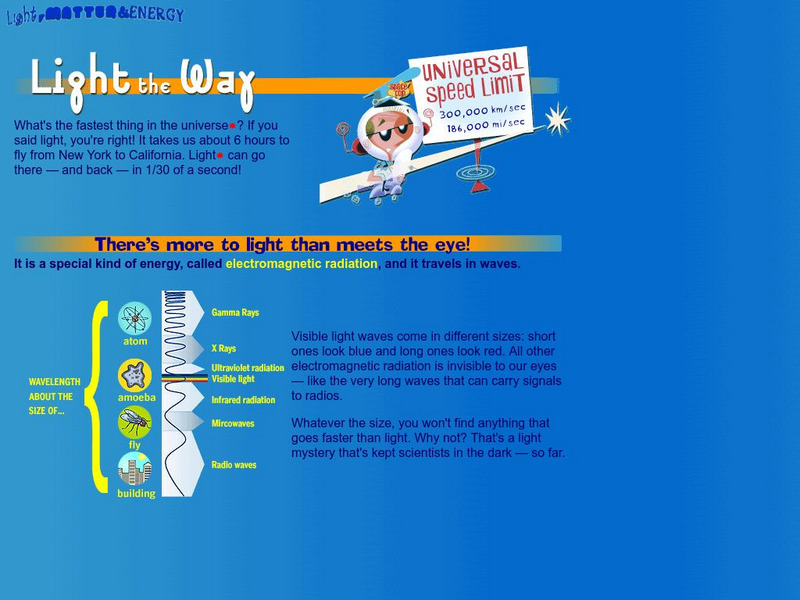
American Museum of Natural History: O Logy: Light, Matter, Energy: Light the Way
What is electromagnetic radiation and how does it work? Review a captioned graphic that explains electromagnetic radiation and the visible and invisible types of radiation on the electromagnetic spectrum.
Science Struck
Science Struck: Wavelength of Light
Describes the characteristics of light, presents two formulas for calculating its wavelength, and provides a table of the different wavelength ranges across the electromagnetic spectrum.
Science4Fun
Science4 Fun: Light
What is light? Illustrated discussion of the speed of light, how we see colors, and how light helps us.
NASA
Electromagnetic Spectrum: Ultraviolet Waves
Ultraviolet (UV) light has shorter wavelengths than visible light. Though these waves are invisible to the human eye, some insects can see them. The specific wavelength values are given. Uses and applications of these waves are explained.
Georgia State University
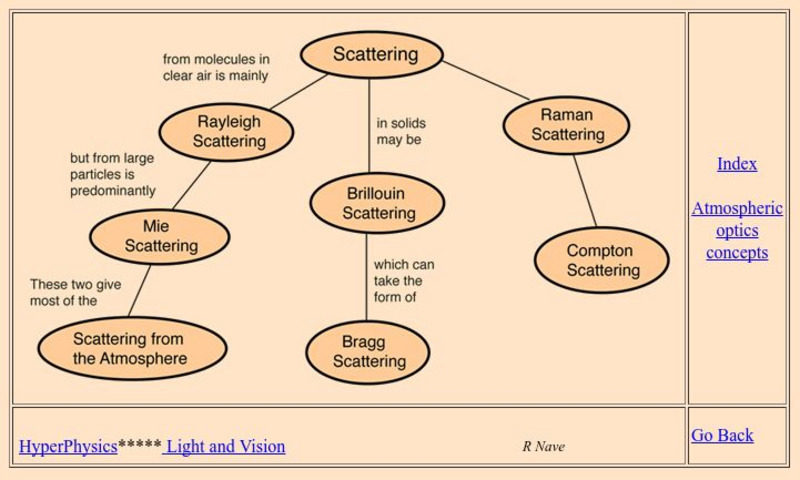
Georgia State University: Hyper Physics: Scattering Concepts
A collection of several pages explaining the principles which underlie Rayleigh scattering of light.

Georgia State University
Georgia State University: Hyper Physics: Wave Particle Duality
The dualistic nature of light is discussed. The photoelectric effect and the Davisson-Germer experiment are contrasted as empirical evidence supporting each of the two views - particle and wave - of the nature of light. The photoelectric...
Physics Classroom
The Physics Classroom: Blue Skies and Red Sunsets
This high school resource shows how the blue of the skies and the red of the sunsets can be explained by the interaction of sunlight with atmospheric particles which causes scattering of light.
Science Struck
Science Struck: Visible Color Spectrum Wheel
A brief explanation of the visible color wheel.
Other popular searches
- Visible Light Spectrum
- Light Spectrum Stars
- Light Spectrum Waves
- Light Spectrum Activity
- Light Spectrum and Colors
- Light Spectrum and Waves
- Newton's Light Spectrum
- Light Spectrum \ Stars
- Spectrum of Light
- Spectrum Light