Hi, what do you want to do?






Curated OER
Fun with Electromagnets
Junior scientists work in groups to construct electromagnets. They experiment by varying number of wraps around the nail, the diameter of the nail, and the type of metal the nail is made of to see if any of these factors has an...

Curated OER
Detecting Disease
In this detecting disease worksheet, students will review the different tools scientists use to identify diseases including the steps of Koch's postulates. This worksheet has 14 fill in the blank and 4 short answer questions.

Curated OER
Using Magnetotactic Bacteria to Study Natural Selection
Students demonstrate that living organisms may possess incredible adaptations which enable them to survive. They observe bacteria that are able to orient themselves using the Earth's magnetic field and formulate a hypothesis as to how...

It's About Time
Electromagnets
Young scientists build their own electromagnet and test it by picking up paperclips. Analysis questions evaluate knowledge at the end of the activity.

Curated OER
The Aurora
Students study the Aurora Borealis lights known commonly as the Northern and Southern lights. In this space science lesson, students study pictures of the Auroras for Jupiter and Saturn. Students visit the given website for an...

It's About Time
AC and DC Currents
An informative physics lesson includes two teacher demonstrations, one on AC currents and the other on DC currents, allowing pupils to take notes while watching. The resource includes questions to assign as homework or...

Curated OER
Making a Sun Clock
In this clock construction lesson, young scholars use a pencil, compass, and sun clock diagram to construct a homemade sun clock. A very interesting lesson on combining images with text.

Curated OER
So Many Inventions!
Students read two books about Chinese inventions such as the compass, kite or dominoes. They bring in examples of Chinese inventions from home and create a class gallery. They make a compass in class.

Curated OER
Compass Building Instructions
Students build their own compass following a given procedure. In this technology lesson, students explain how a compass is used in navigation. They trace the history of its development.

Curated OER
Galvanometers
Learners construct their own galvanometer. In this physics lesson, students explain how it is used to detect electric current. They conduct an experiment to measure how much electricity flows through the circuit.

Curated OER
Origins: Earth Is Born
Students develop a timeline of all the major events involved in the formation of the Earth and the emergence of humans. In groups, they focus on a specific topic by watching a PBS program and taking notes. After the video, they list...

Curated OER
The Electromagnetic Crane
Students explore electromagnetism, simple machines and the design process. They use the concepts of electromagnetism to design and build a device that uses an electromagnet, a pulley and a lever using the provided Engineering Design...

Curated OER
So Many Inventions!
Students listen to a teacher read aloud of two books about Chinese inventions. They examine some items that were invented by Chinese inventors such as dominoes, an abacus, a silk scarf, or kite. Next, they determine how a compass works...

Curated OER
Plasmasphere
In this plasmasphere worksheet, students determine how long the plasmasphere takes to rotate around the Earth using two satellite images taken three hours apart.

Curated OER
Navigation Across the Seas
Young scholars examine nautical navigation and discover the differences between nautical charts and other types of maps or charts. Students practice setting a course, taking a bearing, and dead reckoning. This gives young scholars an...

Curated OER
Plasma
In this matter worksheet, students review the states of matter, including plasma. Students read about where plasma is found and then complete 3 short answer questions.

Curated OER
Timing An X-ray Pulsar
Students use X-ray data to identify an object as a rotating neutron star, and determine its period of rotation. They use XTE observations of the Crab Pulsar to determine the period of the light intensity, interpret this period as the...

Curated OER
The Invention of Faraday Cage
Young scholars demonstrate how Faraday's cage work by building their own electroscope. In this physics lesson, students explain how Faraday's cage work. They cite several applications of this principle in the real world.

Curated OER
The Invention of the Telephone
Students study the history of the telephone and its inventor. In this communications lesson plan students complete a tuning fork experiment to further demonstrate how sound is produced.

Georgia Department of Education
Ga Virtual Learning: Forces on Moving Charges in Magnetic Fields
In this interactive tutorial students will explore magnetic force. Students will observe interactions of magnets and study magnetic fields. The source of magnetic properties is believed to be moving charge. Since moving charge produces...
TeachEngineering
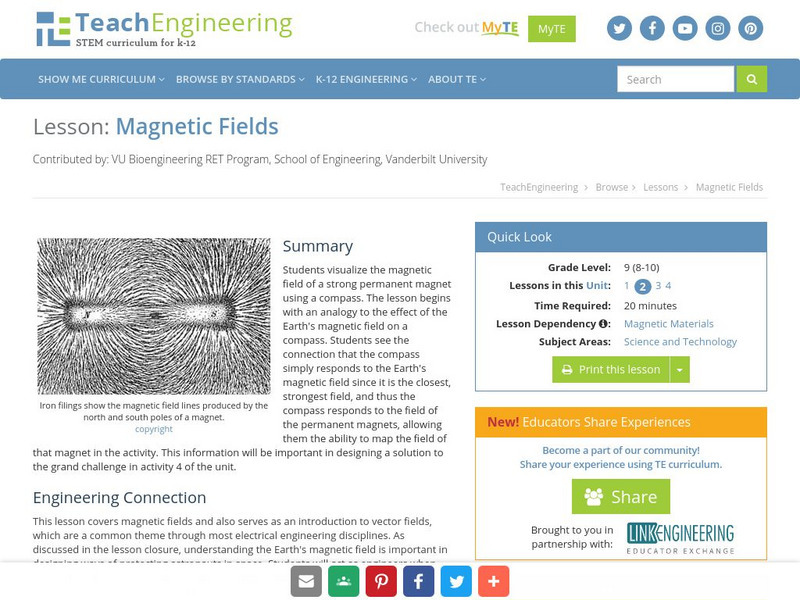
Teach Engineering: Magnetic Fields
Students visualize the magnetic field of a strong permanent magnet using a compass. The lesson begins with an analogy to the effect of the Earth's magnetic field on a compass. Students see the connection that the compass simply responds...
TeachEngineering
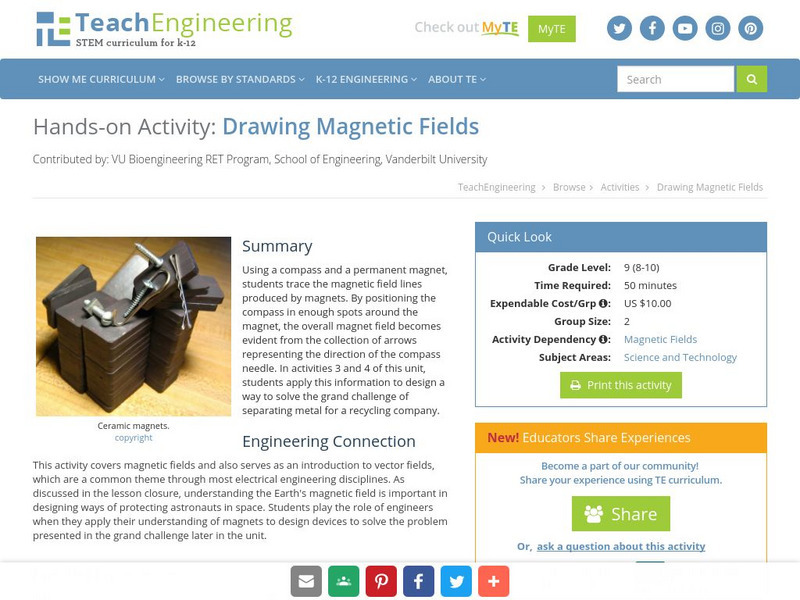
Teach Engineering: Drawing Magnetic Fields
Students use a compass and a permanent magnet to trace the magnetic field lines produced by the magnet. By positioning the compass in enough spots around the magnet, the overall magnet field will be evident from the collection of arrows...
NASA
Nasa: Magnetic Fields
This site from NASA provides a short, illustrated description of the basics of magnetic fields and magnetic poles.
CK-12 Foundation
Ck 12: Earth Science: Earth's Magnetic Field
[Free Registration/Login may be required to access all resource tools.] Examines Earth's magnetic field.