Hi, what do you want to do?






Teach Engineering
Straw Bridges
Pairs work as engineering teams to design and build model bridges from drinking straws and tape. In this third segment in a series of 10, teams compete in an attempt to build the strongest bridge. To help with the design, the groups...

Teach Engineering
Bridge Types: Tensile and Compressive Forces
Bridges rely on tension and compression to keep them standing. Pairs test this principle by constructing simple bridges and applying a force to the center. Teams use the provided activity to record their observations of the...

Oregon Department of Education
Building Number Sense
It's never too early to begin a child's math education. This collection of fun hands-on activities engage youngsters in building their number sense as they learn how to count objects, identify numerals, compare amounts, and much more.

Math Learning Center
Grade 1 Supplement Set A4 – Number and Operations: Equivalent Names
Engage young mathematicians in developing their basic arithmetic skills with these great hands-on activities. Using Unifix® cubes to model a variety of single digit addition and subtract problems, children build a basic...

Math Learning Center
Grade 1 Supplement Set A5 – Number and Operations: Place Value
First graders work together to sort, categorize, and order collections of objects through activities that help build number sense.

Teach Engineering
Machines and Tools (Part 2)
Which pulley system will give us a whale of a good time? Teams compare the theoretical and actual mechanical advantages of different pulley systems. They then form a recommendation for how to move a whale from an aquarium back to the ocean.

Illustrative Mathematics
Christo’s Building
Hook your charges on how to solve a real-world art problem with mathematics by showing works of Christo. You can find eye-catching images on the Christo and Jeanne Claude webpage. Here, math learners help Jean Claude and Christo prepare...

Teach Engineering
Ranking the Rocks for Desired Properties
Math rocks! Cavern design teams determine the rankings of rock types based upon desirability points. The points are connected to the properties of the rocks and their usefulness in building a cavern.

Teach Engineering
A Good Foundation
It takes a strong foundation to build a house and a stronger one for a bridge. This resource presents the effects of geology and soil on bridge foundations. Working in groups, the class investigates the interaction of shallow and deep...

Teach Engineering
Load It Up!
See how a marshmallow can hold up a bridge load. Teams take a closer look at the design of bridge piers. They determine the types of loads that might affect a bridge, and, using that information, they calculate the needed cross-sectional...

Teach Engineering
Cost Comparisons
Our final proposal for the cost of the bridge requested is ... In the last segment in a series of 10, pairs work together to develop a proposal for a city bridge design. The class completes a cost comparison between concrete and steel to...

Teach Engineering
Breaking the Mold
A little too much strain could cause a lot of stress. Groups conduct a strength test on clay. Using books as weights, pupils measure the compression of clay columns and calculate the associated strain and stress. Teams record their...

Teach Engineering
Protecting Our City with Levees
Teams use the design process to design, build, and test a model levee to protect the town from a wall of water. A handout provides a price list for the materials learners can use to build their levee within a budget.

Teach Engineering
Gumdrop Atoms
There's nothing sticky about the resource, unless you count the gumdrops! Scholars create a model of a lithium atom, complete with protons, neutrons, and electrons. It's just that these models are made with gumdrops and toothpicks.

Teach Engineering
A Simple Solution for the Circus
Class members are challenged to design a device that will move a circus elephant into a train car. Groups brainstorm ideas that use simple machines to load the elephant. They then choose one of their ideas, sketch a plan, and present it...
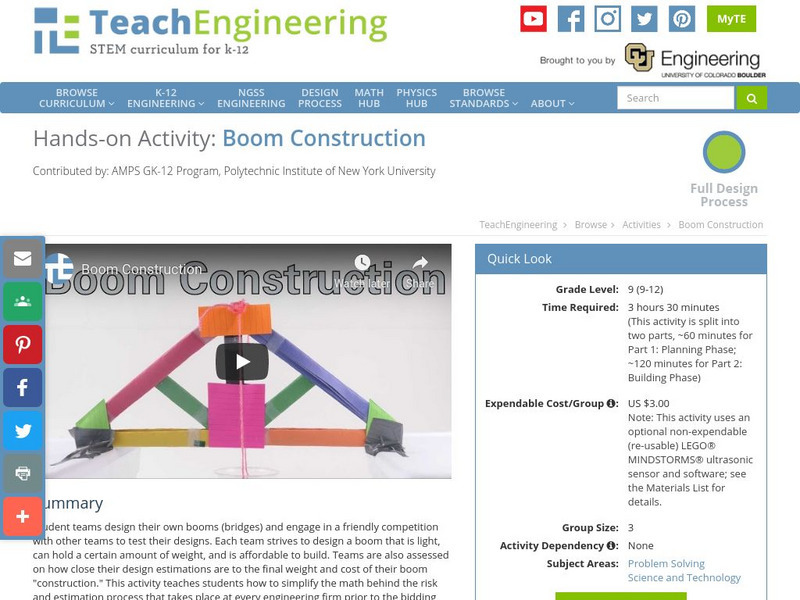
TeachEngineering
Teach Engineering: Boom Construction
Student teams design their own booms (bridges) and engage in a friendly competition with other teams to test their designs. Each team strives to design a boom that is light, can hold a certain amount of weight, and is affordable to...
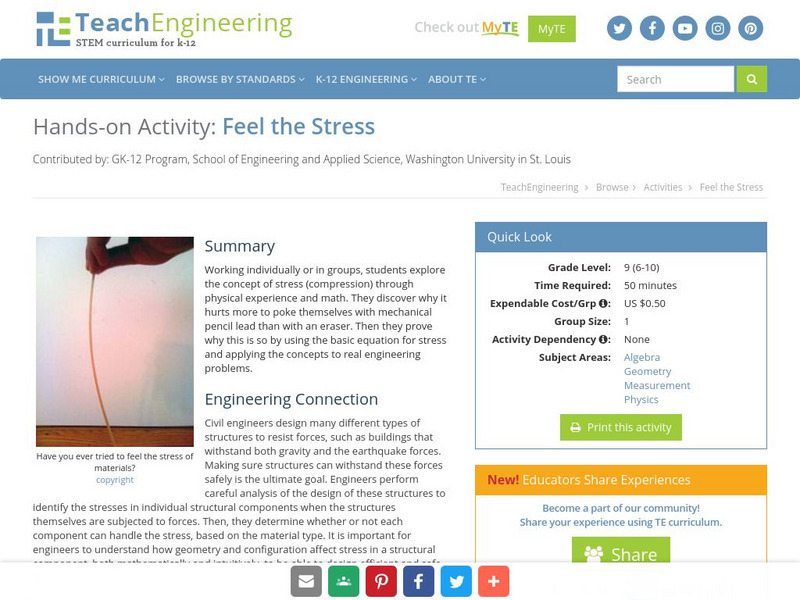
TeachEngineering
Teach Engineering: Feel the Stress
Working individually or in groups, students explore the concept of stress (compression) through physical experience and math. They discover why it hurts more to poke themselves with mechanical pencil lead than with an eraser. Then they...