Hi, what do you want to do?






Teach Engineering
How Big? Necessary Area and Volume for Shelter
Teams must determine the size of cavern needed to house the citizens of Alabraska to protect them from the asteroid impact. Using scaling properties, teams first determining the number of people that could sleep in a classroom and then...

Teach Engineering
What is a Nanometer?
Teams learn about the size of a nanometer by measuring objects and converting those measurements. A worksheet then tests the groups' abilities to use nanometers by having them determine the size of objects that are too small to...

Howard Hughes Medical Institute
What van Leeuwenhoek Saw
When van Leeuwenhoek saw cells and single-celled organisms for the first time, he knew these small things were a big deal! Share his discoveries with young learners through a narrated video, model-building activity, and scale study....

National Nanotechnology Infrastructure Network
The Pinch Test
Test your pupils' understanding of the scale from macro to atomic. While displaying images of different materials, learners identify what they would need to make that material visible. Their choices range from the human eye to an...

Illustrative Mathematics
Paper Clip
With minimal setup and maximum freedom, young geometers are encouraged to think outside the box on a seemingly simple application problem. Though the task seems simple, measuring a given paper clip and finding how many 10 meters can...

Exploratorium
Tired Weight
You don't need a scale to determine weight. This activity provides a way to use the concepts of air pressure and surface area to determine the weight of a vehicle by calculating the amount of weight each tire supports.

National Nanotechnology Infrastructure Network
Shrink Me!
The incredibly shrinking meter—decimeters to centimeters, to millimeters, and now to nanometers! Learners may have a difficult time visualizing particles on a nanoscale. Help them see a little clearer using a well-designed lesson...

National Nanotechnology Infrastructure Network
What’s In Your Neighborhood?
Chart your way to an understanding of nanoscale. Using a Google map, learners estimate a radius around their location of 1,000 and 1,000,000 meters. Predicting what 1,000,000,000 meters would look like takes them off the charts!...

Illustrative Mathematics
How Thick Is a Soda Can I?
The humble soda can gets the geometric treatment in an activity that links math and science calculations. After a few basic assumptions are made and discussed, surface area calculations combine with density information to develop an...

National Nanotechnology Infrastructure Network
The Micro and Macro World Around Us
Don't let your eyes play tricks on you ... use scale to keep your eyes in check! Young scholars observe images without scale and try to identify the structure. Then, they look at the same image with a scale bar and assess whether their...

Curated OER
Ant and Elephant
Have you ever wondered how many ants make up an elephant? Inquisitive minds will be amazed as they use scientific notation to compute and compare the mass of an elephant to an ant. Have participants make guesses and see how close they...

Exploratorium
Tired Weight
Take your class out to visit your automobile and use the tires to compute the weight of the vehicle. This is done by measuring the surface of the tire meeting the ground and the air pressure. This is a fun lesson in the relationship...

Teach Engineering
Human Power
How many humans does it take to power a light bulb? The 10th part of a 25-lesson Energy Systems and Solutions unit has learners conduct an experiment to calculate power. They then use the results to determine how many classmates they...
Other
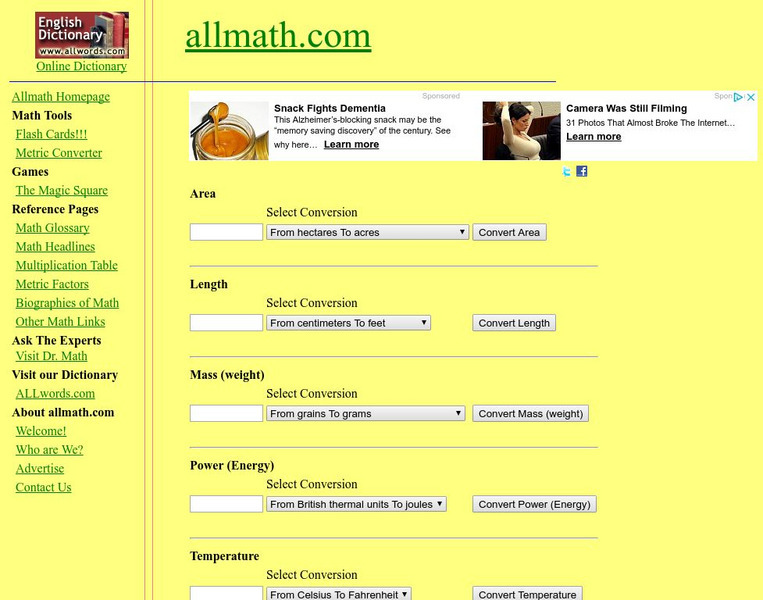
Allmath.com: Metric Converter
Use this converter to find equivalent units for a measure. You can convert measures for area, length, weight, temperature, and volume.

CK-12 Foundation
Ck 12: Plix: Metric Prefixes: Decimal Conversions
[Free Registration/Login Required] In this interactive you will move the point to different metric prefixes and observe how the decimal point moves and the value of the number changes. You will need a sign-in to access this media, but it...
Texas Instruments
Texas Instruments: Imperial to Metric Time Line
A number line showing the conversion of Imperial units to Metric units.
Texas Instruments
Texas Instruments: Metric to Imperial Time Line
A number line showing the conversion of Metric units to Imperial units.
Math Is Fun
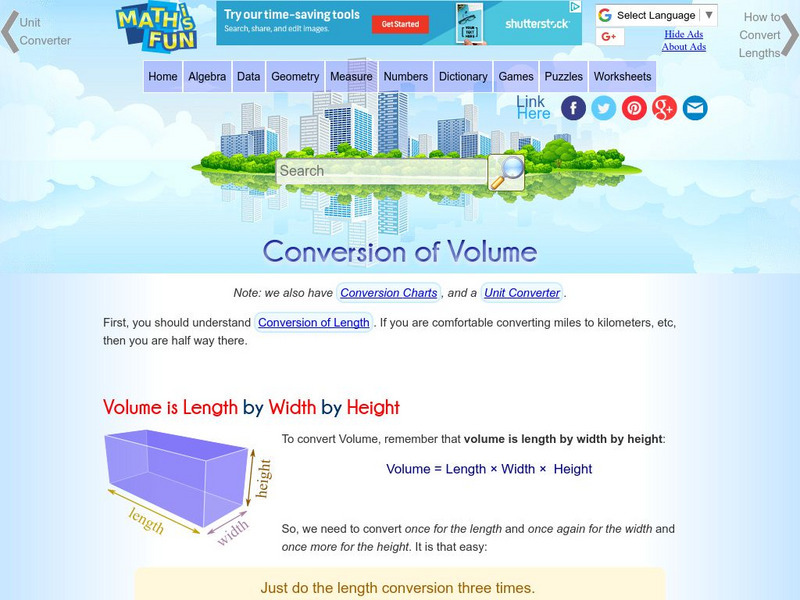
Math Is Fun: Conversion of Volume
Find guidelines and examples that will help you convert volume from standard to metric units. If you need extra help, refer to the conversion chart, linked to at the top of the page.
Texas Instruments
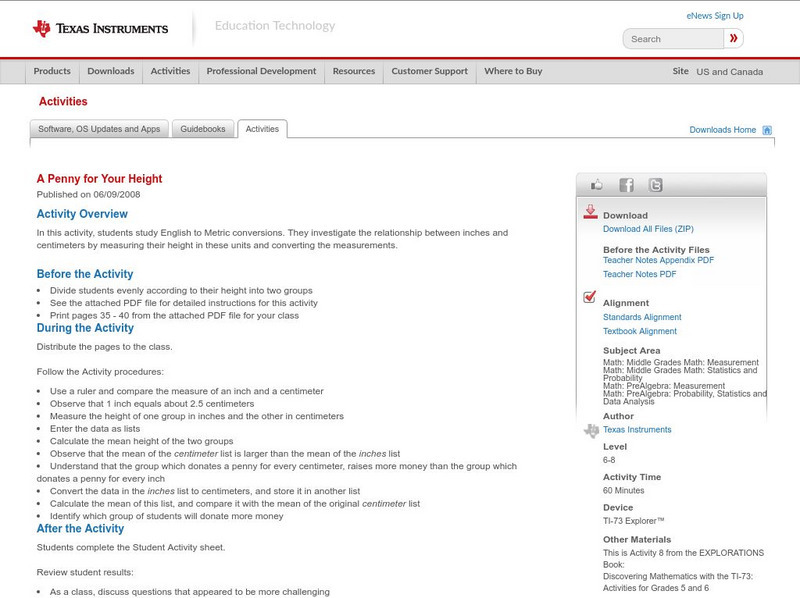
Texas Instruments: A Penny for Your Height
In this activity, students study English to Metric conversions. They investigate the relationship between inches and centimeters by measuring their height in these units and converting the measurements.
Texas Instruments
Texas Instruments: Units and Conversion
This StudyCards stack enables students to review and practice using the metric system of measurement.

Math Is Fun
Math Is Fun: How to Convert Metric to Imperial
Simple steps and examples to help you convert metric measurements to Imperial units. Use a Metric - Imperial Conversion Chart as a reference.
Math Is Fun
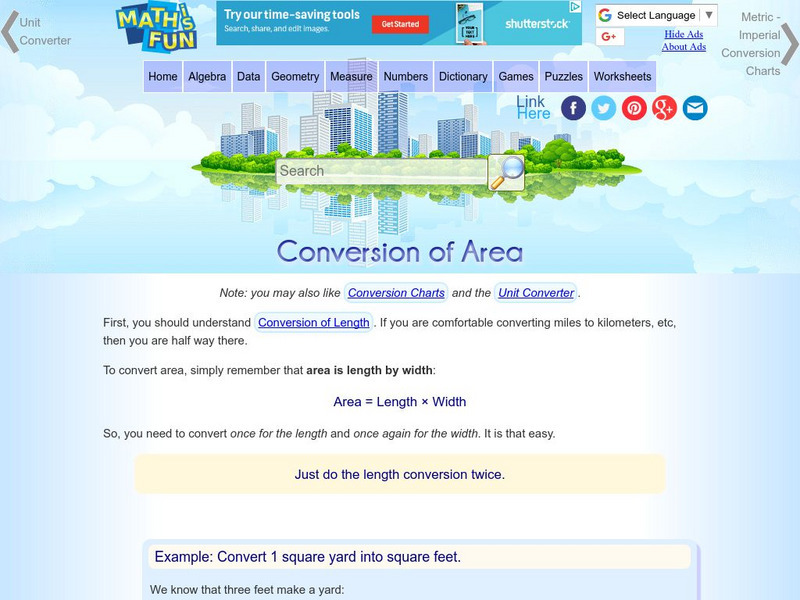
Math Is Fun: Conversion of Area
View examples to learn how to convert area in square feet to area in square meters. If you need help, follow a link to a conversion chart.
Other
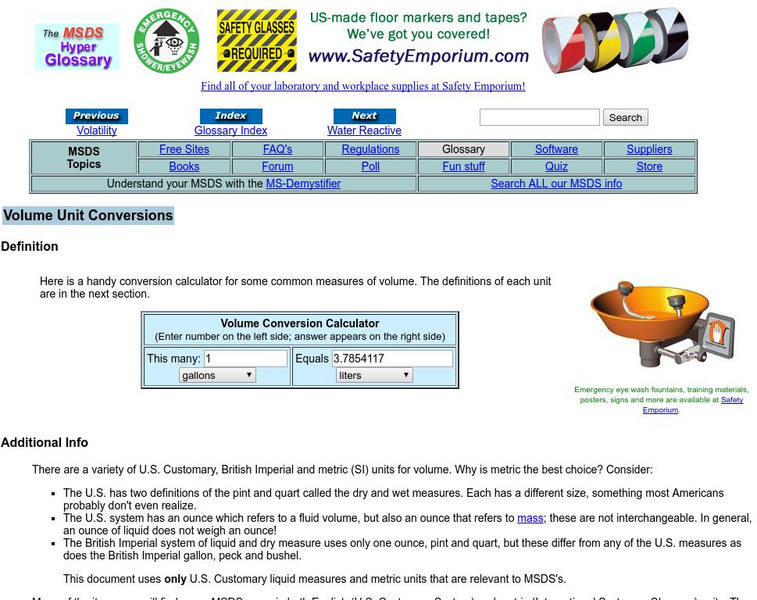
Interactive Learning Paradigms: Volume Unit Conversions
Learn the units of volume measurement. Page includes a conversion calculator, information about the metric system, and numerous links to other relevant material.
Texas Instruments
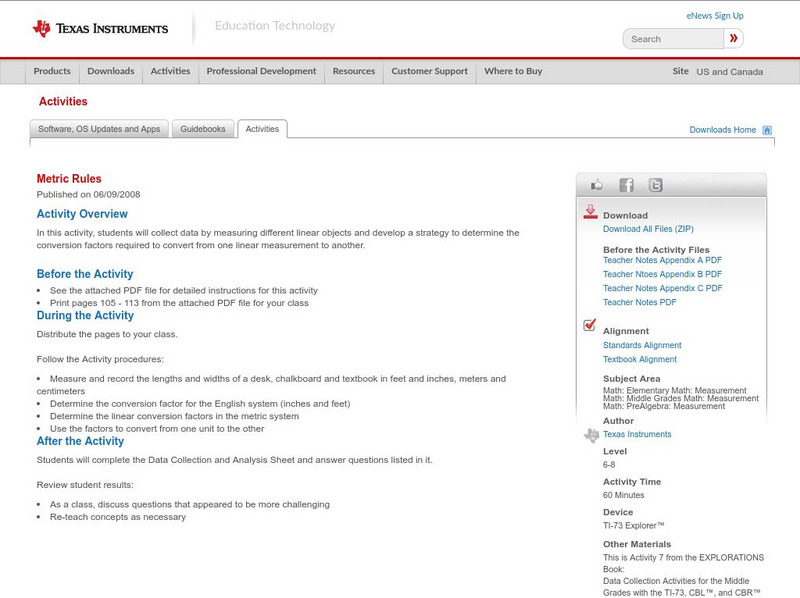
Texas Instruments: Metric Rules
In this activity, students will collect data by measuring different linear objects and develop a strategy to determine the conversion factors required to convert from one linear measurement to another.