
Curated OER
Current Interactions
High schoolers design an experiment to see how wind, temperature, and salinity work together to influence ocean currents and present it in a report format. They explain to their classmates how experiment findings relate to ocean currents.

Curated OER
Health and growth
Young scholars examine ways for people to stay healthy, such as exercising and eating right.

Curated OER
Interdependence and Adaptation
Fifth graders construct a food web to illustrate how animals and plants are interdependent. In this interdependence lesson, 5th graders identify how consumers, producers, herbivores, carnivores and predators are related in a habitat....

Curated OER
Taro
Students locate taro growing areas on a map and how it got there, explain intercultural contact and how taro has been adapted in Hawaii and trace human/taro migration to Hawaii.

Curated OER
Weather
In this weather worksheet, students will match 4 weather terms to their correct definition. Vocabulary words include wind, weather, air mass, and front. Then students will complete 3 short answer questions based on high and low air...

Curated OER
I'm Not In Range
Students discover how cell phone service works while participating in a role play activity. They identify its advantages and disadvantages based on service. They examine how engineers use this information to develop better...

Curated OER
Weather Predictions
Fourth graders explore meteorologists. They explore symbols on a weather map and make five day forecasts.

Curated OER
Adapted to Fire
Fourth graders explore forest species' adaptations to fire by participating in a scavenger hunt and mapping a burned forest. Students create maps and explore how indigenous species adapted to living with fire.

Curated OER
What is Migration
Students conduct individual research and participate in discussion be able to identify difference between forced and voluntary migration. They identify if push and pull factors are caused by political, social, economic, or environmental...

Curated OER
Keeping Warm
Students participate in an online activity to determine how objects heat and cool. They determine what objects best serve as thermal insulators.

Curated OER
Habitats
Students participate in an online lesson to determine that different plants and animals are found in different habitats. They use food chains to show feeding relationships in a habitat, and see that nearly all food chains start with a...

Curated OER
Light and Shadows
Students participate in an online lesson to determine how light travels from a source, and to explain that shadows form when light travelling from a source is blocked.

Curated OER
Gases Around Us
Students participate in an online lesson showing that gases are formed when liquids evaporate and that when a gas is cooled, it condenses to form a liquid, and gases move and flow more easily than liquids, and how gases differ from solids.

Curated OER
Micro-organisms
Students examine how micro-organisms are living organisms that are often too small to be seen. They explain that micro-organisms may be beneficial or harmful.

Curated OER
Weather Records
Learners write newspaper articles using a "weather record" worksheet and information they find in newspapers.

CK-12 Foundation
Ck 12: Earth Science: Revolutions and Rotations of the Earth Study Guide
[Free Registration/Login may be required to access all resource tools.] Summarizes the key points about how our understanding of the Earth's movements evolved from ancient times and what we know today. Includes some questions to check...
Annenberg Foundation
Annenberg Learner: Essential Science for Teachers: Earth and Space 3
Visit an active volcano site to find out the connection between the movement of the Earth's plates and the processes deep within the Earth's interior. [58:23]
Science Education Resource Center at Carleton College
Serc: Let's Build the Earth!: The Structure of the Earth's Crust and Interior
In this activity, students will make observations then construct a "sample" model representation of the Earth's layers. They will compare and contrast the movement and material in each layer explaining the location and what it contains.

US Environmental Protection Agency
Epa: The Spirit of the First Earth Day
This article is an in-depth description of the first Earth Day, and includes the impact the demonstration had on the environmental movement.
PBS
Pbs Learning Media: The Lowdown: Brief History of the First Earth Day and What We Can Learn From Its Success Lesson Plan
Earth Day grew out of the environmental movement in the late 1960s in response to a series of environmental disasters that took lives, marred natural beauty and threatened animal species. An estimated 20 million Americans participated in...
Digital History
Digital History: The Earth First, 1960's
This excellent resource provided by Digital History contains a wealth of information on the environmental movement of the 1960s in America, as well as the rest of the century.
PBS
Pbs Learning Media: Mountain Maker, Earth Shaker
This interactive activity adapted from A Science Odyssey Web site helps you visualize different types of plate tectonic activity and shows the impact this activity has on Earth's surface.

TED Talks
Ted: Ted Ed: The Sun's Surprising Movement Across the Sky
Suppose you placed a camera at a fixed position, took a picture of the sky at the same time every day for an entire year, and overlaid all of the photos on top of each other. What would the sun look like in that combined image? A...
European Space Agency
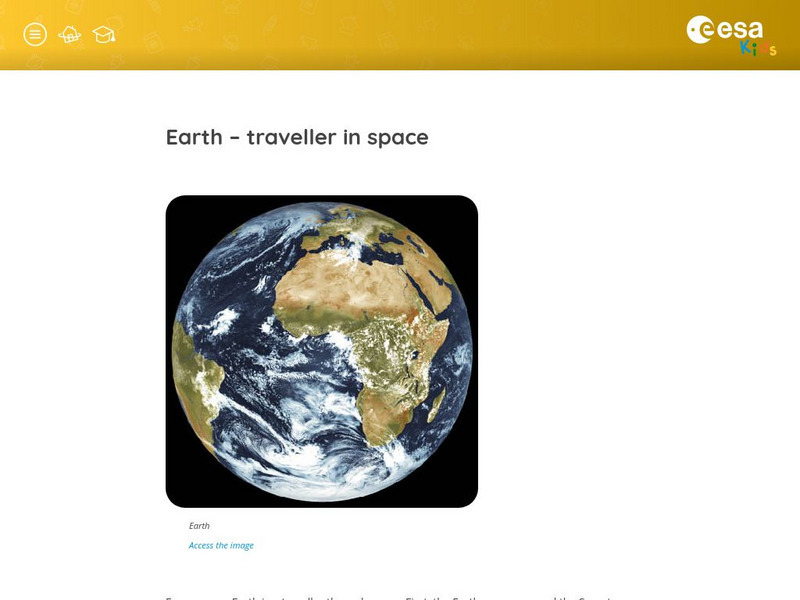
European Space Agency: Esa Kids: Our Universe: Earth
A basic overview of the planet Earth. Links to information about the other planets and objects in our solar system are included.