Hi, what do you want to do?






American Museum of Natural History
Mesozoic Museum
Mini museum curators create an exhibit that showcases the Mesozoic era. Pupils use their knowledge of dinosaurs to make informative posters, drawings, and dioramas. Following three steps to complete the hands-on activity, scholars read...

National Park Service
The Young Naturalist
Beginning with a brief history of our 26th president, Theodore Roosevelt, then followed by a discussion of his interest in nature, young scientists take to the outdoors to locate and observe local plants and insects....

Curated OER
The Effect of Natural Selection on Genes, Traits and Individuals
Rotating through five stations, evolutionary biologists explore the question of how changes in DNA facilitate the changes in a population over time. High-quality, colorful cards of animals, skeletons, skulls, and DNA sequences can all be...

K-State Research and Extensions
You Ol’ Fossil
Geologists are gneiss, tuff, and a little bit wacke. The fifth chapter of seven includes ten activities at four different levels. The hands-on activities cover fossils including how they are formed, vertebrates, invertebrates,...

American Museum of Natural History
Draw a Monarch Butterfly: Scientific Illustrations
One doesn't have to be an artist to appreciate nature. A thorough resource shows pupils how to create detailed illustrations of a monarch butterfly. The lesson highlights the benefits of creating scientific drawings as opposed to simply...

American Museum of Natural History
Create a Coral Reef
Scholars create a diorama to showcase a vibrant coral reef. Six steps walk pupils through setting up the diorama box, crafting four different types of marine life, and putting it all together.

Early Childhood Learning and Knowlege Center
My Body My Senses
In a comprehensive unit of activities, learners explore the five senses. Youngsters discover the many different body parts and their functions that allow humans to have sense of sight, touch, smell, taste, and hearing. The best way to...

American Museum of Natural History
Create Your Own Time Capsule
The corona virus pandemic is indeed a historic event. A time capsule activity permits young historians to document these days of social distancing, remote learning, and quarantine by collecting artifacts that capture what their lives are...

American Museum of Natural History
Draw a Monarch
Five steps walk scholars through the process of drawing a Monarch butterfly. Participants research the insect, make observations, trace, then color.
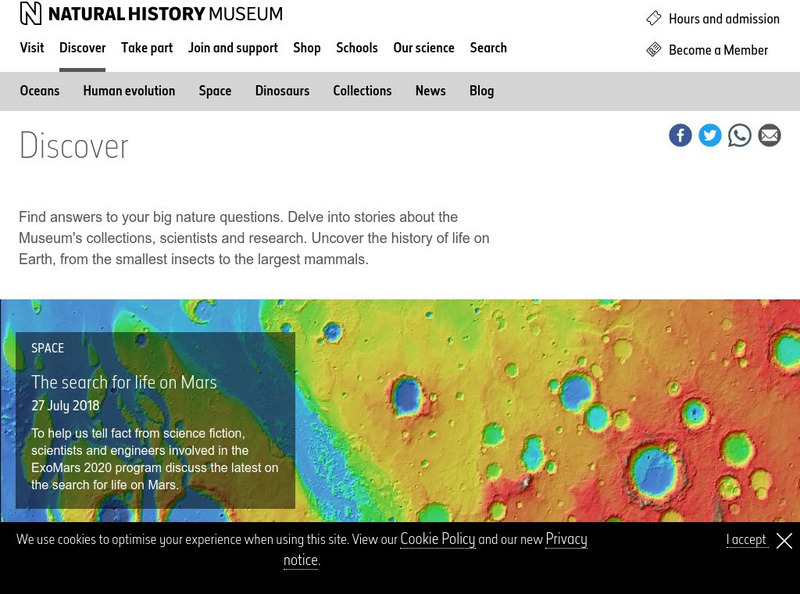
Natural History Museum
Natural History Museum: The Oceans
This online exhibit from the Natural History Museum is home to ten units covering various aspects of the world's oceans including frozen oceans, deep oceans, barnacles, coral reef, deep-sea fish, sponges, vents, and more.

Natural History Museum
Natural History Museum: Volcanoes and Earthquakes
As an online exhibit from the Natural History Museum, this site provides three videos on natural processes of Earth. The videos cover tsunamis, earthquakes, and volcanoes.
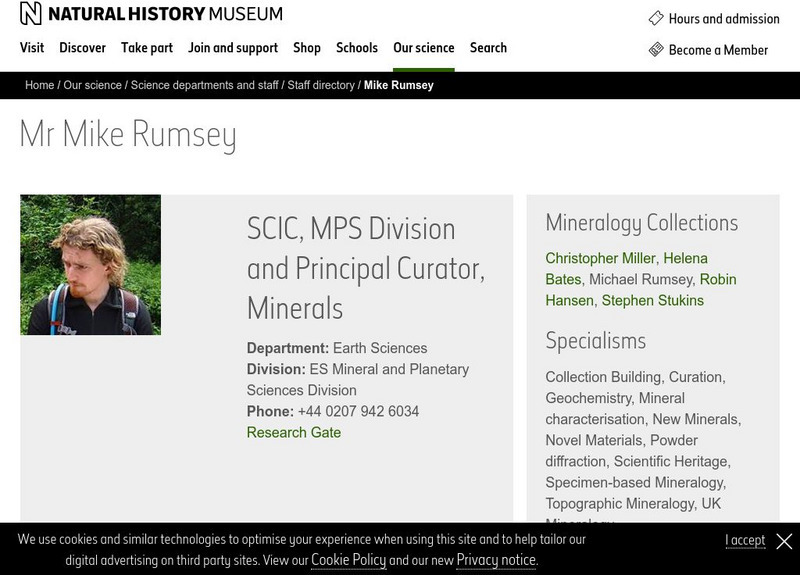
Natural History Museum
Natural History Museum: Mike Rumsey Mineralogist
This resource features a question and answer session in text format with Mike Rumsey, resident Mineralogist at the Natural History Museum. The questions are directed at understanding what it means to be a Mineralogist and to study rocks...
San Diego Natural History Museum
San Diego Natural History Museum: Mineral Matters: Grow Your Own Crystals
Here are step-by-step instructions on how to create crystals. This is a great experiment for students to use in learning about the structure and formation of crystals.
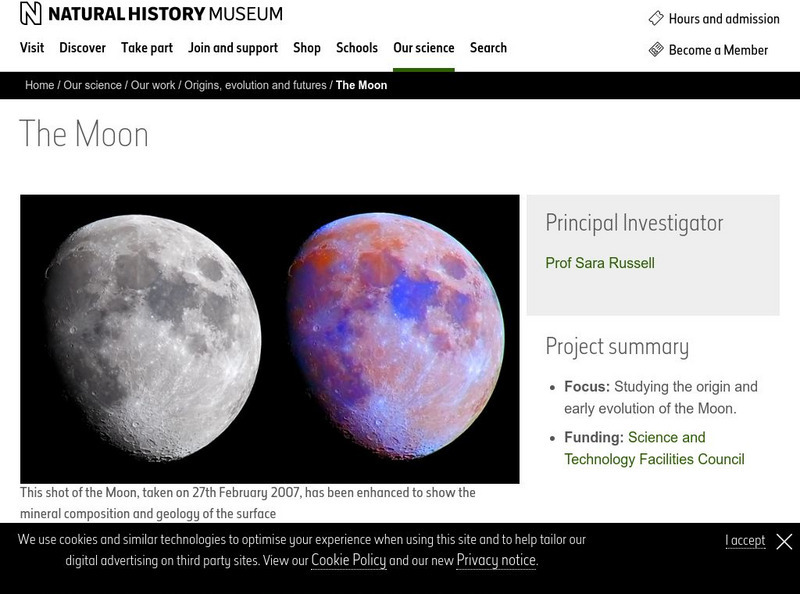
Natural History Museum
Natural History Museum: The Moon
A study of the moon that centers on its origin, its structure, and its behavior.

Natural History Museum
Natural History Museum: Meteorites
As an online exhibit on meteorites, this site provides information on both collecting and identifying meteorites. Topics covered include falls and finds, hot desert meteorites, Antarctic meteorites, and more.

Natural History Museum
Natural History Museum: Types of Meteorites
As an online exhibit on meteorites, this site discusses the primary types of meteorites including iron meteorites, stony-iron meteorites, and stony meteorites.
San Diego Natural History Museum
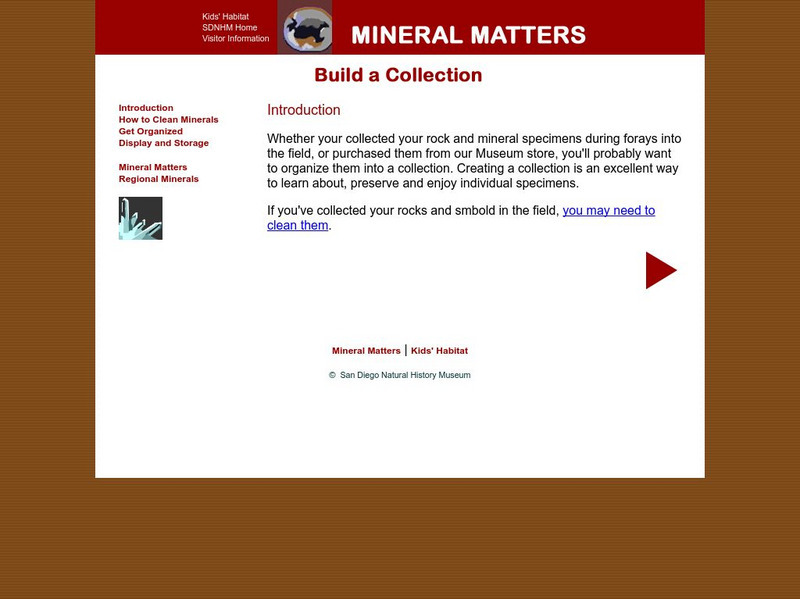
San Diego Natural History Museum: Mineral Matters: Build a Collection
Create your own rock and mineral collection. Site shows you how to clean minerals, get organized, and it gives suggestions for display and storage.
San Diego Natural History Museum
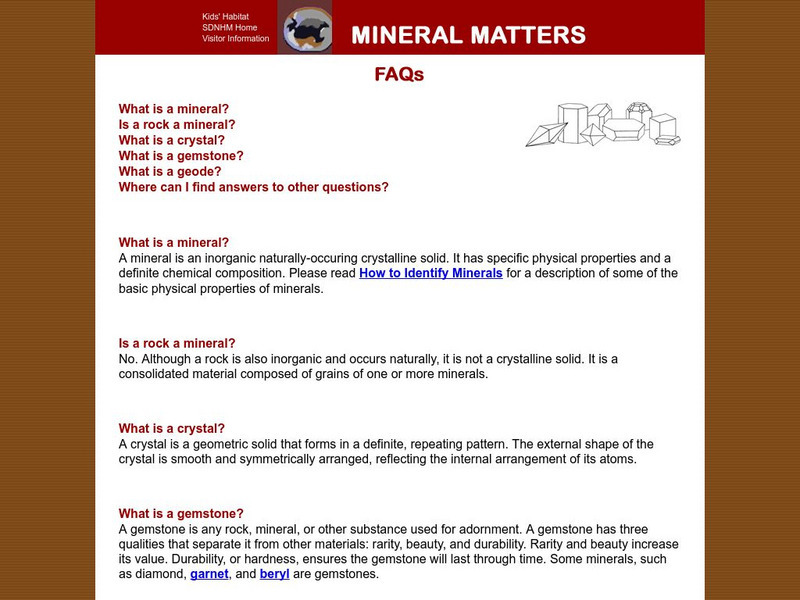
San Diego Natural History Museum: Mineral Matters: Frequently Asked Questions
Frequently asked rock and mineral questions are answered and illustrated.

Natural History Museum
Natural History Museum: Evolution
As part of a larger online exhibit answering the question, What is evolution, this site examines the specific theory of evolution with immediate attention given to exploring and defining morphs.
Natural History Museum
Natural History Museum: Volcanoes
Learn about the role volcanoes have played in shaping the Earth by engaging in interactive activities such as building a volcano or learning about the lava, water vapor, and gases that erupt from volcanoes.
American Museum of Natural History
American Museum of Natural History: Living Large
This engaging game about dinosaurs allows students to analyze and interpret fossil data, as well as engage in argument from evidence. The game helps students to understand that fossils provide evidence about the types of organisms that...
University of Oxford (UK)
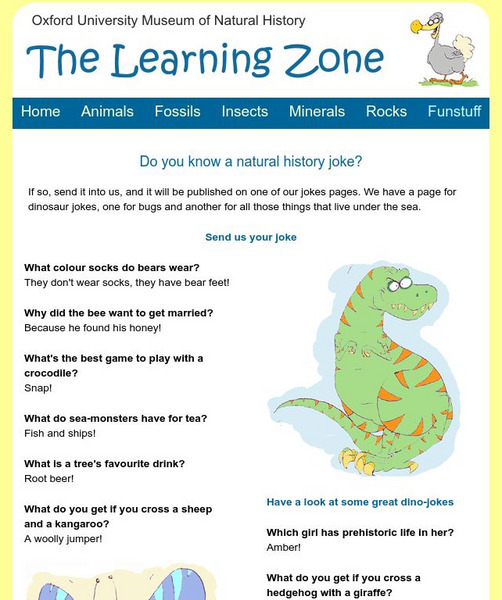
Oxford University Museum of Natural History: Jokes
Do you know a natural history joke? If so, send it into us, and it will be published on one of our jokes pages. We have a page for dinosaur jokes, one for bugs and another for all those things that live under the sea.
Natural History Museum
Natural History Museum: Shark Teeth Fossils
The information provided at this site is part of a larger online exhibit centered on fossils and fossil research. The shark tooth is listed as one type of fossil and here it is pictured and described.
Smithsonian Institution
National Museum of Natural History: Vikings: Game of Hnefatafl
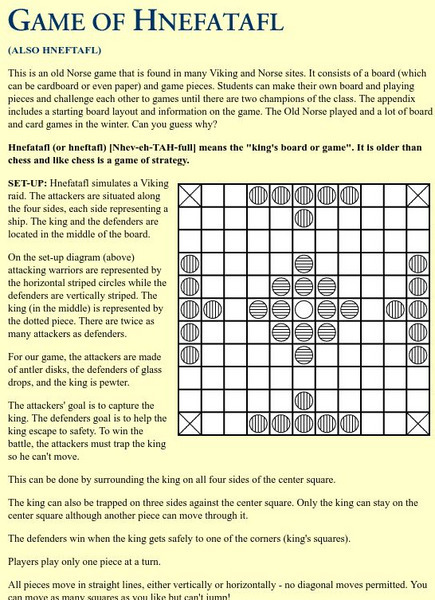
This history project features an old Norse game that is found in many Viking and Norse sites. It consists of a board and game pieces like chess and checkers. Students can make their own board and playing pieces and challenge each other...