Hi, what do you want to do?






Curated OER
Floating Fishes: How do Fishes Control Buoyancy?
Playing with balloons, water, oil, and bottles help put this lesson over the top! Participants use air-filled balloons in water tanks to experience gas compression. They also use oil-filled bottles to experiment with buoyancy. Included...

Florida International University
Simulating Microgravity with Buoyancy
How do astronauts know how to live and work in a weightless environment? It doesn't come naturally! Junior physicists conduct experiments to examine the link between buoyancy and microgravity. Each activity illustrates a different aspect...

Curated OER
How Fish Maintain Neutral Buoyancy
In this buoyancy worksheet, students read about neutral buoyancy and that the downward force of gravity is equal and opposite to the upward force of water. They answer four critical thinking questions about buoyancy.

California Academy of Science
Buoyancy Bulls-Eye
Why does a seastar sink, but a jellyfish float? Through a fun investigation, learners examine the concept of buoyancy using simple household items. The challenge: create neutral buoyancy for an action figure in water. With ample...

Curated OER
Exploring Buoyancy
Students use materials found at a resource table to design simple devices that will house instruments to take water samples from a tub of water. They design 3 instruments, each varying in density so that one will float, one will hover...

Curated OER
Come On Down!
Begin with an introduction to famous deep-sea submersibles. Learners work in groups to gather information on different vessels and then share with the class. Each group then uses water displacement to help calculate the density of...

Tech Museum of Innovation
Lighter than Air
Scholars participate in two design challenges concerning flight in the second instructional activity of the series. They design balloon crafts that have neutral buoyancy and forward motion.

DiscoverE
Action Figure Diver
Will your next buoyancy lab rise to the occasion? Make a splash with action figure divers! Teams of young physicists explore the relationship between mass and buoyancy by adding weights or balloons to achieve a diver that neither sinks...

NOAA
Come on Down!
What do we do when a dive is too dangerous for humans to accomplish? Send in the robots! Middle school scientists get acquainted with several different models of submersible robots in the second instructional activity of six from NOAA....

Teach Engineering
Cartesian Diver
Amaze your scholars with an activity that uses a Cartesian diver to demonstrate Pascal's Law, Archimedes' Principle, and the Ideal Gas Law. Groups then repeat the process and make their own diver move up and down in a bottle.

DiscoverE
Pilot a Balloon
Balloons will go where you want them to. Young pilots first add paper clips to a balloon to make it neutrally buoyant. They then use cardboard to steer the balloon in different directions, taking air pressure into account.

Museum of Science
Design a Submarine
Don't just sink the boat. Using a closed container as a submarine, pupils experiment to see what to add to the container to make it float, sink to the bottom, and hover in the middle. After finding one option, learners see if they can...

Curated OER
Archimedes' Principle
In this Archimedes' principle worksheet, students answer 13 questions about the concepts of Archimedes' principle such as water displacement, buoyancy and force. The answer questions from a lab they did in class to simulate Archimedes'...

Curated OER
Hitler's Lost Sub
Students watch a video clip about German submarines lost during World War II. They work together to create their own submarine out of a plastic bottle. They test the buoyancy of the submarine in different activities.

DiscoverE
Water Sampling
What is the best way to test water quality? Using plastic bottles, scholars create monitoring sensors to test water quality. Creating three different sensors allows individuals to measure water quality at different water levels.

Curated OER
Submersible Designer
Students work in groups to design, build, and test a submersible prototype. In this engineering activity, students learn about the importance and design of submersible vessels and apply their knowledge by building one of their own. They...
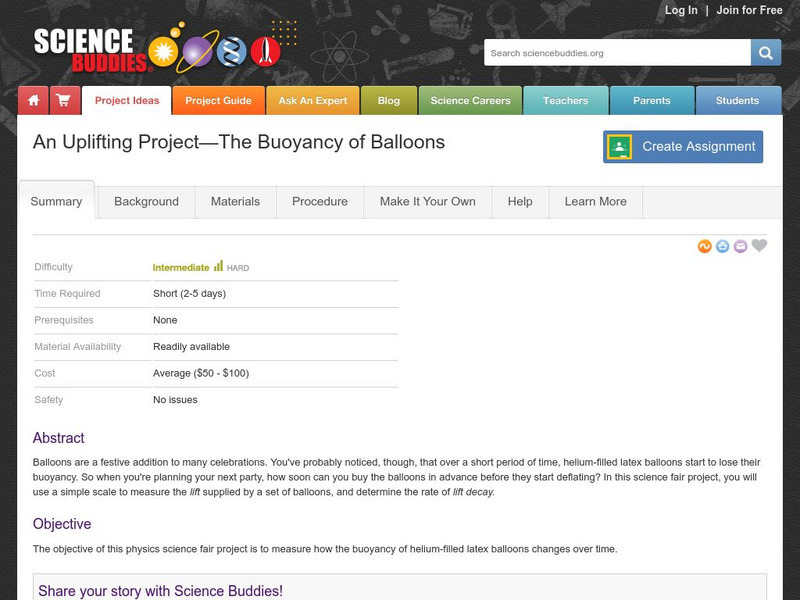
Science Buddies
Science Buddies: An Uplifting Project: The Buoyancy of Balloons
In this science fair project, measure the "lift" of a set of balloons and track how it changes over time as the helium escapes from the balloons. The Science Buddies project ideas are set up consistently beginning with an abstract,...