Hi, what do you want to do?






Teach Engineering
The Great Gravity Escape
Groups simulate an orbit using a piece of string and a water balloon. Individuals spin in a circular path and calculate the balloon's velocity when the clothes pin can no longer hold onto the balloon.

California Academy of Science
Which Way is North?
Who needs a compass to find cardinal directions? Just place a stick in the ground and record the movement of its shadow over the course of a day. Then, measure the shadow lengths in order to determine a north-south line. A simple...

California Academy of Science
Kinesthetic Astronomy: Mars Opposition Dance
Your class will watch as one child orbits the sun as Earth, while another orbits as Mars. If the timing is right, they will see the repetitive dance between the two planets and discover how often they are opposite from each other. For...

NASA
Exploring Exoplanets with Kepler
Calculate the movement and properties of planets like professional astronomers! Scholars use Kepler's third law to find Mercury and Venus's distance from the sun. Using changes in brightness of distant stars and Kepler's third law,...

California Academy of Science
Kinesthetic Astronomy: Birthday Stars
Space explorers take a virtual trip around the sun right within your classroom! They stand in a circle facing away from the "sun" (a lamp) in the center of the room. As they move according to your instructions, they view different...

International Technology Education Association
Launch a Frisbee into Orbit!
How fun it must be to play Frisbee in space! That is just what a NASA engineer gets to do, and you can learn how, too. Follow the instructions provided in this informational article to create your own satellite launcher. Afterward,...

Illustrative Mathematics
Solar Eclipse
Learners take on the role of astronomers, calculating conditions necessary for a total solar eclipse. Concepts of similar triangles and properties of circles come together as pupils create ratios and use real measurements in determining...

California Academy of Science
Kinesthetic Astronomy: The Meaning of a Year
How many times have you traveled around the sun? Aspiring astronomers grasp what a year is and they differentiate between orbit and rotation by walking around the sun right within your classroom. Place a lamp in the center of the room to...

NASA
Eclipse Activity Guide
Ever made solar s'mores? Or recreated the solar system using peanuts? Astronomers young and old investigate all things solar using a variety of activities. Explore how the sun works, types of light it emits, and methods of charting the...

New Mexico State University
Lab 6: Kepler's Laws
A 15-page package thoroughly teaches your physics or astronomy learners about Kepler's three laws of planetary motion. Each one is stated and explained. Class members answer questions, solve problems, and participate in the classic...

Star Date
Modeling the Night Sky
Dramatize the stars and planets as they become a visual representation of the solar system in this activity. Young astronomers track and simulate various constellations as they orbit the Earth to learn the position and motion of...

Astronomical Society of the Pacific
Toilet Paper Solar System
Can we model how large the solar system really is? Attempt an astronomical feat with a hands-on-activity that uses a roll of toilet paper. Young scientists measure the distances of the planets from the sun to create a scale model of...

Exploratorium
Diamagnetism
If you are attracted to activities dealing with diamagnetism, here is a rare find that you will appreciate. With a neodymium magnet and a few common materials, move a pair of juicy grapes without touching them. Though the fruit is...

University of Colorado
University of Colorado: Ph Et Interactive Simulations: Gravity and Orbits
An interactive simulation that teaches about gravitational force, circular motion, and astronomy by manipulating the sun, earth, moon, and a space station to observe the effects of gravity and orbital paths. This simulation can either be...
Texas Instruments
Texas Instruments: Multiple Choice Planetary Motion Study Cards
Kepler's Laws 1,2,3 including eccentricity of elliptical orbits. Good for reviewing planetary motions (NYS Earth Science).
Harvard University
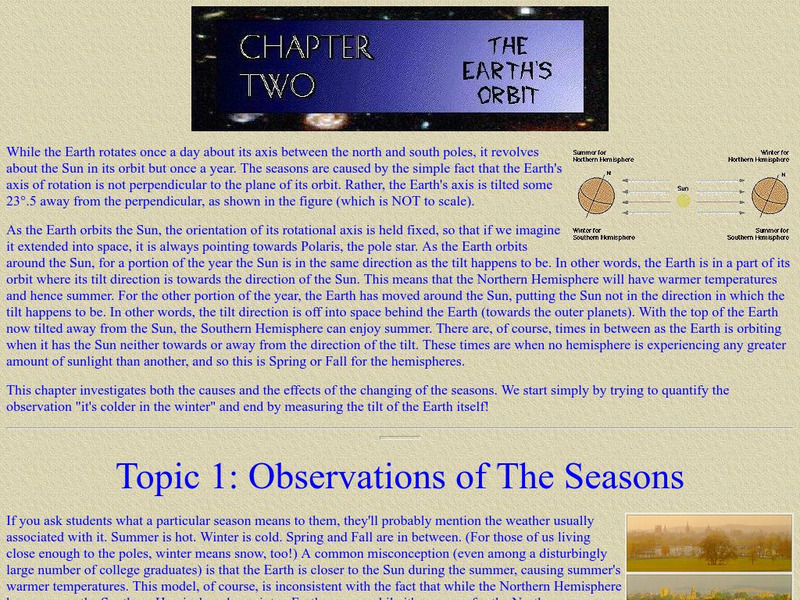
Eyes on the Sky, Feet on the Ground: The Earth's Orbit
Students perform many inquiry activities related to Earth's orbit. Included are recording daily temperatures, observing the sun's path over several weeks, tracking sunrise and sunset times, and angle of sunlight. Diagrams make lessons...

Exploratorium
Exploratorium: Your Age on Other Worlds
How old would you be on Mars? Venus? Have fun plugging in your birthdate to see your age on other planets then read scroll down for a full explanation.
TeachEngineering
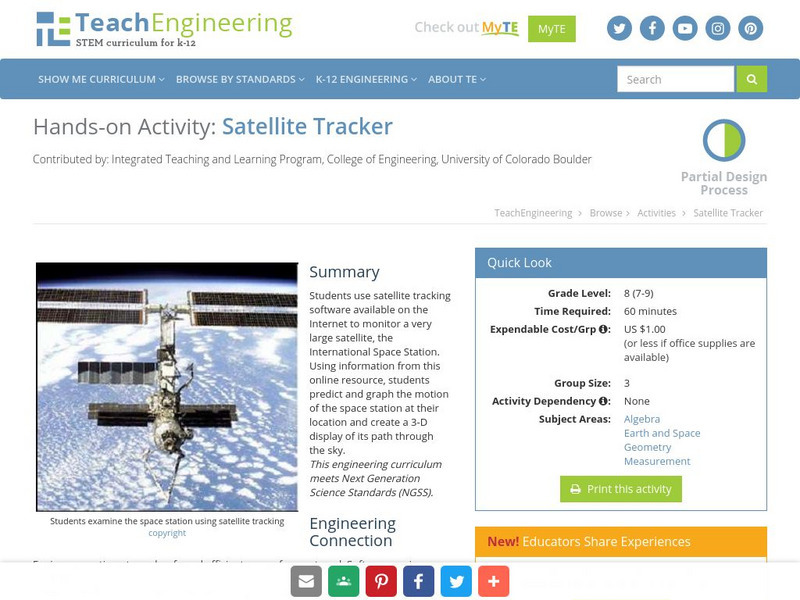
Teach Engineering: Satellite Tracker
Students use satellite tracking software available on the Internet to monitor a very large satellite, the International Space Station. Using information from this online resource, students predict and graph the motion of the space...
Other
Center for Science Education: Eye on the Sky: Motion of the Sun and Earth
Students model the interaction of the earth and the sun. The activity is designed for the playground. You will need chalk, but all the other worksheets are provided.
Harvard University
Harvard University: The Solar System
These hands-on activities are a great way for students to gain perspective on the relative sizes and distances of each planet, the relationship between the sun and Earth, and much more.