Hi, what do you want to do?






Curated OER
"Water, Water Everywhere and None to Drink"
Ninth graders research the importance of maintaining an unpolluted water source in their community. They work together in groups and brainstorm ideas on what they can do to help. They can also write their local politicians.

Curated OER
Kepler's Second Law
Students gain an understanding of Kepler's 2nd law--that planets (and satellites) move fastest at their closest approach to the center of attraction, and slow down when far away. They explore the concepts of "potential energy" and...

Curated OER
Calculating Arc Lengths of Simple Functions-I
In this calculating arc lengths worksheet, learners are given 4 simple functions and they use the Pythagorean Theorem and the basic techniques of calculus to find the arc-length formula in order to find the arc-length.

Curated OER
Physics of Space Flight
In this space flight worksheet, students will review physics terms relating to space which includes measuring the distance of space objects, how rockets work, and electromagnetic waves. This worksheet has 10 terms in a crossword puzzle,...

Curated OER
Worksheet 34
In this math worksheet, students find the plane perpendicular to the path (t2, t, cos 2πt) at time t = 1/4. Then they determine the location in which the object is moving the fastest.

Curated OER
Kepler And His Laws
Students engage in an overview of the story of Tycho Brahe and Johannes Kepler, and of Kepler's laws. Each of Kepler's laws be studied separately in more detail in later lessons. They examine Kepler's 3rd law.

Curated OER
Worksheet 13
In this math worksheet, middle schoolers write down the equation of a plane. Then they create the equation of a line. They also define the lines that are perpendicular.

Curated OER
Around the World
Students find the circumference of various round objects. In this finding the circumference of various round objects lesson, students find the circumference of the Earth. Students find the circumference of trees, tires, and...

Curated OER
Motion Through the Ages
Eighth graders conduct internet research to produce a timeline of man's growth in understanding of concepts of motion and planetary motion through history.
Georgia State University
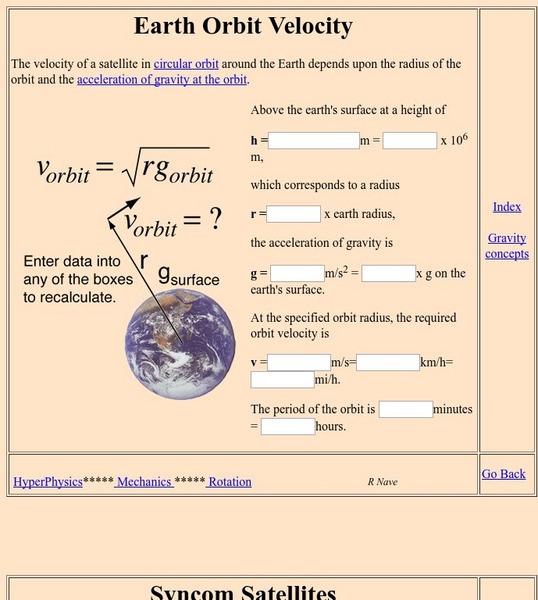
Georgia State University: Hyper Physics: Earth Orbit Velocity
A discussion and statement of an equation for orbital speed. An interactive JavaScript form allows the user to investigate the relationship between orbital height and orbital speed. A very good opportunity to practice and receive...

Physics Classroom
The Physics Classroom: Circular and Satellite Motion: Orbital Motion Interactive
This simulation of a satellite's elliptical motion around a central body allows students to alter the eccentricity of the orbit while learning about velocity and force vectors.
Science Education Resource Center at Carleton College
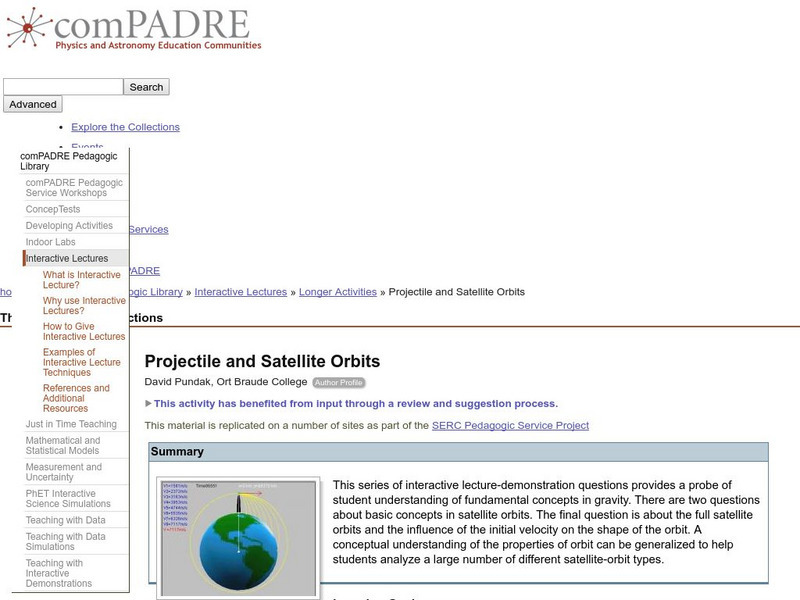
Serc: Projectile and Satellite Orbits
This activity introduces gravity and Kepler's Laws and helps to develop an understanding of gravitational force, satellite orbits, and their dependence on the initial velocity.
Georgia State University
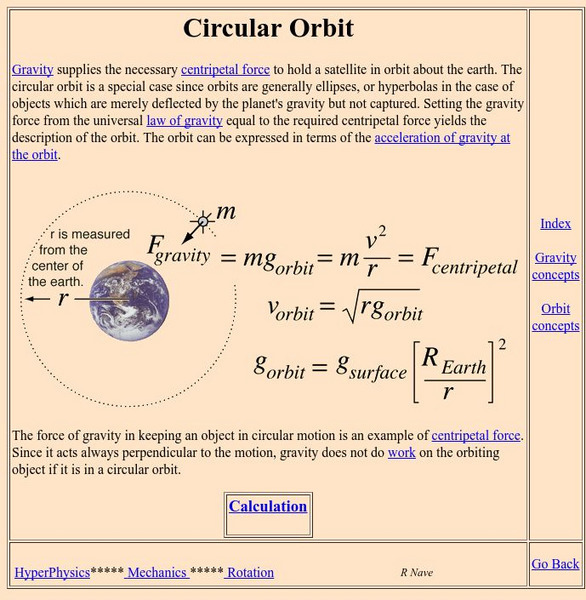
Georgia State University: Hyper Physics: Circular Orbit
The necessity of gravitation to a circular orbit is discussed and equations for the orbital speed are derived from the law of universal gravitation. Binary systems in which two objects orbit about a center of mass are explained and...
Science Education Resource Center at Carleton College
Serc: Geo Logic: Terrestrial and Jovian Planets
Through GEOLogic puzzles, learners are given clues about properties about the terrestrial and Jovian planets respectively, and challenged to match the planet with the correct equatorial radius, mean orbital velocity, and period of rotation.
Physics Classroom
The Physics Classroom: Circular and Satellite Motion: Speed and Velocity
In this interactive module, describe and explain the motion of objects that either move in circles or can be approximated to be moving in circles. Kinematic concepts and motion principles will be applied to the motion of objects in...
Physics Classroom
The Physics Classroom: Satellite Motion
An animation depicting the path of projectiles launched at various launch speeds from the fictional Newton's Mountain. Accompanying text discusses satellite motion and the requirements of orbital motion. Links to further information is...
TeachEngineering
Teach Engineering: The Great Gravity Escape
Students use water balloons and a length of string to understand how gravity and the velocity of a spacecraft balance to form an orbit. They see that when the velocity becomes too great for gravity to hold onto an object, the object...
Physics Classroom
The Physics Classroom: Circular Motion Principles for Satellites
From The Physics Classroom. Uses easy- to-understand language to discuss how circular motion principles apply to the motion of satellites. Describes the tangential velocity and centripetal acceleration of a satellite. Includes many...
Physics Classroom
The Physics Classroom: Mathematics of Satellite Motion
The mathematics associated with the motion of satellites is described. Equations (for period, velocity, acceleration and force) are stated, symbols described, and sample problems solved. Includes five practice problems with solutions and...
Physics Classroom
The Physics Classroom: Energy Relationships for Satellites
The orbits of satellites are described and an energy analysis is performed. Kinetic, potential and total mechanical energy are explained and applied to the motion of satellites.
CK-12 Foundation
Ck 12 Exploration Series: Simulations: Physics: Newton's Cannon
[Free Registration/Login Required] Learn about orbits and how an object can stay in orbit under the influence of gravity. By adjusting launch velocities users will understand how to successfully put a virtual satellite into orbit without...
NASA
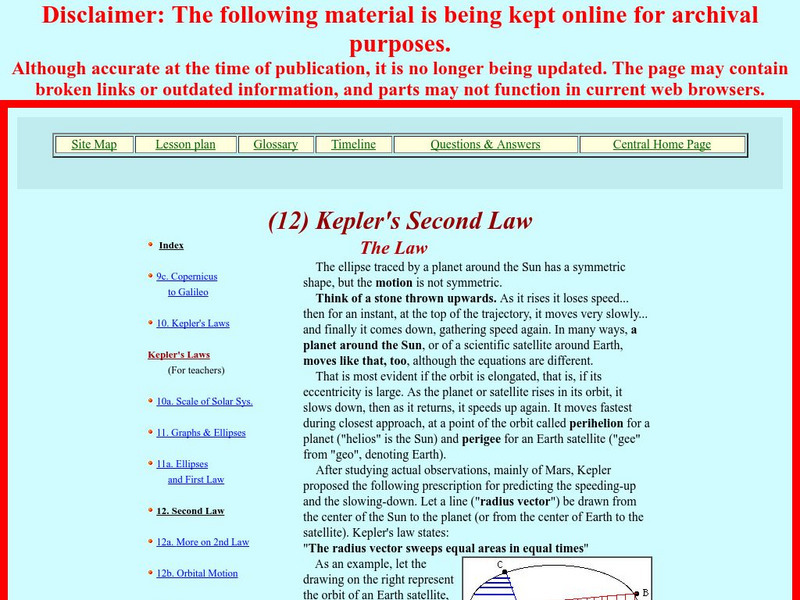
Nasa: Kepler's Second Law
This site from NASA states Kepler's second law of planetary motion and depicts its meaning with an informative diagram. Relates the law to conservation of energy principles and discusses the eccentricity of a satellite's (or a planet's)...
NASA
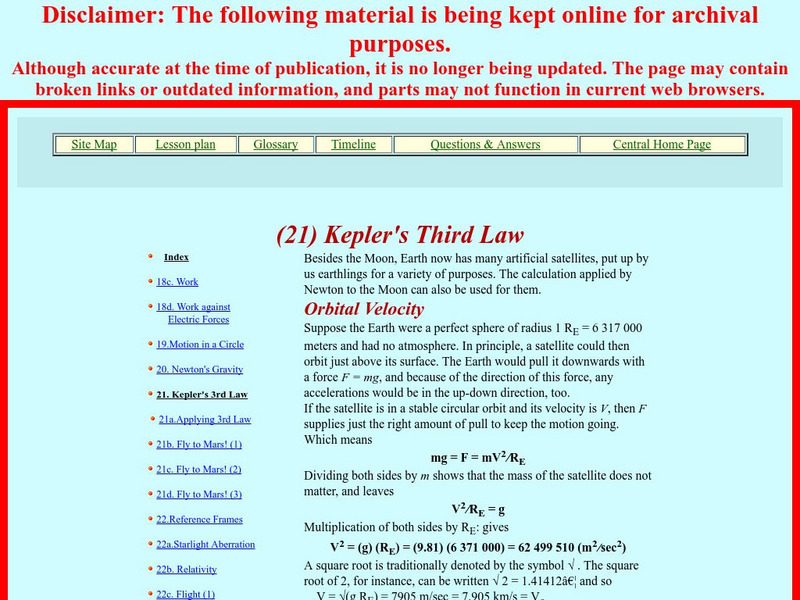
Nasa: Kepler's Third Law
This site from NASA states Kepler's third law of motion and extends it to develop an equation for the velocity of an orbiting planet.

Concord Consortium
Concord Consortium: Stem Resources: Launching a Satellite
Do you think you could fire an "unpowered" object into orbit? By controlling the angle and speed at which the satellite is launch, students will try to launch a satellite into space with this computer model. Activity includes questions...