Hi, what do you want to do?






Curated OER
Analyzing Tree Rings to Determine Climate Change
Young scholars examine how to locate and access data sets. In this climate change lesson students import data into Excel and graph it.

Outdoor Learning Center
Outdoor Survival
Which of the following can you survive without for the longest time: water, food, or a positive mental attitude? The answer may surprise you. Guide learners of all ages through games, activities, and discussions about surviving in the...

Curated OER
It's Raining, It's Pouring: The Water Cycle
Middle schoolers investigate the relationship of the steps in the water cycle, and create a simulation of the water cycle in a jar.

Curated OER
Sand & Water: Arctic in the Sun
Learners chill out on a hot day with this outdoor activity. In this early childhood physical education lesson, students have fun experimenting through play with ice and toy animals in water.

Curated OER
Gallery Walk Questions about Energy and Material Cycles
Students state the physical, chemical or biological processes associated with these environments: Pelagic ocean zone, California coat Cave, Indiana Barrier island beach, North Carolina Sand dune, Dunes National Park, Colorado Wetland and...

Curated OER
Different Types of Changes (1.2)
In this recognizing different types of changes instructional activity, students answer questions about such things as reversible change, irreversible process, climatic change, filtration process, physical change, and change in the state...

Curated OER
Regolith Formation
Students study what regolith is and how it contrasts with weathering on Earth. In this weathering activity students divide into groups, hypothesize and confirm their guesses.

Curated OER
Earth's Water
If the majority of our planet is covered with water, why do we need to bother conserving it? With a thorough and varied investigation into the location and types of water on the earth, learners will gain an understanding of why this...

Curated OER
In Harm's Way: Natural Disasters in My Community
Eleventh graders research and debate natural disasters that have occurred in their community. They assess whether these natural disasters were avoidable or were accidents. They investigate the extent of insurance coverage for disasters.

Curated OER
Less vs. Fewer
When should you use less, and when should you use fewer? Straighten out this dilemma with a helpful resource about using less vs. fewer based on sentence context clues. After reading detailed instructions and examples, young learners...

Curated OER
Properties of Fresh and Sea Water
Students work with three stations to demonstrate the properties of water. They explore water's boiling point, freezing point, and its ability to store heat.

Curated OER
Clouds
Test your students' science and/or reading comprehension skills with this activity, which provides a page of information about clouds and cloud classification. Both an earth science teacher and a language arts teacher could use this...

Curated OER
Summer Science Lesson Plans
You can use these lesson plans to incorporate some science into your summer.

Curated OER
Sleet and Hail Have Their Own Seasons
Second graders explain the definition of hail and sleet. In this precipitation lesson, 2nd graders discuss when hail and sleet fall and the results of hail falling.

Curated OER
Climate Change Effects on Organisms and Ecosystems: You are the Experts!
Seventh graders research about the effect of climate on different ecosystems. In this life science lesson, 7th graders present their research by creating a poster, infomercial, skit or song. They discuss how organisms adapt to climate...

A&E Television
History.com: How Early Humans Survived the Ice Age
The most recent ice age peaked between 24,000 and 21,000 years ago, when vast ice sheets covered North America and northern Europe, and mountain ranges like Africa's Mt. Kilimanjaro and South America's Andes were encased in glaciers. At...
Woods Hole Oceanographic Institution
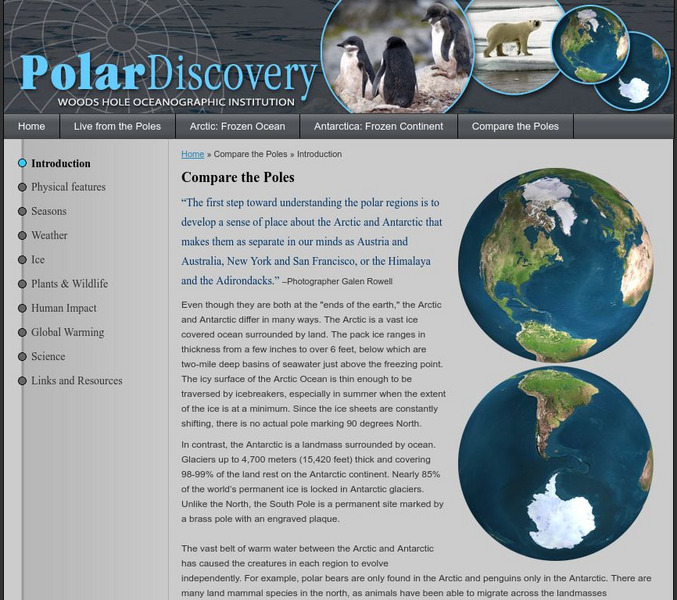
Polar Discovery: Compare the Poles
A detailed comparison of many aspects of the two polar regions. Includes physical features, seasons, weather, types of ice, plants and animals, human population, and climate change.