Hi, what do you want to do?






Curated OER
Rock On! Featuring the Igneous, Sedimentary and Metamorphic Trio!
Get your classroom rocking with this four-lesson earth science unit. Through a series of shared reading activities and hands-on investigations, young geologists learn about the three types of rocks and the unique properties of each.

Columbus City Schools
Force Field Physics
Attracted class members to an activity-packed journey through the science behind the invisible forces at work all around us. From jump rope generators to junkyard wars, there's never a dull moment when eighth grade physics scholars...

Government of South Australia
Don't Waste Your Energy
Don't lift another finger, this physical and environmental science unit has everything you need to begin teaching your class about energy. Starting with a look at the greenhouse effect, these lessons and activities take young scientists...

Curated OER
Earthquakes: Sixth Grade Lesson Plans and Activities
Young seismologists learn more about plate tectonics with a set of pre-lab, lab, and post-lab lessons plans on earthquakes. After exploring how waves travel through various materials, sixth graders record their observations and...

Association of American Geographers
Project GeoSTART
Investigate the fascinating, yet terrifying phenomenon of hurricanes from the safety of your classroom using this earth science unit. Focusing on developing young scientists' spacial thinking skills, these lessons engage...

Smithsonian Institution
Water/Ways: The Poetry of Science
Water is the source of life. It appears in poetry in both peaceful and torrential descriptions; it appears in earth science in its liquid, gaseous, and solid states. Combine these interpretations of our planet's most precious and...

University of Southern Indiana
Manifest Density
There's a lot content packed into the four lessons of this physical science unit on density. From salad dressing to the water cycle and hot air balloons, these lessons engage students in hands-on activities that explore real-world...

Columbus City Schools
The Mystery of Earth’s History
Every living creature can leave a fossil record, yet most fossils belong to extinct organisms rather than ones currently living. Scholars learn about dating rock layers, fossils, and the environment of the past. Pupils understand that...

Columbus City Schools
Keeping It Hot!
Hot off the presses, this collection of thermal energy activities, lessons, and printables is sure to amaze. Demonstrate how thermal energy moves about in a system using simple materials. Pupils demonstrate their understanding...

Columbus City Schools
Constructive and Destructive Geologic Processes
Show the class the world as they've never seen it before—from way above! Learners try to unravel the mysteries presented by rich satellite imagery, learn to interpret topographic maps, and study erosion by constructing their very...

Columbus City Schools
History Helps When It Comes To Plate Tectonics
Get ready to move, shake, slip, and slide with a well-rounded plate tectonics unit! The engaging resource includes everything you need to inspire eighth grade science scholars, from worksheets to demonstrations. Assess their...

PBS
Blow the Roof Off!
Blow the minds of young scientists with this collection of inquiry-based investigations. Based on a series of eight videos, these "hands-on, minds-on" science lessons engage young learners in exploring a wide range of topics...

Columbus City Schools
Geological Effects of Plate Tectonics
Don't get your classes all shook up about plate movement, instead use a thorough unit that guides learners to an understanding of plate tectonics. The lessons incorporate a study of the types of plate boundaries and their effects on the...

Columbus City Schools
Planet X
How did the earth become the mass that it is now? Your young scientists explore this question through the concept of density. Their inquiries consider the impact of gravity on the formation of planets. The culminating activity of the...

Tech Museum of Innovation
Analogous Models
What goes into a museum display? A secondary-level STEM project prompts groups to design a museum display for the Tech Museum of Innovation. They create an analogous, interactive model illustrating a science concept to complete the...

Curated OER
Our Solar System
Students study the Earth and Solar System through a variety of activities. They compile a coloring book show the characteristics of the Sun and nine planets.

Vision Learning
Visionlearning: Earth Science: Minerals Ii: Properties
Instructional module focusing on the physical properties of minerals. Discussion includes the identifying characteristics such as color, hardness, luster, crystal forms, density, and cleavage. Site also includes an interactive practice...
Vision Learning
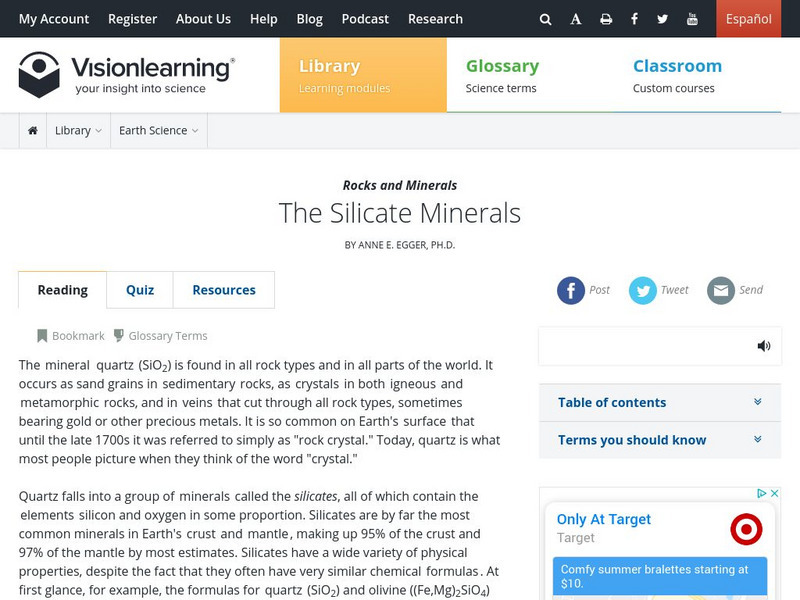
Visionlearning: Earth Science: Minerals Iii: The Silicates
Instructional module focusing on the Silicate minerals. Discussion includes the most common minerals on Earth such as quartz, feldspar, mica, amphibole, pyroxene, and olivine. Site also includes an interactive practice quiz and links...
CK-12 Foundation
Ck 12: Earth Science: Scientific Models
[Free Registration/Login may be required to access all resource tools.] Recognize the uses, limitations, and different types of scientific models.
CK-12 Foundation
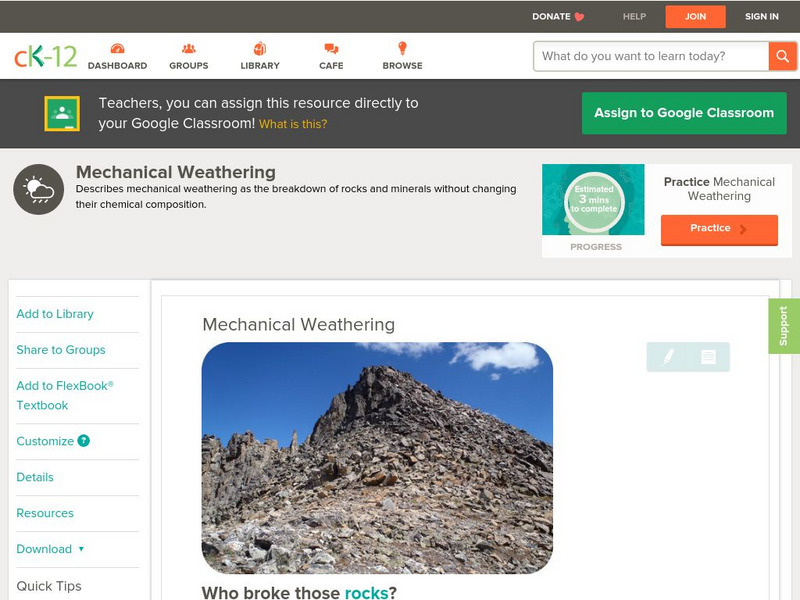
Ck 12: Earth Science: Mechanical Weathering
[Free Registration/Login may be required to access all resource tools.] Describes various types of mechanical weathering.
CK-12 Foundation
Ck 12: Physical Science: Alkaline Earth Metals
[Free Registration/Login may be required to access all resource tools.] Group 2 elements and their properties.

E-learning for Kids
E Learning for Kids: Science: Greece: What Is the Earth Made Of?
Dionysus is a Greek God. and a theater director. Help him get ready for the play and learn about land, water, and air. After completing this lesson, students should be able to identify the different materials Earth is made up from (land,...
Scholastic
Scholastic: Study Jams! Science: Weathering & Erosion
A video and a short multiple-choice quiz on the topic of weathering and erosion, what they are, and how they alter the Earth's surface.
CK-12 Foundation
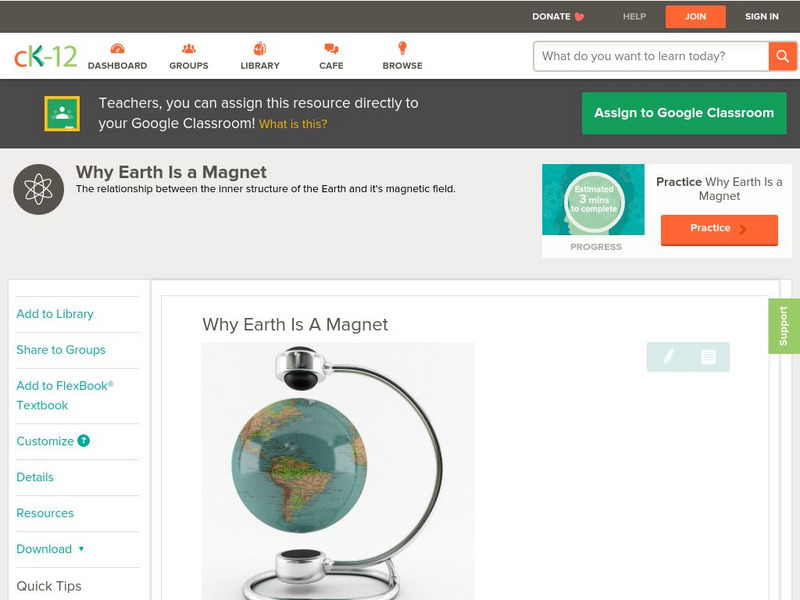
Ck 12: Physical Science: Why Earth Is a Magnet
[Free Registration/Login may be required to access all resource tools.] Why the Earth is a magnet and how its inner structure relates to its magnetic field.