Hi, what do you want to do?






Texas State Energy Conservation Office
Investigation: Kinetic and Potential Energy
A well-developed lab sheet guides physical science learners through an investigation of kinetic and potential energy. In small groups, collaborators discover whether or not the ramp height or mass of an object has an effect on the...

Texas State Energy Conservation Office
Investigation: Conservation of Energy
By rolling marbles down a six-foot length of track, physical scientists determine how much energy is lost to heat. It is recommended that you opt for the foam pipe insulation track because more friction slows the marble, allowing...

Foundation for Water & Energy Education
How is Flowing Water an Energy Source? Activity C
Can the force of falling water through a tube vary by altering the diameter of the tube or its height? That is what physical scientists aim to discover in this activity, the third in successively more revealing activities on the power of...

Curated OER
The Physics of Sports: An 8th Grade Physical Science Project
Explore the relationship between sports and physics in a cross-curricular lesson. Middle and high schoolers prepare a multimedia presentation based on a chosen sport. They answer five physics vocabulary questions about how the laws of...

Teach Engineering
Energy Storage Derby and Proposal
Small groups use the engineering design process to build and test a vehicle capable of carrying 250 grams a distance of five meters. The design must allow for the storage of potential energy and turn it into motion,...

Foundation for Water & Energy Education
How is Flowing Water an Energy Source? Activity B
Explore the world's water without leaving the classroom! In this second of three uncomplicated but wonderful activities, physical science learners feel the pressure of water. They discover that the deeper the water, the stronger the...

Anchorage School District
Roller Coaster Project
Emerging engineers work in teams to design pipe insulation roller coasters for marbles that meet specific parameters. They are required to label along the track the areas where kinetic and potential energy are highest and lowest, where...

MENSA Education & Research Foundation
Roller Coaster Mania!
Raise the energy level of your physical science class with this exciting hands-on activity. Applying their knowledge of kinetic and potential energy and Newton's laws of motion, young engineers use foam tubing and marbles to create...

Savvas Learning
Let's Get Moving
Scholars examine, cut, paste, and sort 12 images featuring different types of movement in order to show what they know about energy—potential and kinetic.

Teach Engineering
Amusement Park Ride: The Ups and Downs in Design
Groups design the ultimate roller coaster by considering potential and kinetic energy. They test their designs using marbles and then go on to rate each group's design based on aesthetics, loop diameter, and cost.

DiscoverE
Slinky® Science
Toys are great for learning about physics. Scholars use Slinky® toys to study Newton's laws of motion and types of energy. After a little play, they then model longitudinal and transverse waves with the Slinky® toys.

It's About Time
Defy Gravity
Test the limits of gravity while encouraging full class participation with this thrilling lesson. Pupils investigate the meaning of work and how it is equivalent to energy. They explore the joule and apply it as a unit of work. They...

DiscoverE
Build a Roller Coaster
Let the good times roll as young thrill seekers build a roller coaster on school grounds. Future engineers design and build a roller coaster from flexible tubing. The roller coaster is for a marble, so there will be plenty of room to let...

Trash For Teaching
The Light-House Project
Groups work together to design a lighthouse, from designing and drawing the wiring diagram, to creating prototypes of the switch and circuit, to envisioning and building a scale model along with a blueprint. By including different...

Teach Engineering
Bubbles and Biosensors
Bubbles aren't just for children. In the third installment of a seven-part series, teenagers use bubble solution to create bubbles and observe patterns of refraction on the bubble surfaces. Application of this concept to thin films in...
Science Buddies
Science Buddies: Converting Potential Energy to Kinetic Energy
If you'd like to investigate the physics of amusement park rides, then this project is for you. You'll build a roller coaster track for marbles using foam pipe insulation and masking tape, and see how much the marble's potential energy...
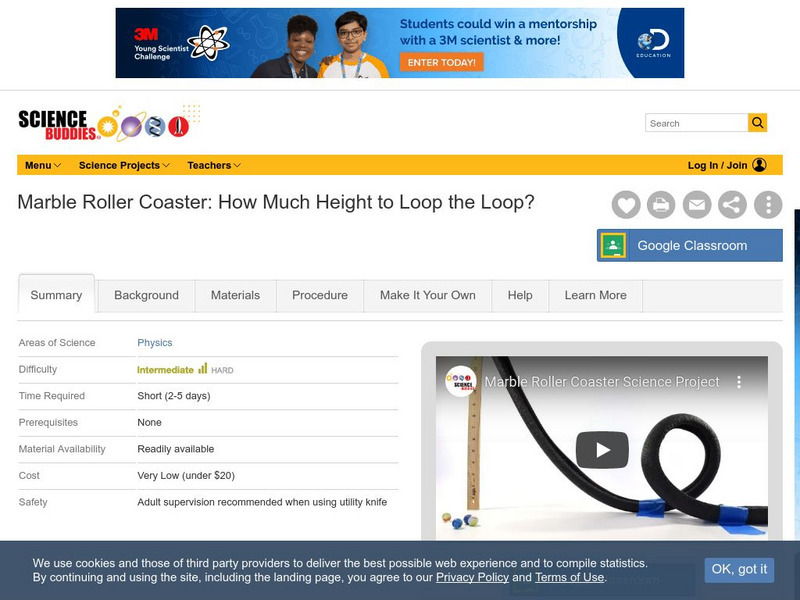
Science Buddies
Science Buddies: Roller Coaster Marbles: How Much Height to Loop the Loop?
This is a really fun project even if you don't like going on roller coasters yourself. You'll build a roller coaster track for marbles using foam pipe insulation and masking tape, and see how much of an initial drop is required to get...

Science Buddies
Science Buddies: The Height Limits and Linearity of Bouncy Balls
You might think that plants and animals have little in common with batteries, springs, or slingshots, but they actually do have something in common. Both living and non-living things store and transfer energy from one form to another. In...
Science Buddies
Science Buddies: How Long Will My Sleepy Yo Yo Sleep?
Yo-yo's are a fun toy and there is nothing simpler than a string wrapped between two connected disks. But there's a lot of physics that makes a yo-yo work. In this science fair project, learn more about how and why a yo-yo works. You...
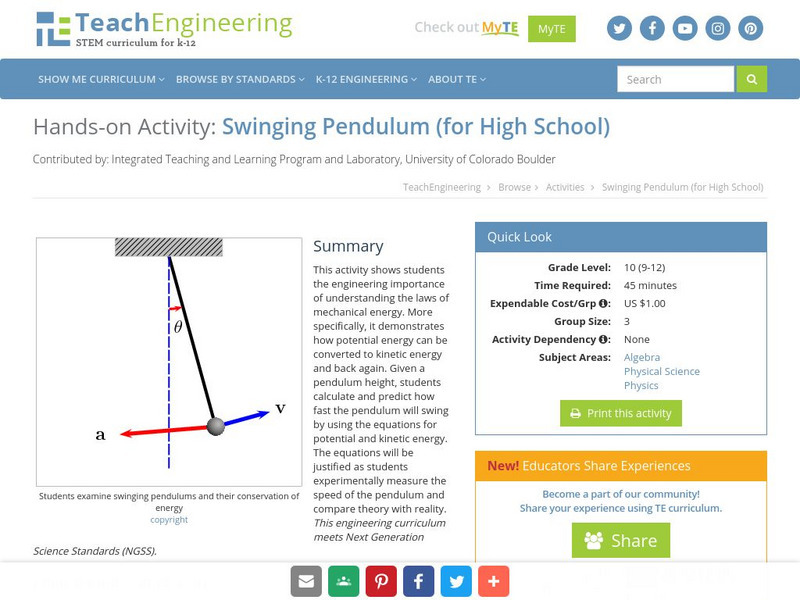
TeachEngineering
Teach Engineering: Swinging Pendulum
This activity shows students the engineering importance of understanding the laws of mechanical energy. More specifically, it demonstrates how potential energy can be converted to kinetic energy and back again. Given a pendulum height,...
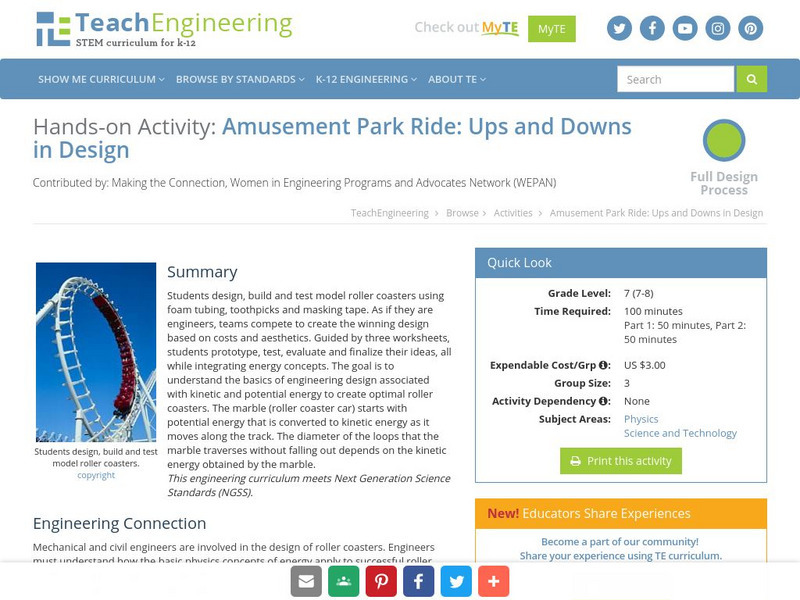
TeachEngineering
Teach Engineering: Amusement Park Ride: Ups and Downs in Design
This unit has students design and build foam tubing roller coasters. The design process integrates energy concepts as they test and evaluate their designs that address the task as an engineer would. The goal is for students to understand...
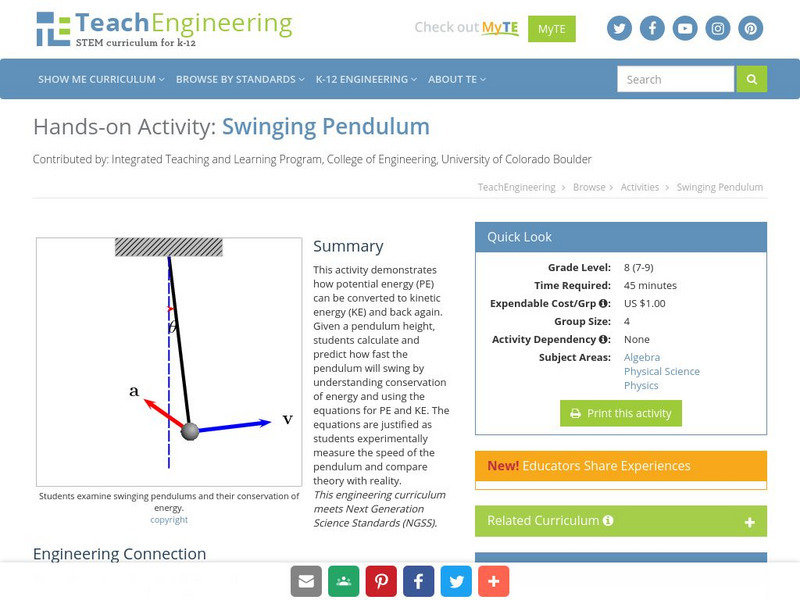
TeachEngineering
Teach Engineering: Swinging Pendulum
This activity demonstrates how potential energy (PE) can be converted to kinetic energy (KE) and back again. Given a pendulum height, students calculate and predict how fast the pendulum will swing by understanding conservation of energy...
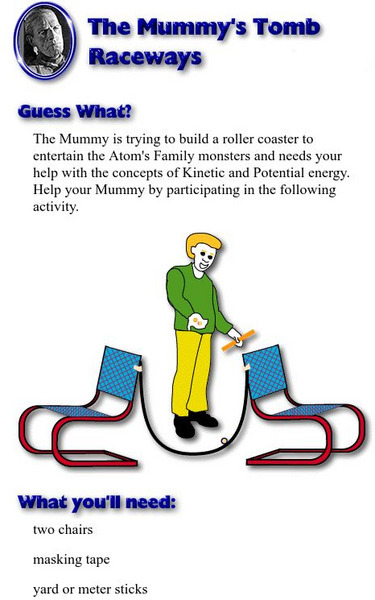
Other
Puhinui School: The Atoms Family: The Mummy's Tomb: Raceways
Help the Mummy build a rollercoaster to entertain the Atoms Family monsters by investigating the concepts of kinetic and potential energy.
Science Buddies
Science Buddies: Build a 'Breath Spray Bomb' to Study Small Explosion
Hold onto your hats. In this science fair project, you will make a device that sends a film canister across the room with a small chemical explosion. The energy for the explosion is derived from the combustion of ethanol. You will...