Hi, what do you want to do?






Curated OER
Discovering the Forgotten Kingdom Protista
Protists, like algae and mold, are sometimes overlooked for classroom study, but they are astonishing in their diversity and importance.

Curated OER
Organisms that Glow
In this bioluminescence worksheet, students read about various organisms that glow on land and in the sea. They answer three critical thinking questions after reading about these chemical reactions.

Curated OER
WiTricity Explained
Students explain how electricity is transferred from source to load without actual wires connecting the two. For this physics lesson, students explore how wireless electricity was discovered. They cite practical applications of this...

Curated OER
Can Photosynthesis Occur at Saturn?
Learners identify the different requirements for photosynthesis to take place. In this space science lesson, students simulate conditions in Saturn to investigate if photosynthesis is possible there. They use data and observations...

Curated OER
Living or Non-Living
Students examine living and non-living things. In this life science instructional activity, students are given a group of objects and discuss if they are living or non-living. Students identify and list characteristics of living things.

Curated OER
The Bottom Line
Seventh graders assume the role of stockholders in a fictitious biotech company. After investigating the cloning of pets, the effects of cloning on the health and well being of the cloned animal, and the ethical issues involved, groups...

Curated OER
Fifth Grade Life Science Review/Quiz
For this life sciences review or quiz worksheet, 5th graders use recall of knowledge to answer multiple choice questions. Students answer 20 questions.

Curated OER
Introduction to Chemistry
In this introduction to chemistry worksheet, students answer 9 questions regarding the study of chemistry. The first part is matching, then they "think like a scientist" and then they problem solve.

Curated OER
Science Puzzlers, Twisters, and Teasers: The History of Life on Earth
A somewhat amusing assignment, this worksheet lists statements that an ancient organism may have made and asks learners to determine what geologic era that each may have lived in. It uses witty word puzzles and fill-in-the-blank-style...

Curated OER
Analogies
In this analogies instructional activity, students complete the analogies about fuel, carbon dioxide, decay, and more. Students complete 10 analogies.

Curated OER
Effects of the Sun on Our Planet
Students examine the effect of different types of light on the Earth. They discover the role of evaporation and the effects of the sun on the magnetosphere. They also observe different solar phenomena.

Curated OER
What is Life?
Students investigate the characteristics of living things. For this life science lesson, students examine several living and non-living specimens. Students determine which things are living and non-living.

Curated OER
Living and Non-Living
Fourth graders are divided into small groups and collect 4 objects from the playground. They take 5 to 10 minutes to classify their groups and discuss their findings including the terms "living" and "non-living". As a class they discuss...

Curated OER
Water and Diffusion
In this water and diffusion worksheet, learners will explore the characteristics of water and the water molecule. Students will also answer questions about diffusion and the movement of materials due to concentration differences. This...

Curated OER
Outdoor Survival
Learners are introduced to basic outdoor survival concepts. They identify the seven basic needs for survival. Students describe the symptoms and treatment for frostbite and hypothermia. They compare and contrast the value of different...

Curated OER
Milkweed Monitoring
Ninth graders study milkweed and see how it is effected by ozone. In this air pollution lesson students complete a lab activity that includes data analysis.

Curated OER
Living vs. Non-Living Things
Fourth graders describe the characteristics that determine if something is living, dead, or non-living. They determine the difference between living and non-living things. Students determine if an object is living or non-living and...

Curated OER
Smallest Thing
Learners compare characteristics of myobacteria and viruses to determine which is the smallest life form. They read and discuss an article that presents different viewpoints on the definition of life to determine their own viewpoint.

Curated OER
Classifying Life
In this classifying life worksheet, students review the 5 kingdoms of organisms by completing 10 matching and 7 fill in the blank questions.

Curated OER
Fungi
Students study fungi and its parts. In this exploring fungi lesson students fill out a worksheet that includes a diagram of fungi and questions.

Curated OER
Types of Reactions
In this reactions instructional activity, students describe combustion as either exothermal or endothermal. Students balance reactions and label the types of reactions. This instructional activity has 1 multiple choice, 2 short answer,...
Ducksters
Ducksters: Biology for Kids: Plant Cell Chloroplasts
Study the plant cell chloroplasts in the science of biology including their function, structure, and how they help make energy through the process of photosynthesis on this site.
My Science Site
Life Systems: Cells, Tissues, Organs
Extensive site for teachers provides some helpful resources that pertain to plant and animal cells. Includes a microscope diagram as well as plant, animal and pond labs. Also contains links to structures and mechanisms, matter and...
TeachEngineering
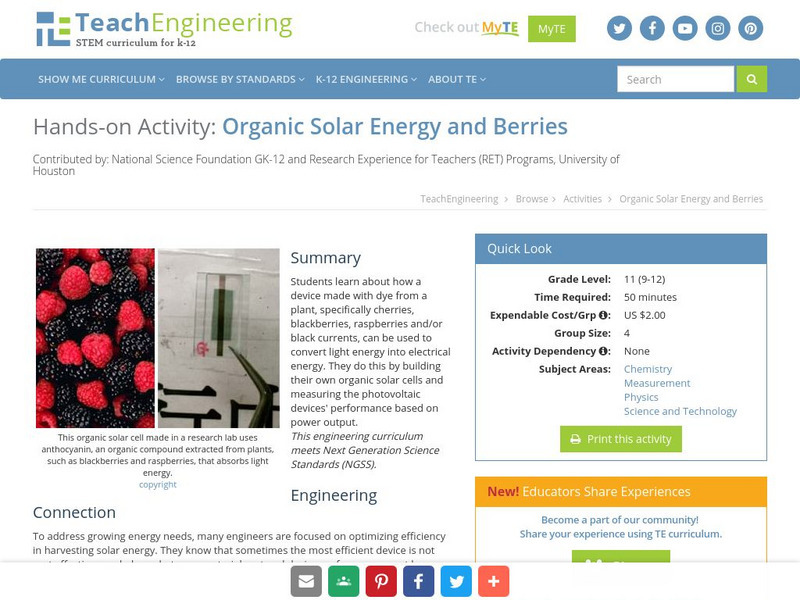
Teach Engineering: Organic Solar Energy and Berries
Students learn about how a device made with dye from a plant, specifically cherries, blackberries, raspberries and/or black currents, can be used to convert light energy into electrical energy. They do this by building their own organic...