Hi, what do you want to do?






Curated OER
Andrew Jackson
In this online interactive history worksheet, learners respond to 6 short answer and essay questions about Andrew Jackson. Students may check some of their answers on the interactive worksheet.

Curated OER
The Campaign of 1840: William Henry Harrison and Tyler, Too
Students list some issues important during the campaign of 1840. They compare and contrast the careers of Martin Van Buren and William Henry Harrison before they became president and explain why the Whigs wanted to find a candidate in...

Curated OER
Andrew Jackson: 1767-1845
A thorough examination of Andrew Jackson's presidency and politics, these slides contain important facts and pictures of the growing United States. Events such as the Trail of Tears and the Tariff Battles of the early 19th century are on...

Curated OER
The Union is Perpetual: Lincoln is Elected
Young scholars take a closer look at the election of Abraham Lincoln. In this historical analysis instructional activity, students analyze letters, political cartoons, and campaign materials from Lincoln's campaign. Analysis worksheets...

Curated OER
Closest Presidential Race Ever. . . Or Is It?
High schoolers examine the presidential election of 2000. In this American history instructional activity, students listen to their instructor lecture on the details of the 2000 election. High schoolers respond to discussion questions...

Curated OER
The Clinton Administration (5)
In this online interactive history worksheet, students respond to 14 matching questions regarding the presidency of Bill Clinton. Students may check their answers immediately.

Curated OER
Analysis of a Historic Presidential Election
Students research the 2000 presidential elections. They explain why the presidential winner was initially too close to call, discuss how the winner was determined and predict how the 2000 election might change the process of electing a...

Curated OER
Research Skills: Ronald Reagan
In this Internet research on Ronald Reagan instructional activity, learners answer 10 multiple choice questions about the former president. Students will need to do their own research.

Curated OER
The Campaign of 1840: The Campaign
Students discuss the use of visual images, objects, and spectacle in the 1840 campaign, then take a stand: Was the campaign of 1840 based more on substance or image?

Curated OER
The Campaign of 1840: The Candidates
Learners compare and contrast William Henry Harrison and Martin Van Buren as candidates for president. They explain why the Whigs wanted to find a candidate in the mold of former president Andrew Jackson and discuss whether Harrison fit...

Curated OER
The Campaign of 1840: The Whigs, the Democrats, and the Issues
Students reflect on the nature of the campaign of 1840. They identify the positions of the Democrats and the Whigs and their basic differences.

National Endowment for the Humanities
The 1828 Campaign of Andrew Jackson and the Growth of Party Politics
High schoolers analyze changes in voter participation and regional power, and review archival campaign documents reflecting the dawn of politics as we know it during the critical years from 1824 to 1832. Students utilize worksheets and...

Curated OER
Reading Comprehension: Who Elects the President?
In this reading comprehension worksheet, students read a text about the presidential election in 2000. Students fill in 10 blanks, choosing from 4 words for each that will make the text make sense.

Curated OER
Cartoons for the Classroom: Donkeys, Elephants, and Elections
In this current events worksheet, students analyze political cartoons about the 2006 American mid-term elections. Students then respond to 3 short answer questions.

Curated OER
Debate - Election of 1876
Eleventh graders examine how Rutherford Hayes should be elected President of United States in order for the Union to continue effective Reconstruction.

Curated OER
The 2004 Presidential Election
Students examine the 2004 Presidential election between George W. Bush and John Kerry. Using a variety of primary source documents, they discover where the candidates stood on the issues. In groups, they create a tableau in which they...

Curated OER
The Solid South Switcharoo
Students examine primary sources. In this lesson on political parties, students view historic documents, speeches, and photos to trace the rise and fall of particular political parties. Students will be looking at the success of each...

Curated OER
The 1828 Campaign of Andrew Jackson: Issues in the Election of 1828 and Beyond
Young scholars research the campaign and election issues of Andrew Jackson. For this presidential election lesson, students research the campaign of 1828. Young scholars then list the important issues. Students discuss the political...

US National Archives
Nara: u.s. Electoral College: u.s. Electoral College
National Archives and Records Administration home page on the U.S. Electoral College. Contains details on historic voting patterns as well as technical details on procedures.
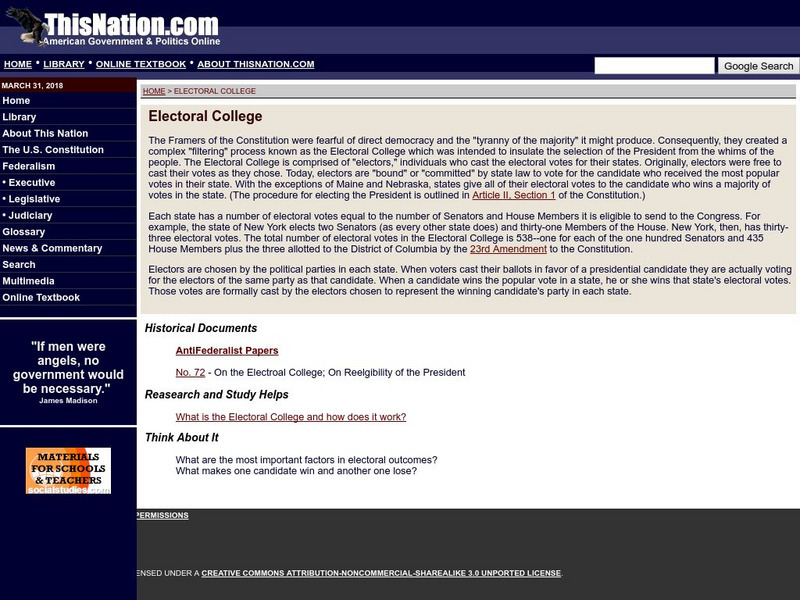
This Nation
This nation.com: Electoral College
A textbook excerpt from ThisNation.com that includes a useful chart of electoral votes by state. Clickable links to pertinent articles and amendments of the Constitution are another plus.
iCivics
I Civics: Popular v. President
Can the candidate who wins the majority of the popular votes miss out on being president? They can, and it's happened before.

ClassFlow
Class Flow: Electoral College vs. Popular Vote
[Free Registration/Login Required] This lesson allows for students to try voting for themselves in order to explore the Electoral College voting system.
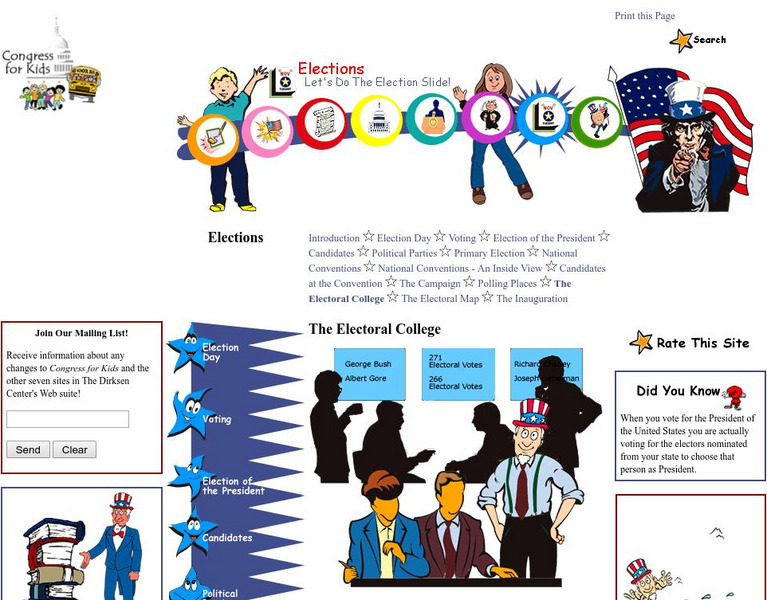
The Dirksen Congressional Center
Congress for Kids: The Electoral College
Political parties want winner-take-all elections for electors. This means that the state that receives the most popular votes wins all the state's electoral votes. All the states except Maine use this winner-take-all system today.
iCivics
I Civics: The Electoral Process
Take a peek into the electoral process from party primaries to the general election. Students will learn the distinctions between the popular vote and the Electoral College, and exercise their critical reasoning skills to analyze the...