Hi, what do you want to do?






Curated OER
Boyle's Law
Students experiment on Boyle's law using balloons and other common materials. In this chemistry instructional activity, students explain the relationship between pressure and volume. They solve problems relating to Boyle's Law.

Curated OER
Mosaic: Press-in Method
Students create individual press-in mosaics using a variety of bought and found objects.

Curated OER
Making Sedimentary Rocks
Young scholars make models of sedimentary rock layers to explain how rocks form layers and represent ancient environments. Layers of sediment and fossils are added together to simulate the environment and connections to sedimentary rocks...

Curated OER
On Our Own- Surviving on Another Planet
Students investigate current models for Lunar and Martian settlements and study the mathematics behind these designs. They design their own Lunar or Martian settlement with an explanation of why their model would work best.

Curated OER
Habitats of the World
Students complete a unit of eighteen lessons that cover climate, geography, location, plants, and animals of each of the five habitats. They are also introduced to habitat destruction and discuss ways to protect the environment. They do...

Curated OER
Animal Movements
Students discuss the behavior of different animals and how they move. They explore the ways that this helps them live and find food in their environment. They participate in a game that requires them to mimic the ways in which animals move.

Curated OER
What Trickles Down?
Students explore different levels of permeability and compare the permeabilities of several different materials. They are introduced to the basic concepts of building design, landscape architecture, and environmental pollutant transport....

Curated OER
Does Size Matter?
Students explore chemical solutions. In this chemistry lesson, students investigate the relationship between three related experiments about solutions. Students determine variables that affect the chemical concentration of each solution.

National Geographic
National Geographic: Programs: Chesapeake Bay Water Quality Project
A project-based collaborative unit of study that teaches students about watershed health using real-time geospatial technology. Students engage in outdoor field experiences while using twenty-first century learning skills.

Thinkport Education
Thinkport: Water, Water, Everywhere: Final Presentation
Students plan to present their water purification system at the end of a project-based learning exercise.
Buck Institute
Buck Institute for Education: Pblu: Mazer Tag
Inspired by a work site using a laser to measure in the water, this teacher decided to do a project-based learning lesson with students the required them building an obstacle course that they had to maneuver a laser beam around. Part of...
Center for Innovation in Engineering and Science Education, Stevens Institute of Technology
Ciese: K 12 Education Curriculum: Online Classroom Projects
This site presents projects for individual classrooms and collaborative projects that can be done with other classes or schools. Most of these are science projects.
TeachEngineering
Teach Engineering: Tippy Tap Plus Piping
The Tippy Tap hand-washing station is an inexpensive and effective device used extensively in the developing world. One shortcoming of the homemade device is that it must be manually refilled with water and therefore is of limited use in...
Science Buddies
Science Buddies: Harmful Algal Blooms in the Chesapeake Bay
Harmful algal blooms occur when algae, which form the base of the ocean food web, grow in massive numbers and produce toxic or harmful effects on people, fish, shellfish, marine mammals, and birds. In this project you will learn how to...
Science Education Resource Center at Carleton College
Serc: A River Runs Through It
This two-month project requires a nearby stream or river to use for testing. Students use river monitoring equipment to conduct water tests, fish observation, insect identification and to collect data related to physical properties of...
Science Education Resource Center at Carleton College
Serc: "Stained Glass Glue"
In the activity, "Stained Glass Glue," students use common everyday materials to use inquiry when they mix different substances and observe the unusual result of mixing water colors, milk and common dishwashing detergent.
TeachEngineering
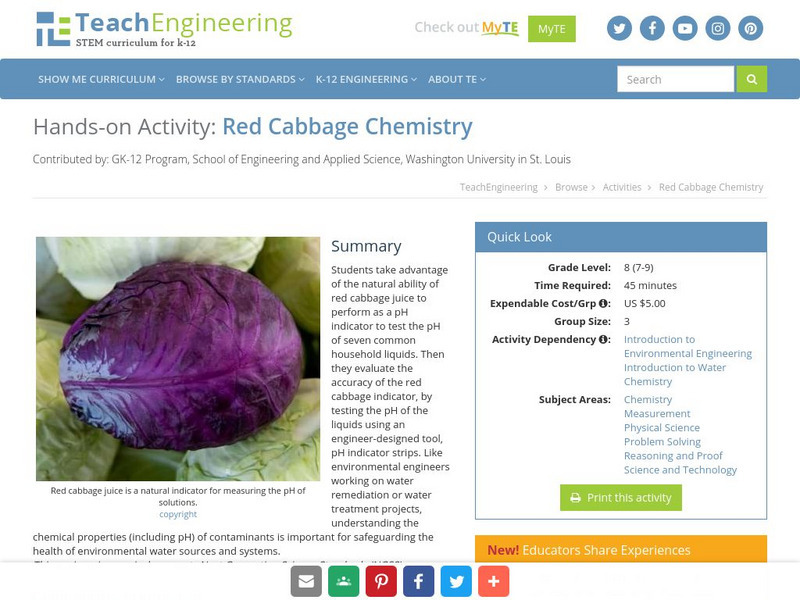
Teach Engineering: Red Cabbage Chemistry
Students take advantage of the natural ability of red cabbage juice to perform as a pH indicator to test the pH of seven common household liquids. Then they evaluate the accuracy of the red cabbage indicator, by testing the pH of the...
TeachEngineering
Teach Engineering: Students as Scientists
This curricular unit contains two lessons that let students actually do the work of scientists as they design their own experiments to answer questions they generate. In the first lesson and its associated activity, students conduct a...
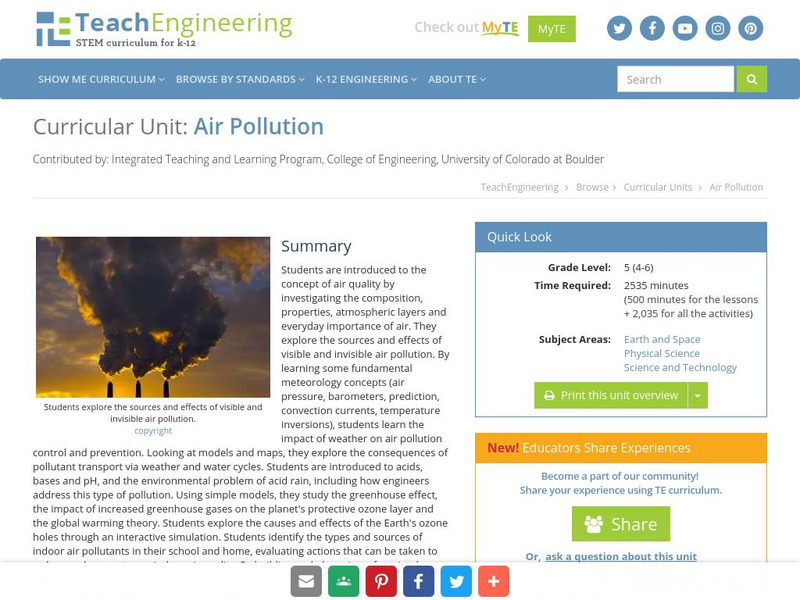
TeachEngineering
Teach Engineering: Air Pollution
Students are introduced to the concept of air quality by investigating the composition, properties, atmospheric layers and everyday importance of air. They explore the sources and effects of visible and invisible air pollution. By...
Other
I*earn (International Education and Resource Network)
This nonprofit organization creates structured projects that facilitate engaged learning and youth making a difference on an International scale. Project areas include interdisciplinary topics such as the environment/science,...
PBS
Pbs Teachers: Helping Kids Help the Environment
Define and explore the concept of environmental citizenship through a series of literacy-based multimedia, online and hands-on learning experiences. Discover how responsible citizens can help protect their local communities by...