Hi, what do you want to do?






It's About Time
The Electricity and Magnetism Connection
Magnets don't grow in fields, but magnetic fields are important to understand. The lesson covers the effect electricity has on magnetic fields. Scholars use a compass, magnets, and electrical wire to test magnetic fields and energy...

Curated OER
Rocks and Minerals
Take young geologists on an exploration of the collection of rocks and minerals that we call Earth with an upper-elementary science lesson. Through a series of class discussion and hands-on investigations, students learn about the...

National Institute of Open Schooling
d-Block and f-Block Elements
Potassium permanganate, containing manganese one of the transition elements, has many uses such as mouthwash and propelling rockets, making it is a very diverse compound. The lesson delves into such transition elements and...
Georgia State University
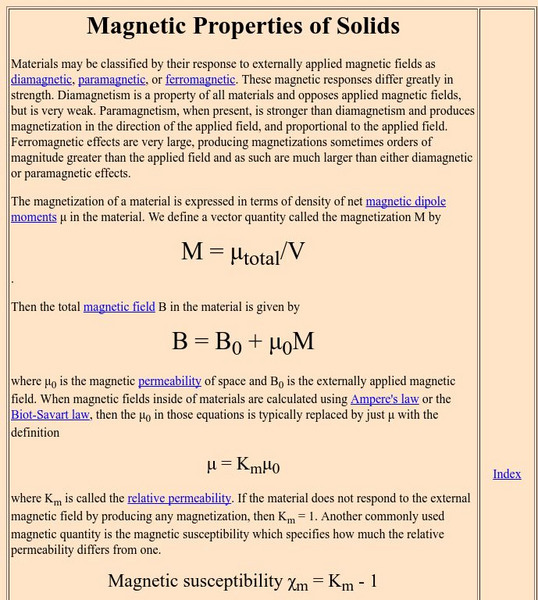
Georgia State University: Hyper Physics: Magnetic Properties of Solids
This site from the Georgia State University contains a good overview of some of the magnetic properties that are common to all materials, such as susceptibility and permeability, and then specific discussion of both diamagnetic and...
National High Magnetic Field Laboratory
Magnet Academy: Felix Bloch (1905 1983)
Physicist Felix Bloch developed a non-destructive technique for precisely observing and measuring the magnetic properties of nuclear particles. He called his technique "nuclear induction," but nuclear magnetic resonance (NMR) soon became...
National High Magnetic Field Laboratory
Magnet Academy: Joseph Henry
Joseph Henry was an American scientist who pioneered the construction of strong, practical electromagnets and built one of the first electromagnetic motors. During his experiments with electromagnetism, Henry discovered the property of...
National High Magnetic Field Laboratory
Magnet Academy: Edward Purcell
Edward Mills Purcell was an American physicist who received half of the 1952 Nobel Prize for Physics for his development of a new method of ascertaining the magnetic properties of atomic nuclei. Known as nuclear magnetic resonance...

Science Struck
Science Struck: The Relationship Between Magnetism and Electricity
Provides a short explanation of the similarities between magnetism and electricity, the properties of their fields, and the effect they each have on a charged particle.
National High Magnetic Field Laboratory
Magnet Academy: Lodestone 600 Bc
The history of electricity and magnetism starts with this special mineral possessing amazing, and still mysterious, properties.
National High Magnetic Field Laboratory
Magnet Academy: Heinrich Hertz
The discovery of radio waves, which was widely seen as confirmation of James Clerk Maxwell's electromagnetic theory and paved the way for numerous advances in communication technology, was made by German physicist Heinrich Hertz. In the...
Science Struck
Science Struck: Properties, Types, and Applications of Alnico Magnets
An alnico magnet is a special type of magnet that combines several metals in order to adapt the magnet for different applications. Learn about their properties, the different types, how they are manufactured, and what they are used for.
Wikimedia
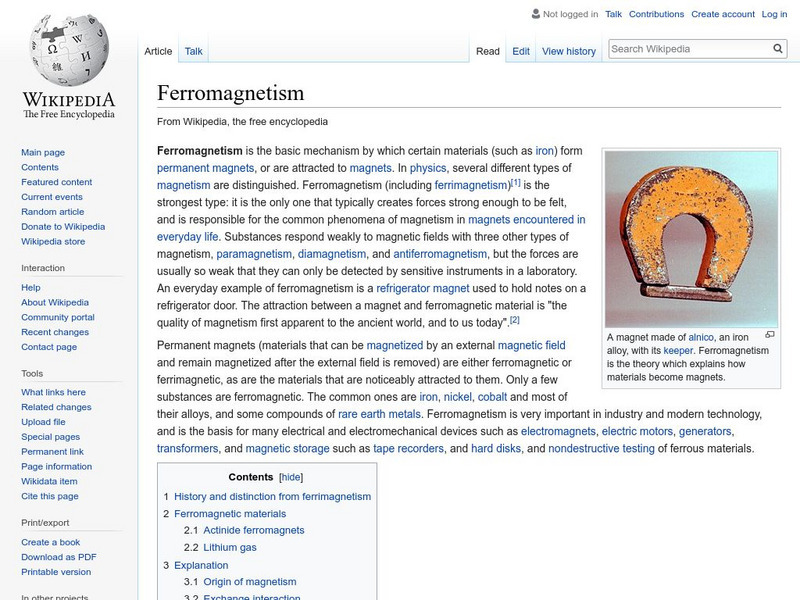
Wikipedia: Ferromagnetism
This site from Wikipedia provides a wonderful in-depth explanation of ferromagnetism, covering the atomic behavior which is responsible for ferromagnetic properties. Also introduces the concepts of magnetic domains and the Curie...
Wikimedia
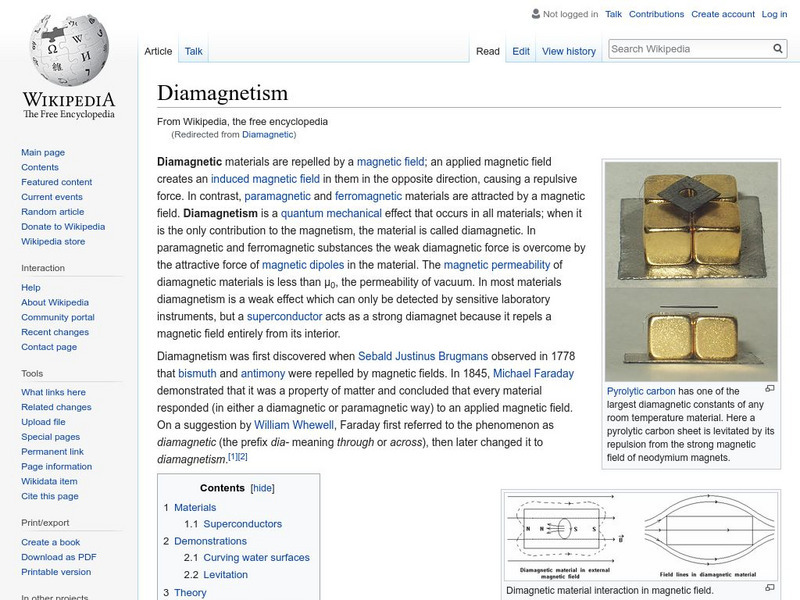
Wikipedia: Diamagnetism
Wikipedia.com offers a good introduction to diamagnetism and diamagnetic materials, including discussion of how superconductors exhibit diamagnetic properties.
Wikimedia
Wikipedia: The Black Hole
This site examines the black hole as an object in astrophysics. Delve into this comprehensive resource that covers this concept from its history, to qualitative physics, the reality of black holes, mathematical physics and more.
Nobel Media AB
The Nobel Prize: Otto Stern Biographical
This is a brief biography on the life and scientific work of Otto Stern, a physicist honored with the Nobel Prize in physics for his "development of the molecular ray method and his discovery of the magnetic moment of the proton."
Florida State University
Florida State University: Molecular Expressions: Electromagnetic Radiation
This Florida State University page introduces light as an electromagnetic wave and discusses the frequency and wavelength range of the various regions of the electromagnetic spectrum. Includes links to some interactive Java applets.
Georgia State University
Georgia State University: Hyper Physics: The Meissner Effect
This site from the Georgia State University provides a good introduction to and illustration of the Meissner Effect, the property of a superconducting material whereby it actively excludes a magnetic field from within its interior.
Florida State University
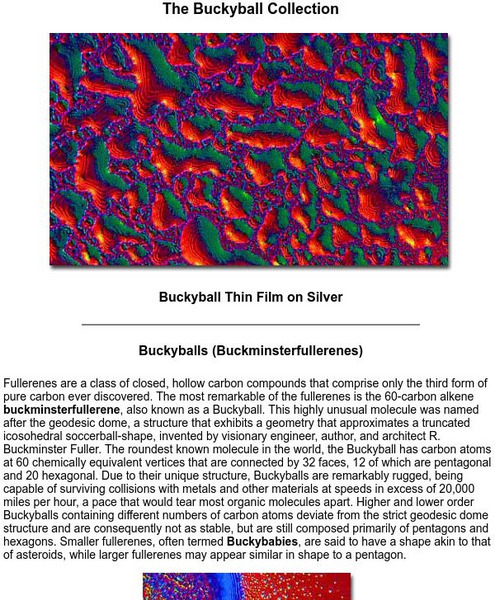
Florida State University: Molecular Expressions: The Buckyball Collection
General information of buckyballs and a description of buckyballs containing ions, called dopeyballs, which have superconducting properties. Colorful photomicrographs of fullerenes on thin films.