Hi, what do you want to do?






NASA
The Science of the Sun
There's more to that glowing ball of light in sky than most children realize. From the overall structure of the solar system, to the changing of the seasons, these hands-on lessons open the eyes of young scientists to...

Core Knowledge Foundation
A Time for All Seasons - Summer
The sun is shining and the birds are singing, what better time to teach young learners about the fun season of summer. In this week-long science series, children learn how the rotation and orbit of the earth influence...

North Carolina Museum of Natural Sciences
Weather Watch Activity Guide: Groundhog Day
Exactly what do groundhogs know about weather? Not as much as your science students will after completing these lessons and activities that cover everything from the earth's rotation and the creation of shadows, to cloud...

Core Knowledge Foundation
A Time for All Seasons - Fall
The weather is cooling down and the leaves are starting to change color; fall is right around the corner. Celebrate this special time of year with this earth and life science lesson series that teaches children about the...

Core Knowledge Foundation
A Time for All Seasons - Winter
As the days get shorter and a chill enters the air, it's time to start teaching your little ones about the wondrous winter season. Through a series of teacher demonstrations, whole-class read alouds and discussions, and hands-on...

Intel
Plugging into the Sun
What's cooking? A sizzling STEM unit challenges scholars to build a solar cooker that can successfully cook an egg. The unit opens with a study of Earth's rotation, the sun's energy, and shadows. Pupils use a compass and thermometer to...

Mathematics Vision Project
Geometric Figures
Logical thinking is at the forefront of this jam-packed lesson, with young mathematicians not only investigating geometric concepts but also how they "know what they know". Through each activity and worksheet, learners wrestle with...

Radford University
Google Earth Trip
A trip around the world sounds nice, but for now we'll just have to make do with Google Earth. Pupils use pictures of landmarks to apply geometry concepts. They determine whether each building has bilateral or rotational symmetry, search...

Curated OER
The Motions of the Oceans
Students examine the topics of ocean waves, currents, and tides. They locate and label ocean currents on a world map, conduct experiments, analyze key vocabulary, view demonstrations and record the data, and complete handouts.

Curated OER
Astronomy
Students complete a unit of lessons on our solar system, its stars, and astronomers. They record information in a space journal, design constellations, define key vocabulary, observe the phases of the moon, and create a group planet...

Curated OER
Our Universe: Always Moving, Always Changing
Students explore the main concepts of astronomy through the eleven lessons of this unit. The past, present, and future methods of studying the science are examined in this unit.
TED Talks
Ted: Ted Ed: What if the Earth Stopped Spinning?
Michael Stevens of Vsauce looks at what would happen if the Earth stopped spinning. He also explores how we construct time as a function of the Earth's rotation and why atomic clocks are so precise. [9:44]
CK-12 Foundation
Ck 12: Earth Science: Rotation of Earth
[Free Registration/Login may be required to access all resource tools.] How the Earth rotates around its axis.
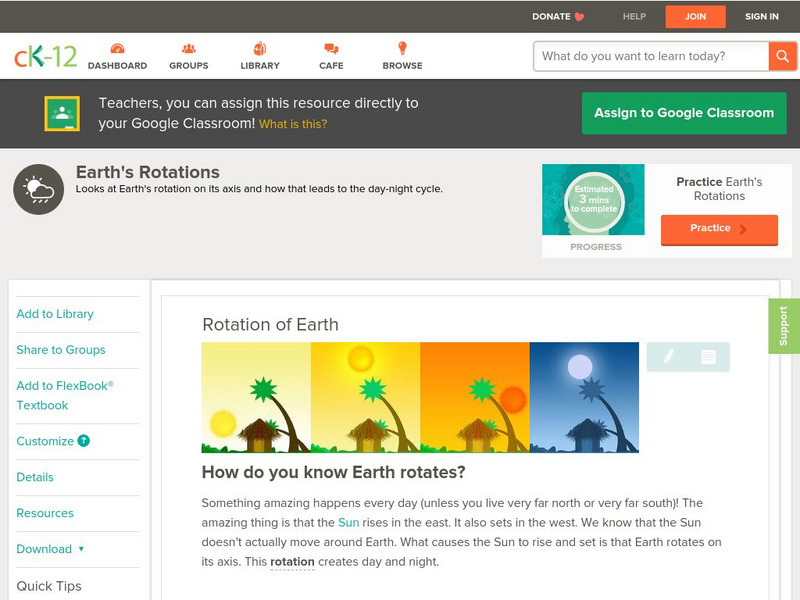
CK-12 Foundation
Ck 12: Earth Science: Rotation of Earth
[Free Registration/Login may be required to access all resource tools.] How the Earth rotates around its axis.

Texas Education Agency
Texas Gateway: The Sun Is the Center of the Solar System
See what you know about the solar system by taking this brief interactive quiz and learning module.

PBS
Pbs Learning Media: Sunspots on the Move
The following videos show sunspots using wavelengths of light that the human eye cannot see. Watch sunspots emerging on the earth's surface, a sunspot moving across the earth's surface, and the rotation of the sun as a sunspot evolves...
E-learning for Kids
E Learning for Kids: Science: Center of the Ocean: The Sun, the Earth, and the Moon
Nita lives on Coco Island in the Indian Ocean, and is learning more about the Sun, the Earth, and the Moon. Join her and learn about day and night.
CK-12 Foundation
Ck 12: Fifth Grade Science: Earth Science: Earth's Motion in Space
[Free Registration/Login may be required to access all resource tools.] Discusses the motion of the Earth with its day and night cycle, the seasons, the Earth's orbit around the Sun, and its year-long cycle.
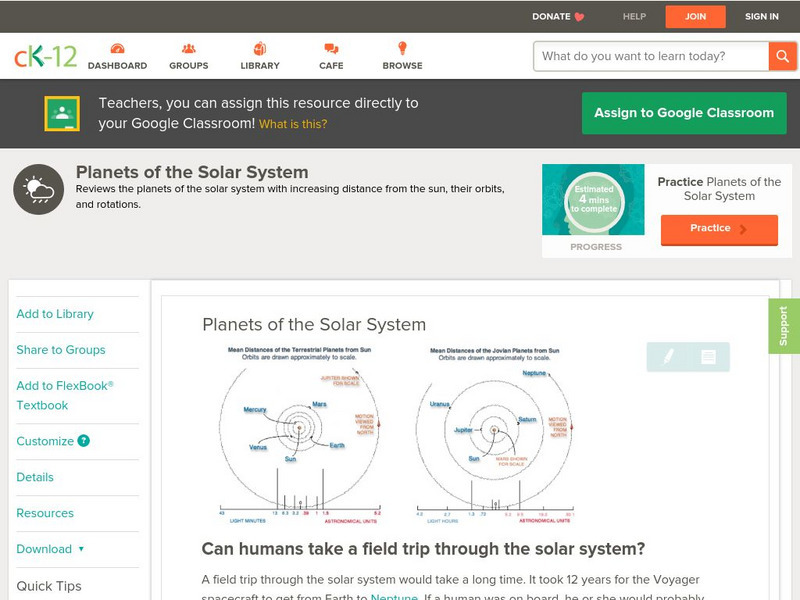
CK-12 Foundation
Ck 12: Earth Science: Planets of the Solar System
[Free Registration/Login may be required to access all resource tools.] Examines the eight planets of our solar system, their orbits, and rotation.

CK-12 Foundation
Ck 12: Earth Science: Planets of the Solar System
[Free Registration/Login may be required to access all resource tools.] Examines the eight planets of our solar system and their orbits and rotation.

Georgia Department of Education
Ga Virtual Learning: The Moon
In this interactive tutorial students will explore what it is like on the Moon. Learn why the shape of the Moon seem to change and also about lunar eclipses. Discover why the tide changes twice a day and explore how the cycle of the Moon...
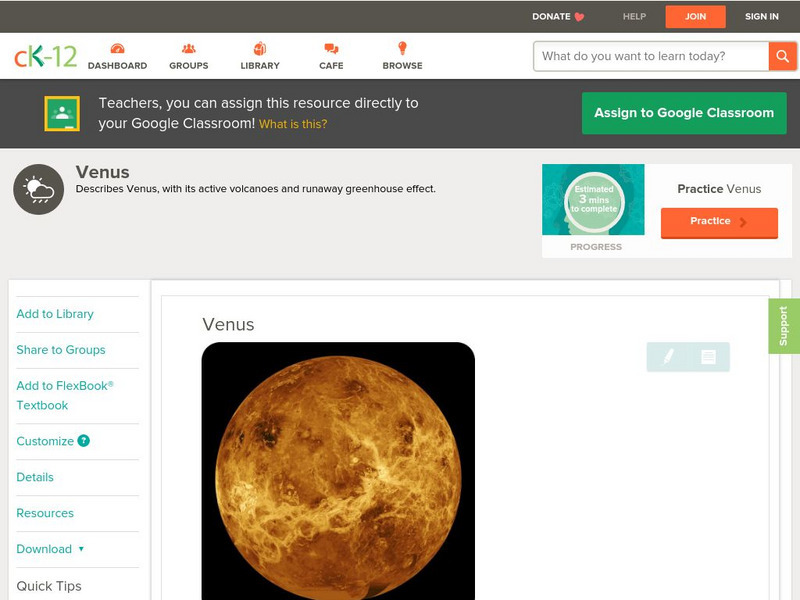
CK-12 Foundation
Ck 12: Earth Science: Venus
[Free Registration/Login may be required to access all resource tools.] Learn about the distinctive features of the planet Venus.
E-learning for Kids
E Learning for Kids: Science: Rio De Janeiro: Day and Night: The Sun
Gabriella lives in Rio de Janeiro, Brazil. Help her learn more about the sun and identify the properties of the sun.
National High Magnetic Field Laboratory
Magnet Academy: Foucault's Disk
Leon Foucault, a French physicist much better known for his pendulum demonstrating the rotation of the Earth, also created in 1855 a device that illustrated how eddy currents work. (Java tutorial)