Hi, what do you want to do?






Curated OER
Using Electricity
Students name appliances that use electricity. They construct a simple electrical circuit. They predict whether a circuit work. They name components of an electrical circuit.

Curated OER
Celebrate The Four Seasons
Students investigate cause and effect and compare and contrast how recurring cycles are evident in multiple aspects of their education. They answer questions in the chosen field. Students model each aspect by interpreting, perceiving and...

Curated OER
Changing circuits
Students identify that there are conventional symbols to represent the components in circuits. Students use these symbols to draw diagrams of circuits. They are reminded that electric circuits can be drawn in diagrams using symbols. ...

Curated OER
Changing Circuits
Students observe an on-line activity to review the basics of electrical circuitry, then research answers to related questions on-line.In this lesson on changing components in a series circuit, students discover how different components...

Curated OER
Curious? Will You Be Eclipsed?
In this "Curious? Will you be eclipsed?" worksheet, 4th graders answer 4 questions interactively about eclipses, then check answers online.

Curated OER
Measuring The Earth
Students use their geometry and trigonometry skills to determine the distance between their school and another school.

Curated OER
Micro-organisms
Students examine how micro-organisms are living organisms that are often too small to be seen. They explain that micro-organisms may be beneficial or harmful.

Curated OER
How We See Things
Learners explain that mirrors reflect light. They examine how when a beam of light is reflected from a surface, its direction changes.

Curated OER
Changing Circuits
Students participate in an online lesson to explain how to make bulbs brighter or dimmer in a series circuit by changing the number or type of components.

Curated OER
The Many Phases of the Moon
Fifth graders explore the phases of the moon as it relates to the calendar.

E-learning for Kids
E Learning for Kids: Science: Scotland: Why Do Shadows Change During the Day?
William is a Scottish boy who is learning about the sun and how it casts shadows. Try to help him find out.

University of California
At Home Astronomy: Hands on Science Experiments for the Entire Family
A collection of ten hands-on science experiments for the entire family that will help you understand concepts in astronomy. Make an astrolabe, find the size of the sun and moon, build a lunar settlement, find out about meteoroids, shadow...
Other
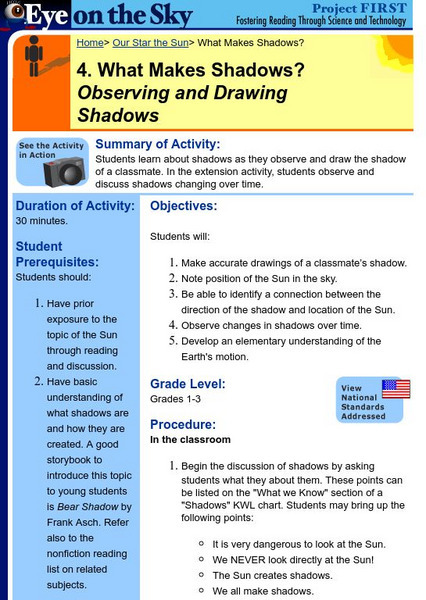
Center for Science Education: Eye on the Sky: What Makes Shadows?
Students will enjoy these activities where they draw shadows, and observe the sun's placement and how its position impacts on the size of a shadow.
Exploratorium
Exploratorium: The Art and Science of Color
This series of programs includes hand-tinted archival films, contemporary offerings by local artists, and films created by artists drawing and painting on the film surface itself. Featuring animated, documentary, and homemade works.
Scholastic
Scholastic Instructor: Sun Sational Science
Discover more about the sun when you visit this educational resource. The content of this site includes solar fun facts, experiments, and activities.

Project Britain
Primary Homework Help: Earth and Space Quiz
This resource provides information about Earth and space. In addition, there is a quiz provided.
Harvard University
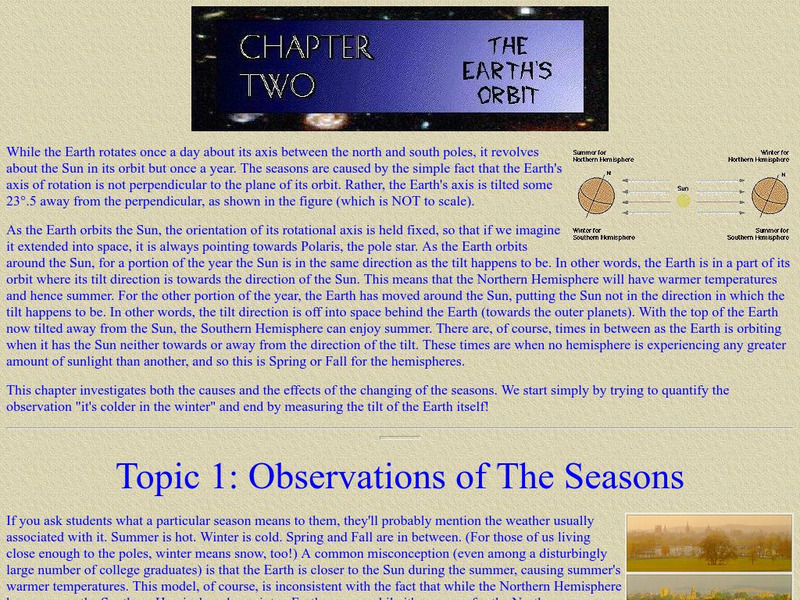
Eyes on the Sky, Feet on the Ground: The Earth's Orbit
Students perform many inquiry activities related to Earth's orbit. Included are recording daily temperatures, observing the sun's path over several weeks, tracking sunrise and sunset times, and angle of sunlight. Diagrams make lessons...
Harvard University
Harvard Smithsonian: Everyday Classroom Tools
The focus of this series of lessons is to engage students in an exploration of the world around them. The emphasis is on inquiry as students learn about the earth, sun, light, shapes and more.
Scholastic
Scholastic: Dirtmeister's Science Lab: Let the Sun Shine In
Students graph data reflecting time of day and length of shadow, and then draw conclusions about Earth's seasons and position in relation to the Sun.