Hi, what do you want to do?






Discovery Education
Future Fleet
Turn your pupils into engineers who are able to use scientific principals to design a ship. This long-term project expects pupils to understand concepts of density, buoyancy, displacement, and metacenter, and apply them to constructing a...

Center for Learning in Action
Properties of Balls
Enhance your states of matter lessons with a hands-on science investigation that compares six different balls' color, texture, size, weight, ability to bounce, and buoyancy.

PBS
Watercraft
Whatever floats your boat—with some additional weight. The first activity in a five-part series challenges pupils to design a boat to hold pennies. Using the design process, learners design, build, and test their boats, making sure they...

CK-12 Foundation
Scuba Training
How does a scuba diver control whether they sink or float? Scholars observe the relationship between absolute pressure and depth below the surface in an undersea simulation. They control the diver size and depth to center of mass to...

Curated OER
Buoyancy-Why Things Float
In this buoyancy worksheet, students read about the principles behind objects floating including density, buoyancy and Archimedes' Principle. Students complete a buoyancy lab where they use a balloon and water and a film canister and...

CK-12 Foundation
Going Fishing
Why do some things float and others sink? A creative simulation allows learners to adjust mass and volume of an object to affect its buoyancy in water. A graph records the effect of each manipulation.

Teach Engineering
Rock and Boat
Present the class with a question on whether the water level of a pond will rise they take a large rock out of a boat and drop it into the pond. Groups come down on all sides of the question and try to justify their answers. The activity...

Curated OER
Archimedes' Principle
In this Archimedes' principle instructional activity, high schoolers answer 13 questions about the concepts of Archimedes' principle such as water displacement, buoyancy and force. The answer questions from a lab they did in class to...

DiscoverE
Water Sampling
What is the best way to test water quality? Using plastic bottles, scholars create monitoring sensors to test water quality. Creating three different sensors allows individuals to measure water quality at different water levels.

DiscoverE
Design a Flotation Device
Save the soup! Scholars devise a flotation device using straws, balloons, foam, corks, and other objects. A can of soup must stay afloat for at least a minute with this device—your dinner might depend on it!

Curated OER
Properties of Matter
Students describe four states of matter and their characteristics, explain thermal expansion of matter, interpret state changes in terms of kinetic theory of matter, explain relationship between temperature and volume of a gas, state...

Curated OER
Fishy Physics
Learners explore how fish are able to move easily from one depth to another in water. In this fish lesson students create their own balloon fish.

Curated OER
Investigating the Effect of Salinity on the Density and Stability of Water
Water with varying amounts of dissolved salt are dyed and then used to compare densities. The objective is to discover the effect of salinity, and therefore density, on ocean water on the stability of the ocean. Many branches of science...

PBS
Pbs Learning Media: Buoyancy Brainteasers: Buoyancy Question
This interactive brainteaser from the NOVA: "Voyage of Doom" Web site challenges you to figure out what causes an object to sink.
University of Colorado
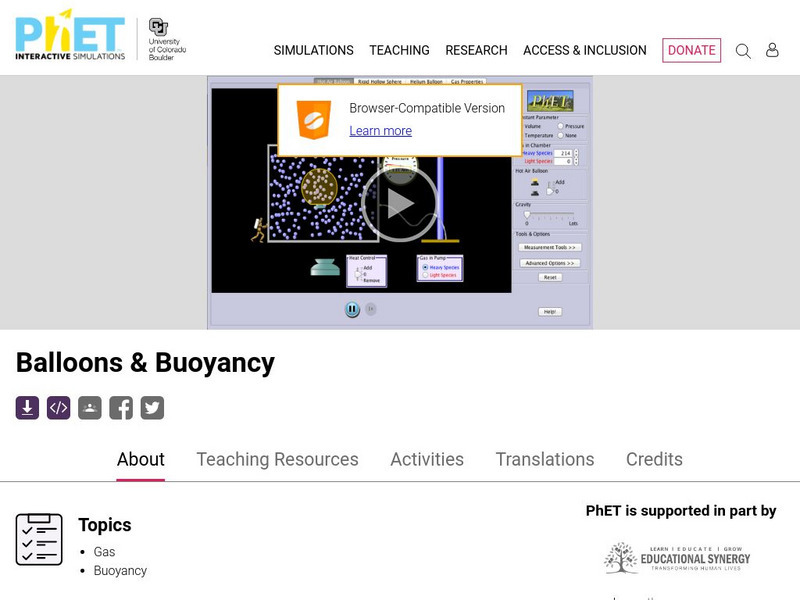
University of Colorado: Ph Et Interactive Simulations: Balloons & Buoyancy
Experiment with a helium balloon, a hot air balloon, or a rigid sphere filled with different gases. Discover what makes some balloons float and others sink.
Science Education Resource Center at Carleton College
Serc: Mn Step: Sinking Water: Glaciers, Ocean Currents and Weather Patterns
A activity where students learn how warm water is less dense than cold water, and what this means for global climate change as ice from the polar regions melts. Students will do experiments in buoyancy and water density when hot or cold,...
Utah Education Network
Uen: Sink or Float
Predict and test everyday objects as to whether they sink or float.
University of Colorado
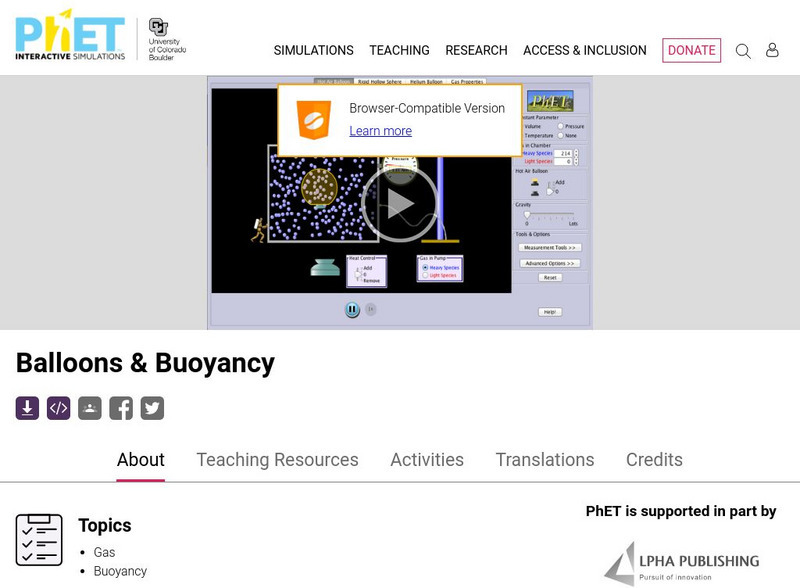
University of Colorado: Ph Et Interactive Simulations: Balloons & Buoyancy
Students studying buoyancy will better understand its concepts with this virtual experiment using various balloons and testing what makes them float or sink.
PBS
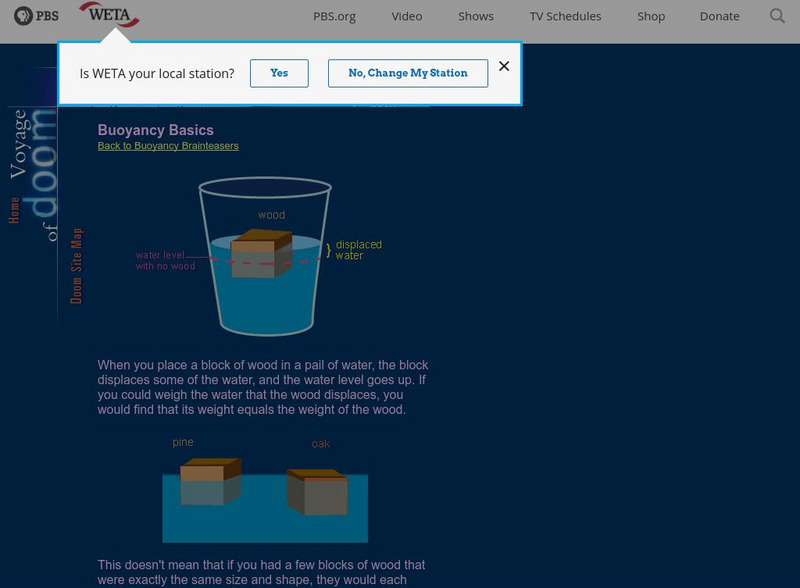
Pbs: Buoyancy Basics
NOVA explores the basic principle of buoyancy. Also included at this site are some interesting brain-teasers related to the topic.
Science Education Resource Center at Carleton College
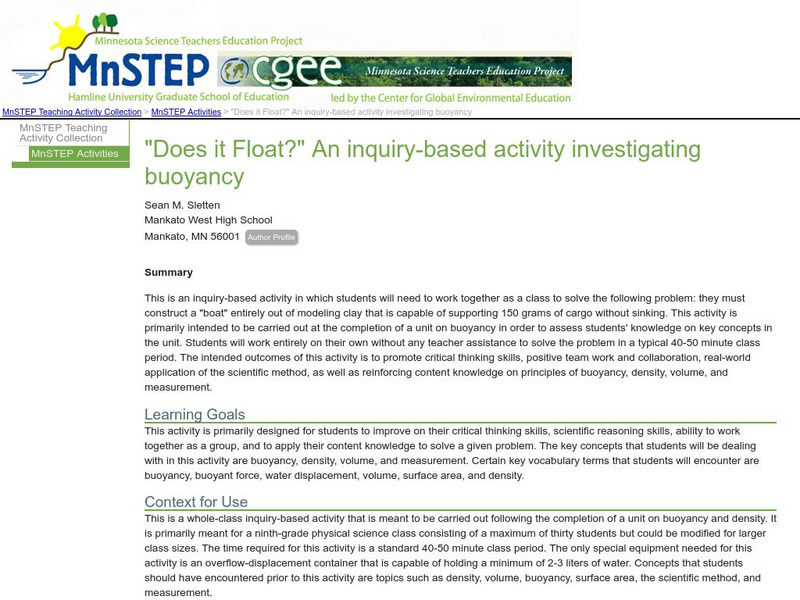
Serc: "Does It Float?" an Inquiry Based Activity Investigating Buoyancy
This is an inquiry-based activity in which students will need to work together as a class to solve the following problem: they must construct a "boat" entirely out of modeling clay that is capable of supporting 150 grams of cargo without...
TeachEngineering
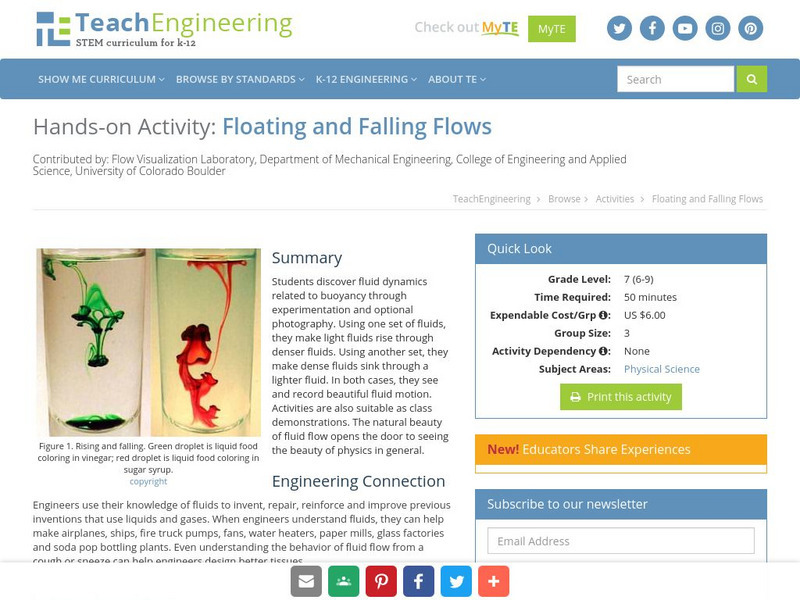
Teach Engineering: Floating and Falling Flows
Students discover fluid dynamics related to buoyancy through experimentation and optional photography. Using one set of fluids, they make light fluids rise through denser fluids. Using another set, they make dense fluids sink through a...
Science Education Resource Center at Carleton College
Serc: Investigating Buoyancy, Density, and Fluid Principles: Make Mini Submarine
In this lab, learners will use the scientific method to design an experiment that explains how/why a submarine floats and sinks.

TeachEngineering
Teach Engineering: What Floats Your Boat?
Students use modeling clay, a material that is denser than water and thus ordinarily sinks in water, to discover the principle of buoyancy. They begin by designing and building boats out of clay that will float in water, and then refine...
Museum of Science
Museum of Science and Industry: Online Science: Design a Submarine
Become an engineer, and design a submarine that moves in the water like a real submarine. Try making it sink, float, and hover in the water.