Hi, what do you want to do?






Museum of Science
Hot Air Balloon
It is more than just blowing hot air. Pupils first build a hot air balloon out of tissue paper by cutting enough panels of tissue paper to form a balloon shape and glue the panels together. Using a hot air gun, individuals then inflate...

NOAA
Climate, Weather…What’s the Difference?: Make an Electronic Temperature Sensor
What's the best way to record temperature over a long period of time? Scholars learn about collection of weather and temperature data by building thermistors in the fourth installment of the 10-part Discover Your Changing World series....

Discover Earth
Weather Stations
Transform your classroom into a fully functioning weather station with this series of hands-on investigations. Covering the topics of temperature, precipitation, wind patterns, and cloud formation, these activities engage young...

Baylor College
Moving Air
In lab groups, young scientists place aluminum cans with a bubble-solution cap into different temperatures of water to see what size of bubble dome forms. As part of an atmosphere unit in preparation for learning about convection...

Discovery Education
How's the Weather?
Young meteorologists explore different aspects of the weather while learning about measurement devices. They build instruments and then set up a weather station outside and measure temperature, humidity, air pressure, wind speed, and...

American Chemical Society
Heat - Energy on the Move
Turn up the heat. Individuals conduct two experiments to observe the difference between heated water and air versus cold water and air. Using food coloring, pupils observe the movement of the molecules in the two temperatures of water. A...

American Chemical Society
The Energy of Evaporation
Do all liquids evaporate at the same rate? Young scientists observe the evaporation rate of three different liquids. They measure the time, the temperature, and the change in energy. After comparing the chemical formulas, scholars...

NOAA
The Climate Team: Make a Solar Heat Engine
Learners investigate how solar energy is converted into heat in part two of the 10-part Discover Your Changing World series. They build and test homemade solar cookers to boil water and cook rice. Pupils consider the impact of heat...
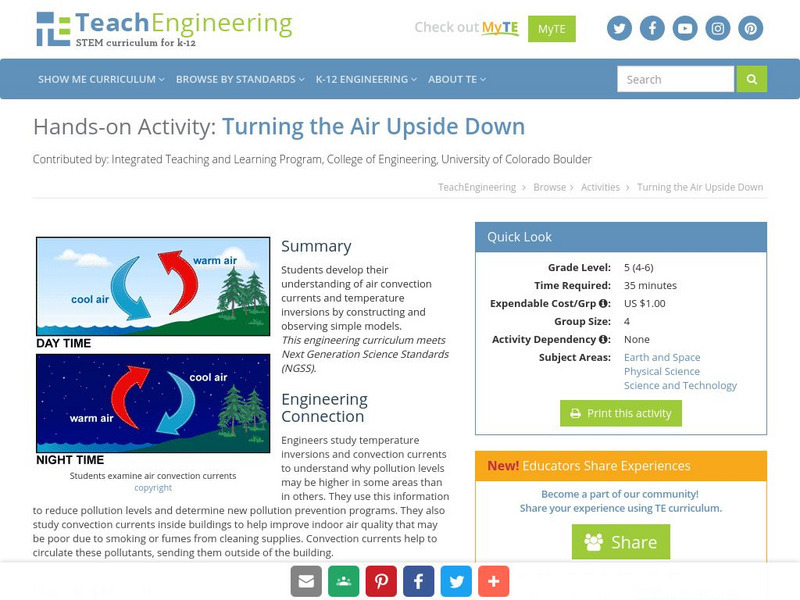
TeachEngineering
Teach Engineering: Turning the Air Upside Down
Students develop their understanding of air convection currents and temperature inversions by constructing and observing simple models.

TeachEngineering
Teach Engineering: Let's Get Breezy!
Students apply an understanding of the concept of heat transfer through convection, conduction, and radiation as they use wireless temperature probes to investigate the heating capacity of different materials under heat lamps.