Hi, what do you want to do?






Weber State University
The Sun and the Seasons
Why is there more daylight in June than in December if you live above the equator? How does the angle of sunlight shift throughout the year? Answer these questions and more with an interactive article about the sun, its path through the...

Curated OER
The Reasons for the Seasons
Young scientists use a globe and a light to simulate the rotation of the earth and sun to show the seasons. Additionally, they simulate direct sunlight and indirect sunlight showing intensity of the sun, and answer questions based...

Core Knowledge Foundation
A Time for All Seasons - Summer
The sun is shining and the birds are singing, what better time to teach young learners about the fun season of summer. In this week-long science series, children learn how the rotation and orbit of the earth influence...

CK-12 Foundation
Seasons: Shadow Lengths
Before iPhones and calendars, how did humans determine the seasons of the year? Middle school scientists discover how to use shadows to determine the time of year in an enlightening interactive. Pupils manipulate the sun and examine the...

Space Awareness
Climate Zones
The climate at the equator is hotter than the climate at the poles, but why? The lesson goes in depth, explaining how the angles of illumination relate to the heating rate at different latitudes and seasons. Scholars use a strong lamp,...

Curated OER
Bill Nye Video: Earth's Seasons
In this earth's seasons worksheet, students answer fill in the blank questions after seeing Bill Nye's video. Topics include the rotation of the earth around the sun, the tilt of the earth, the time zones and sunlight.

S2tem Centers SC
Seasons
Winter, spring, summer, and fall—take the learning of the seasons beyond the elementary level to the middle school classroom. Curious learners begin by watching videos about the seasons and the rotation of planet Earth. Then,...

Curated OER
The Reason for the Seasons
Students compare graphs of their data that was generated on a NASA website. In this seasons lesson students complete a lab activity.

Curated OER
The Four Seasons - Earth's Rotation
Students identify characteristics in correlation with each season and identify dates of the changing seasons. They identify and describe how the Earth rotates around the sun and its effects on the temperatures of the earth.

California Academy of Science
Kinesthetic Astronomy: Birthday Stars
Space explorers take a virtual trip around the sun right within your classroom! They stand in a circle facing away from the "sun" (a lamp) in the center of the room. As they move according to your instructions, they view different...

Curated OER
Student Exploration: Summer and Winter
For this recognizing the seasons online/interactive worksheet, students explore the Earth's positions and determine the summer and winter season. Students answer 21 short answer questions

University of Arizona
The Exotic Vacation
Students explain the concepts and vocabulary of Earth's rotation. They plan imaginary vacations based on the seasons in different locations. This is a very creative lesson plan, which students enjoy.

Curated OER
Winter Holiday Celebrations
Students understand how holidays revolve all around light. In this winter holidays lesson, students find the similarities and differences between the winter holidays. Students discuss the winter solstice and how it relates to the holiday...

Curated OER
What Causes Day and Night?
Why do we have four seasons? A series of questions about the Earth's orbit and its impact on seasons challenge Earth science students.The second page of the resource has nine multiple choice questions, such as "One year on Earth is one...

Curated OER
Solstice And Equiniox Curriculum
Students engage in a instructional activity that investigates finding the dates of the solstices and equinoxes. They define the terms related to the concept and conduct research in order to explain the physical occurrences. They also...

Curated OER
The Earth-Moon System
In this Earth and moon activity, students will review the different phases of the moon, how eclipses are created, and how the moon influences tidal patterns. This activity has 13 fill in the blank, 8 true or false, and 2 short answer...

Curated OER
Reasons for Seasons
Students investigate a model of the tilt of the Earth in its relationship to the Sun during the different seasons of the year. They study the solstices and equinoxes, while determining how sunlight hits the Earth with different angles in...

Curated OER
Investigating Leaves Through Printmaking
Students create leaf rubbings as they study the parts of a leaf. They describe the leaves and chart their observations.

Curated OER
December Celebrations
Students study customs of various winter holidays. In this holiday lesson plan, students read the book The Reasons for the Seasons and complete a winter glyph. Students use graphing software to create a chart of the holidays that are...

Curated OER
Winter Holidays
Students investigate the traditions associated with winter holidays. They examine why most of the holidays are associated with light. They examine the origins and customs of these holidays before creating an original holiday.

Curated OER
Was Kepler Correct?
Students investigate the elliptical orbit around the Sun. They use the information gathered to measure the distance to the Sun from the closest orbital point and the farthest orbital point.
NASA
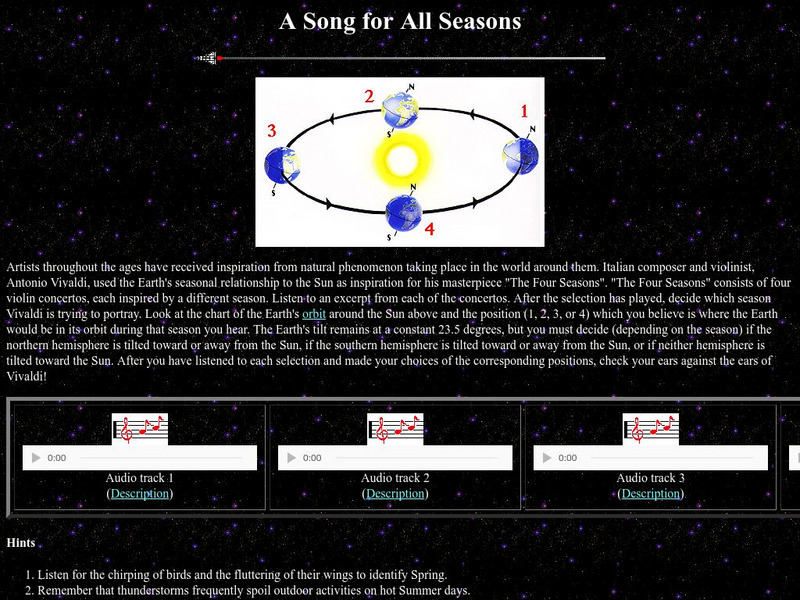
Nasa Star Child: A Song for All Seasons
After listening to excerpts from four of the violin concertos from "The Four Seasons" by Italian composer and violinist, Antonio Vivaldi, decide which excerpt was meant to go with which season, and also decide where the earth would be in...

National Geographic
National Geographic: A Reason for the Season
This site provides a learning activity that can be adapted for all age levels that deals with the seasons. Students are asked to become a "season sleuth" and discover what causes the seasons to change.
Math Is Fun
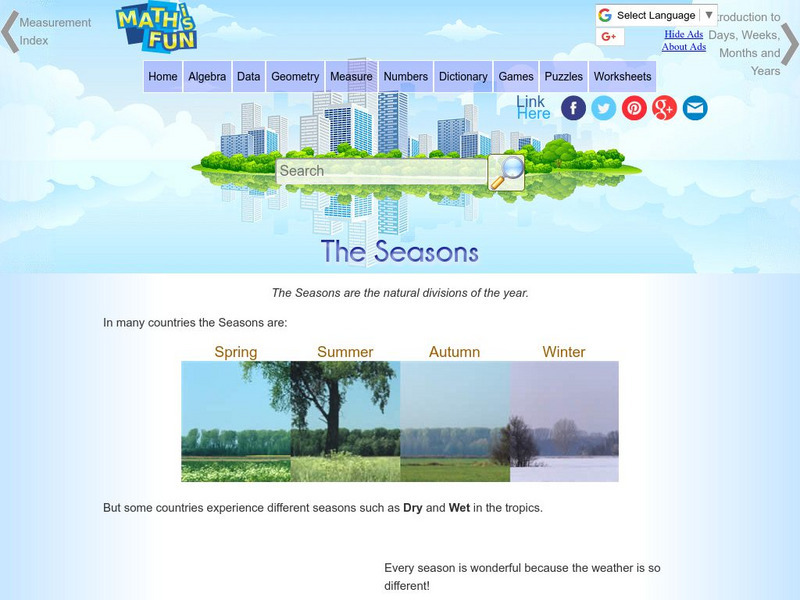
Math Is Fun: The Seasons
Learn about the four seasons, when they occur in the northern and southern hemispheres, and why the seasons change as the Earth rotates around the Sun.