Hi, what do you want to do?






Curated OER
Whitewashing Southern History
Young scholars discuss the fact and fiction of slavery in the South. After viewing a video on two New Orleans plantations, they determine the accuracy of the facts presented. In the computer lab, they visit various sites and examine...

Curated OER
Home Ties
Students explore the reasons people choose to migrate including political, economic and familial motivations. They interview family members and compare their ancestors own reasons for migration to those of African American urban migrants.

Curated OER
SLAVE TRADING AND SMALL TOWNS
Young scholars research the ways slavery shaped social and economic life in the South after 1800, the different economic, cultural, and social characteristics of slavery after 1800, and how the Atlantic slave trade finally ended.

Curated OER
Fugitive Slave Narratives
Learners analyze the ways slavery shaped social and economic life in the South after 1800, the different economic, cultural, and social characteristics of slavery after 1800, and the ending of the Atlantic slave trade.

Curated OER
MANY REASONS TO LEAVE
Learners research different economic, cultural, and social characteristics of slavery after 1800, how slavery hindered the emergence of capitalist institutions and values, and slavery both prior to and after the Civil War.

Curated OER
RAW HISTORY: USING PRIMARY SOURCES
Students analyze the ways slavery shaped social and economic life in the South after 1800, how slaves forged their own culture in the face of oppression; and the role of the plantation system in shaping slaveholders and the enslaved.

Curated OER
Three Coffles Lesson Plan
Pupils read about the slave trade in primary source documents. They discuss differences and commonalities in experiences. They write prose or poetry from the point of view of one of the figures from the reading and create a triptych.

Curated OER
Differences in Location Lesson Plan: Treatment of Early African Americans
Students reach The Domestic Slave Trade, then examine the differences between the people enslaved in North America as opposed to those in Brazil.

Curated OER
Forest Joe Lesson Plan: Outlaw or Hero?
Students become familiar with an American legend that is unfamiliar to many. Presented with the legend of Forest Joe, a runaway slave who, much like Robin Hood, stole from the rich to give to the poor, students draw comparisons and...

Curated OER
African American Emigration: Turner and McNeal
Students discuss reasons why African Americans may have wanted to emigrate from the United States followig the Civil War. They complete a Venn diagram noting the differences between proposals by Marcus Garvey and Henry McNeal Turner.

Curated OER
Little America in Liberia
High schoolers study the history of Liberia prior to and after the influx of immigrants of African Americans. They investigate the cultural differences between the African Americans and newly-arrived Liberians.

Curated OER
Open Door, Closed Door Lesson Plan: Discrimination in Immigration And Migration
Students read The Northern Migration and research immigration policies of different nations for the past and the present. They create a bulletin board or spreadsheet using their information.

Curated OER
Trusting Statistics Lesson Plan
Students read a section of the Runaway Journey narrative and conduct a survey. They use survey statistics to question their validity and decide why a respondent might not answer truthfully.
US Department of State
Office of the Historian: The United States and the Haitian Revolution
Study the roots of the Haitian Revolution and the American response. Our policy shifted many times from 1791 until we recognized Haiti's independence in 1862. Read the following synopsis to better understand our ambivalence.
Other
The Haitian Revolution of 1791 1803
This is the first of four linked pages presenting a comprehensive essay on the Haitian Revolution.
PBS
Pbs: Africans in America the Haitian Revolution
This site, which tells of L'Ouverture's role in the revolution, is part of a larger PBS documentary on Africans in America. Included are a teacher's guide and a narrative of the topic. Also, make sure to use the links at the bottom of...

A&E Television
History.com: How Toussaint L'ouverture Rose From Slavery to Lead the Haitian Revolution
Pushing back aggressions by Europe's greatest powers, Haiti's 'founding father' set the stage for the world's first sovereign Black state. How did Toussaint L'ouverture born into bondage in the French colony of Saint-Domingue...
British Library
British Library: 20th Century Works: The Black Jacobins
C.L.R. James explores the subject of the Haitian Revolution in the play "The Black Jacobins". Read an overview and view additional resources such as articles and collection items.
Black Past
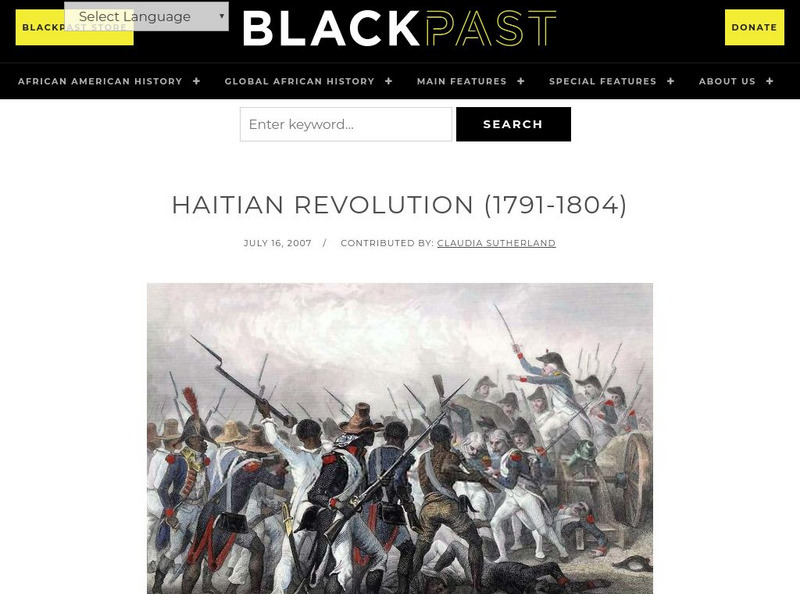
Black Past: Haitian Revolution (1791 1804)
This encyclopedia article is a good overview of the slave revolt that resulted in Haiti's independence.

Khan Academy
Khan Academy: World History: 1750 1900 Enlightenment and Revolution
We have none from this URL but there are some among embedded videos, although not all. For example, we have the two on Haitian Revolution and some on Napoleon. But I couldn't find those on imperialism.
Independence Hall Association
U.s. History: The Age of Atlantic Revolutions
The American Revolution fomented change throughout the trans-Atlantic area. Read about the revolution's influence on the French and their overthrowing of their king, and the slave revolt which brought about the second republic in the New...
CommonLit
Common Lit: How Haiti Saved the United States
A learning module that begins with "How Haiti Saved the United States" by David White accompanied by guided reading questions, assessment questions, and discussion questions. The text can be printed as a PDF or assigned online through...

Black Past
Black Past: Toussaint L'overture
This encyclopedia article gives an accounting of Toussaint L'Overture, freed Haitian slave who was the leader of the revolt against France.
Encyclopedia Britannica
Encyclopedia Britannica: Toussaint Louverture
This entry from Encyclopedia Britannica features Toussaint Louverture, who overran Spanish Santo Domingo in January 1801, freed the slaves, and amazed the Europeans and natives with his magnanimity.